
Private Label Gifts Trends for Resorts and Travel Brands in 2026
In 2026, private label gifts are moving from a pleasant extra to a strategic tool for resorts and travel brands. A well-planned gift now shapes first impressions, extends the destination story, and creates new retail value beyond the room night.
That shift matters because guest expectations have changed. Travelers want items that feel useful, local, responsible, and worth taking home. At the same time, operators need products that are margin-aware, brand-safe, and easier to source across volatile supply chains.
The result is a more disciplined approach to private label gifts, where design, compliance, and merchandising work together. For hospitality groups reviewing sourcing options, the opportunity is no longer just gifting. It is guest engagement with measurable commercial impact.
Why private label gifts are gaining strategic weight
Resorts have always used gifts to welcome, delight, or retain guests. What changed is the level of intention behind them. In many travel businesses, gifting is now tied to loyalty, ancillary revenue, and brand differentiation.
Private label gifts give operators more control than generic merchandise. Packaging, scent, color, materials, and product mix can all reflect a property concept, a destination identity, or a premium service tier.
This also fits broader retail behavior. Guests increasingly buy what they experience. If a beach resort introduces a branded sun-care kit or a mountain lodge offers a destination candle, the gift can become both a memory object and a retail SKU.
From a sourcing perspective, the category has become more sophisticated. Platforms such as Global Consumer Sourcing track how private-label innovation, certification requirements, and sustainable manufacturing are reshaping gifts and travel-related merchandise.
What counts as a strong private label gift in 2026
Not every branded item deserves shelf space or a place in a welcome kit. The strongest private label gifts usually combine four qualities: usefulness, emotional relevance, visual consistency, and supply reliability.
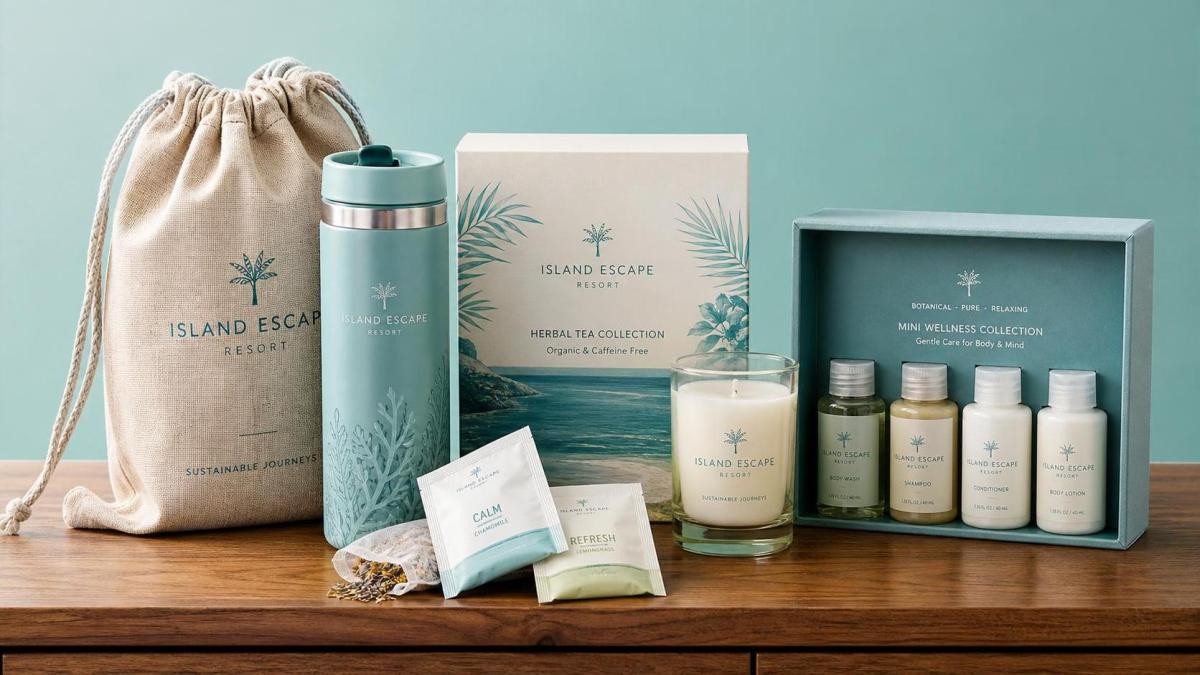
Usefulness remains essential. Guests are more likely to keep travel pouches, refillable drinkware, compact wellness products, sleep accessories, or family-friendly activity kits than decorative items with little practical value.
Emotional relevance matters just as much. A destination-inspired tea blend, a scent linked to a signature spa ritual, or a children’s travel pack designed around the local environment feels more intentional than standard logo merchandise.
Visual consistency connects the gift to the brand. This includes typography, material finishes, color systems, and packaging experience. Private label gifts work best when they feel like part of the guest journey, not an afterthought from procurement.
Supply reliability has become a deciding factor. If a gift program cannot scale across seasons, regions, or property types, the concept quickly loses value. This is why lead times, substitution risk, and quality controls now shape early planning.
The trend lines shaping gifting programs
Sustainability is now a design standard
Sustainability in private label gifts is moving beyond recycled paper sleeves and generic eco claims. Travel brands are asking harder questions about refillability, plastic reduction, mono-material packaging, and end-of-use practicality.
Guests notice whether a gift aligns with the property’s environmental messaging. A refillable aluminum bottle or FSC-certified notebook supports that story better than disposable novelty items.
Local storytelling is becoming more specific
Destination branding is growing more precise. Instead of broad tropical or luxury themes, resorts are using local ingredients, region-specific artwork, and culturally grounded packaging to make private label gifts feel distinct.
That specificity helps protect against sameness. It also supports premium pricing in gift shops, villas, airport retail, and online post-stay channels.
Wellness and comfort remain high-conversion categories
Travel can be restorative, but also tiring. This is why sleep mists, compression socks, mini recovery tools, herbal teas, and spa-led amenity sets are gaining ground in private label gifts.
These items fit both luxury and midscale strategies. They are easy to bundle, relevant across seasons, and often compatible with retail upsell extensions.
Family and multigenerational travel influence assortments
Resort gifting is no longer designed only for solo or couple travel. Children’s welcome packs, pet-friendly add-ons, and products for shared in-room use are expanding the role of private label gifts across guest segments.
This is where category crossover matters. Insights from Baby, Pet, and Gifts & Toys sourcing can inform assortments that feel more complete and commercially relevant.
Where resorts and travel brands are applying these products
Private label gifts now appear across more touchpoints than the traditional check-in desk. The most effective programs align product type with guest context and margin potential.
The main point is simple. Private label gifts perform better when they are tied to a specific occasion, not treated as one generic inventory bucket.
What sourcing teams should evaluate early
Gift programs often fail for operational reasons rather than creative ones. A concept may look compelling, but fall apart when compliance, replenishment, or packaging economics are reviewed too late.
- Check whether the item requires FDA, CE, CPC, or market-specific labeling.
- Review minimum order quantities against seasonal occupancy patterns.
- Test packaging durability for humidity, transit, and in-room presentation.
- Assess whether materials and fragrance claims can be verified.
- Plan substitutions before launch to reduce disruption risk.
- Align the gifting range with both guest experience and retail margin goals.
This is where a data-backed sourcing view becomes useful. GCS has relevance because it connects product trend tracking with supplier capability, certification awareness, and private-label readiness across fast-moving consumer categories.
For travel brands, that broader visibility matters. Gift assortments increasingly overlap with beauty, wellness, outdoor, family, and toy-related products, each carrying different quality and compliance expectations.
How to judge commercial value, not just visual appeal
A gift that photographs well is not automatically a good program. Private label gifts should be measured against several business questions before rollout.
Does it reinforce the brand story?
The item should feel native to the property or travel concept. If the brand promise centers on wellness, ecology, or local immersion, the gift needs to reflect that promise clearly.
Can it support revenue beyond gifting?
The best private label gifts often have a second life as retail products, room add-ons, or loyalty rewards. This improves return on product development and packaging investment.
Will it travel well across channels?
A product designed for a welcome basket may also need to work in boutiques, online stores, or corporate gifting. Multi-channel flexibility is increasingly valuable in 2026.
Is the sourcing model resilient?
Reliable production, transparent documentation, and scalable quality standards matter more than novelty. Supply chain gaps can damage guest trust faster than an ordinary product ever could.
A practical direction for 2026 planning
Private label gifts are becoming part of a broader hospitality retail strategy. They help connect experience design, merchandising, and sourcing discipline in one visible category.
The most effective next step is usually not expanding the range immediately. It is narrowing the brief. Define the guest moment, the brand story, the target price architecture, and the compliance path before choosing products.
From there, compare a small number of formats: welcome gifts, wellness-led items, destination retail products, or loyalty exclusives. That approach makes private label gifts easier to evaluate on both experience value and commercial performance.
In a travel market where memory, utility, and trust all influence spending, gifting is no longer peripheral. It is a sourcing decision with direct brand consequences, and worth reviewing with the same rigor applied to any core guest-facing product line.
Related Intelligence
 Skincare OEMAug 16, 2026Amazon Enforces AI Human Metadata Rule for Beauty and Personal Care SellersAmazon now enforces AI human metadata rules for beauty sellers. Learn how to protect listings, traffic, and compliance in skincare, cosmetics, and beauty devices.
 Beauty DevicesAug 15, 2026China to Roll Out Nationwide Cross-Border Cash Pooling for MultinationalsChina to roll out nationwide cross-border cash pooling for multinationals from Sept. 14. Discover how this policy could improve treasury efficiency, liquidity management, and China-linked supply chains.
 Beauty DevicesAug 14, 2026China Imposes Temporary Export Ban on Helium, Affecting Cooling Supply ChainsChina's temporary helium export ban may disrupt cooling supply chains for beauty RF devices and laser systems. Learn what ODMs, buyers, and procurement teams should check now.
![]() Cosmetics & PkgAug 13, 2026PPWR becomes mandatory: Beauty and personal care packaging materials usher in new EPR and PFAS compliance requirementsPPWR takes effect for cosmetics packaging in the EU, bringing EPR registration and PFAS limits. Learn what brands, importers, and suppliers must do now.
Cosmetics & PkgAug 13, 2026PPWR becomes mandatory: Beauty and personal care packaging materials usher in new EPR and PFAS compliance requirementsPPWR takes effect for cosmetics packaging in the EU, bringing EPR registration and PFAS limits. Learn what brands, importers, and suppliers must do now. Cosmetics & PkgAug 12, 2026EU PPWR Now Enforced for Beauty Packaging ComplianceEU PPWR now enforced for beauty packaging compliance: learn how EPR, ERN, heavy metals and PFAS rules affect EU exports, customs clearance and platform sales.
 Cosmetics & PkgAug 11, 2026EU PPWR Rules Take Effect on Aug. 12 for Beauty PackagingEU PPWR rules for beauty packaging take effect on Aug. 12, 2026. Learn key compliance steps, EPR, labeling, PFAS limits, and how to avoid customs delays and fines.
 Smart Pet DevicesAug 10, 2026EU EPR Rules to Cover Smart Pet Devices on Aug. 15EU EPR Rules will cover smart pet devices from Aug. 15, 2026. Learn how smart collars, feeders, and monitoring devices can avoid delisting, customs delays, and compliance risks in the EU.
 Infant Feeding & CareAug 09, 2026CPSC Recalls Baby Sleep Sacks Over Undeclared TDCPPCPSC Recalls Baby Sleep Sacks Over Undeclared TDCPP: learn how this 2026 recall impacts CPC documents, third-party testing, and U.S. baby product compliance for exporters.
 Infant Feeding & CareAug 08, 2026ECHA Adds 5 SVHCs, Importer Notices Due From Oct 2026ECHA adds 5 SVHCs to the Candidate List, with importer notices due from October 2026. Learn how REACH affects exporters, supply chains, and documentation readiness.
 Baby Gear & StrollersAug 07, 2026CPSC Revises Crib Rail Standard for November 2026CPSC revises crib rail standard for November 2026, adding dynamic impact tests and mandatory third-party lab testing. Learn how the new rule affects U.S. market access, compliance, and shipments.
 Electronic & RC ToysAug 06, 2026EU to Require EN IEC 62115:2025 for Electronic ToysEU to Require EN IEC 62115:2025 for Electronic Toys from Oct 1, 2026. Learn scope, battery and AI safety updates, CE compliance risks, and how exporters can avoid customs delays.
 Baby Gear & StrollersAug 05, 2026US Stroller Stability Rule Takes Effect Aug. 15US Stroller Stability Rule Takes Effect Aug. 15: learn how new U.S. stroller compliance, ASTM F833-26a, and CPSC testing rules may affect imports, certification, and shipment readiness.
 Infant Feeding & CareAug 04, 2026ECHA Adds 5 SVHCs, Triggering Baby Care Export ReviewECHA adds 5 SVHCs, prompting an urgent baby care export review for EU-bound products. Learn the 0.1% threshold risks, compliance steps, and how to avoid customs delays and fines.












