Magnetic Building Blocks Manufacturer: Safety Points You Should Never Skip
For quality and safety managers evaluating a magnetic building blocks manufacturer, overlooking even one compliance detail can lead to recalls, failed audits, and brand damage. From magnet retention strength to material traceability and age-grade testing, every checkpoint matters. This guide highlights the safety points you should never skip when assessing suppliers for reliable, market-ready products.
Why is a magnetic building blocks manufacturer under such strict safety scrutiny?
A magnetic building blocks manufacturer works in one of the most sensitive categories within gifts, toys, and family-oriented travel retail. These products look simple, but they combine several risk factors at once: small parts, embedded magnets, plastic resin safety, coating durability, and repeated impact during real use. For quality control teams and safety managers, that means supplier evaluation cannot stop at a clean sample or a polished factory presentation.
The biggest concern is magnet ingestion. If loose magnets are swallowed, they can attract each other inside the body and cause severe internal injury. Because of that, regulators, retailers, and cross-border marketplaces often apply tougher review standards to magnetic toys than to many ordinary plastic products. A magnetic building blocks manufacturer must therefore prove not only design intent, but also consistent production control.
This matters even more in travel service and family retail channels. Souvenir stores, resort gift shops, airport retailers, museum stores, and destination-based toy programs often sell compact items that parents buy quickly for children during trips. In these fast-purchase environments, safety labeling, age grading, packaging warnings, and reliable compliance records are critical, because the buyer may not spend time researching the product in advance.
What are the first safety documents you should ask from a magnetic building blocks manufacturer?
Before discussing price, tooling, or delivery time, ask for the safety documentation package. A credible magnetic building blocks manufacturer should be ready to provide structured, recent, and product-specific evidence rather than generic claims. If the factory responds with outdated reports, unrelated test files, or broad statements like “all products pass CE,” treat that as an audit warning.
Start with applicable market compliance documents. Depending on your sales destination, this may include ASTM F963, CPSIA, CPC, EN71, REACH, and other relevant toy safety or chemical compliance records. The key point is not simply whether a report exists, but whether the report matches the exact SKU family, material composition, magnet structure, and packaging configuration you intend to source.
You should also request a bill of materials, raw material declarations, magnet specifications, and traceability records for resin, colorants, coatings, adhesives, and packaging inks. Many failures happen because a supplier changes a subcomponent after testing. A responsible magnetic building blocks manufacturer should be able to show change-control procedures, version tracking, and supplier approval records for safety-critical parts.
Which product tests should never be skipped when evaluating a magnetic building blocks manufacturer?
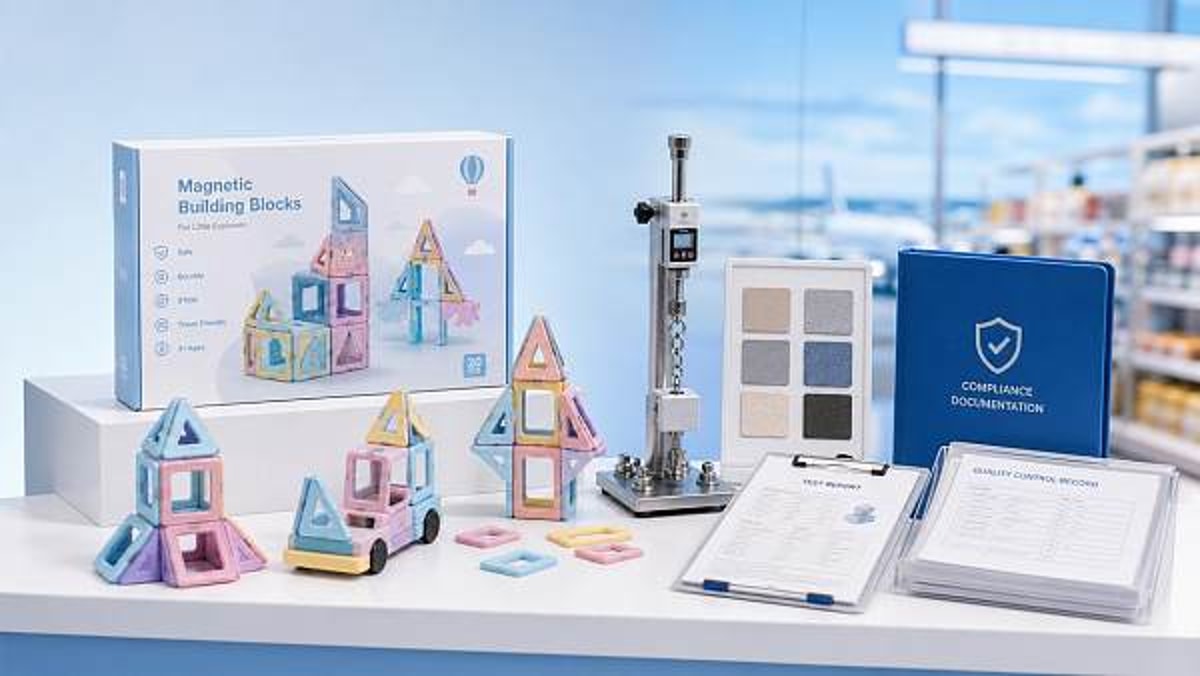
The most important tests are the ones that confirm the magnet stays where it belongs under real-world abuse. A magnetic building blocks manufacturer should validate magnet retention using tension, torque, drop, impact, compression, and abuse testing appropriate to the target regulation and age grading. If the magnet can loosen after repeated stress, the product is unsafe regardless of how attractive the design looks.
Material performance testing is equally important. Ask whether the plastic shell becomes brittle in cold conditions, deforms in heat, or cracks after repeated use. Family travel retail often exposes toys to cars, luggage, hotel rooms, beach environments, and changing temperatures. Products sold in tourism channels should not fail simply because they were packed into a suitcase or left in a warm vehicle.
Chemical compliance must also be treated as a live control issue, not just a one-time test. Verify limits for lead, phthalates, cadmium, and other restricted substances depending on the destination market. Inks, decorative coatings, and internal adhesives are common weak points. A good magnetic building blocks manufacturer can identify which components are high-risk and show routine incoming inspection plans for those materials.
Do not forget packaging and labeling tests. Warning statements, choking hazard language, age grading, and multilingual labeling may be mandatory for certain markets or retail partners. If your company supplies travel venues or international gift programs, mislabeling can block customs clearance or trigger retail rejection even when the product itself passes performance tests.
How can you tell whether a magnetic building blocks manufacturer has real process control, not just good samples?
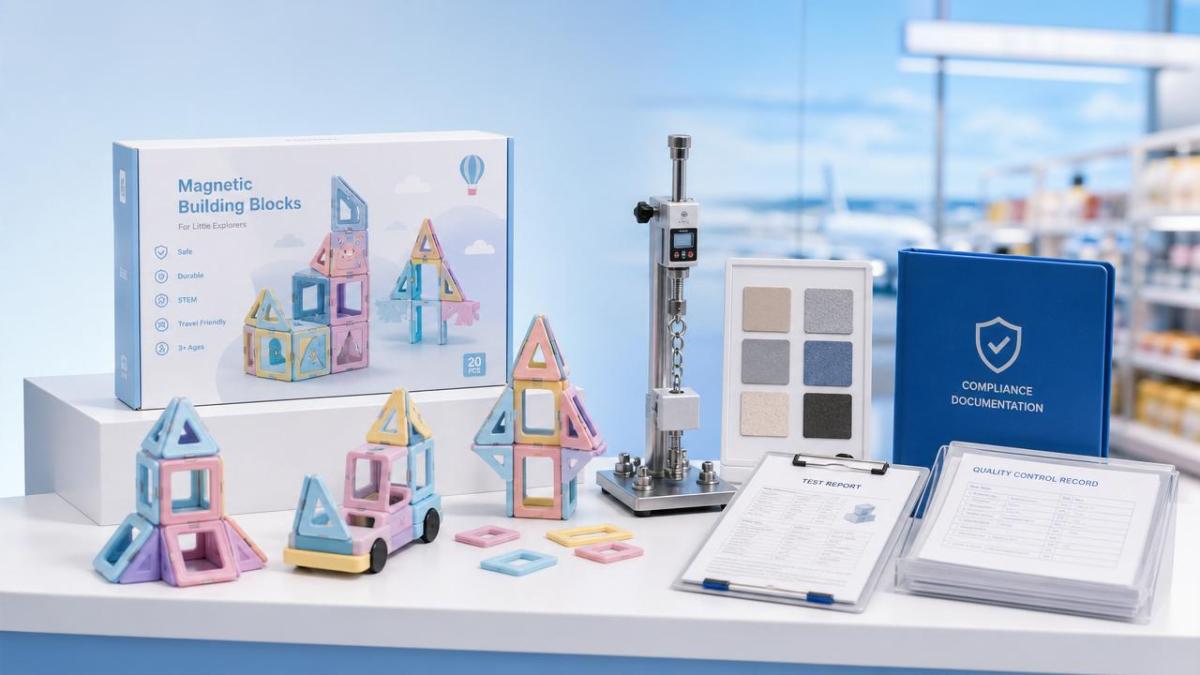
This is where many sourcing teams make the wrong call. A hand-selected preproduction sample may look perfect, but batch consistency is what protects your brand. To judge a magnetic building blocks manufacturer properly, examine the production process from incoming materials to final packing. Ask how magnets are inserted, how cavities are sealed, what adhesive or overmolding method is used, and how the sealing integrity is verified on the line.
Look for documented control points. These should include raw material inspection, in-process pull testing, dimensional checks, visual inspection criteria, metal contamination prevention, and final lot sampling. If the manufacturer cannot show control charts, work instructions, defect classification standards, or batch retention samples, then the safety system may depend too heavily on operator habit.
Quality and safety managers should also ask about subcontracting. Some factories outsource magnet supply, printing, or even component molding. That is not automatically a problem, but it increases traceability risk. A reliable magnetic building blocks manufacturer should disclose subcontractors, define approval controls, and maintain audit visibility over all safety-related external processes.
Another practical signal is how the supplier handles nonconformities. Ask for examples of corrective actions from previous internal or customer audits. Strong manufacturers can explain root-cause analysis, containment actions, retesting logic, and preventive improvements. Weak suppliers often respond only with promises rather than documented CAPA practice.
What are the most common mistakes buyers make when choosing a magnetic building blocks manufacturer?
The first mistake is treating certification as a one-page formality. Test reports are snapshots. They do not guarantee that every shipment matches the tested sample. Buyers should evaluate whether the magnetic building blocks manufacturer has an active compliance maintenance system, especially when molds, materials, pigments, or packaging are updated.
The second mistake is assuming all age grades are commercially interchangeable. Some buyers push for younger age labeling to widen the market, but that can trigger much stricter requirements. A manufacturer must align product size, magnet security, warning language, and testing protocols with the claimed user age. An unrealistic age grade can create avoidable regulatory exposure.
The third mistake is focusing only on FOB price. A lower-cost magnetic building blocks manufacturer may be using weaker resin, thinner wall thickness, inconsistent magnet quality, or poor sealing methods. Safety failures often originate in hidden cost-cutting. For tourism-oriented retail, where products may be purchased as impulse gifts for children, the reputational cost of a recall can be far higher than any unit-price savings.
The fourth mistake is skipping real-use scenario review. Travel retail products may be displayed in high-traffic stores, handled by many shoppers, packed into luggage, and exposed to rough treatment before use. If the supplier has never considered these conditions, your incoming quality standard may be too narrow for the actual sales environment.
What should quality and safety managers check during a factory audit?
During an on-site or remote audit, inspect both the paperwork and the physical process. Start with management responsibility: who owns toy safety decisions, who approves engineering changes, and who signs off on release to mass production? If responsibility is vague, control will be inconsistent. A mature magnetic building blocks manufacturer should have named roles across engineering, QA, purchasing, and compliance.
On the shop floor, review material storage conditions, lot segregation, magnet handling controls, mold maintenance records, and first-article approval procedures. Observe whether rejected products are physically isolated and whether rework is controlled. Ask operators to explain their work instructions. If they cannot describe key checks, written procedures may not be truly implemented.
Pay close attention to traceability. You should be able to connect a finished carton back to its production date, machine, operator group, raw material lot, and magnet source. This is essential if a retailer, online platform, or customs authority requests proof after shipment. For brands serving international travel, hospitality, or destination retail programs, rapid traceability is especially valuable because products may be dispersed across many locations in a short time.
Quick audit checklist for supplier screening
- Are magnet retention test methods documented and repeated by batch or schedule?
- Do material lots match the tested bill of materials?
- Is there formal engineering change control before any material or design substitution?
- Can the magnetic building blocks manufacturer trace finished goods to subcomponent level?
- Are warning labels, age grades, and packaging versions verified before shipment?
- Is CAPA documented with root cause, action owner, deadline, and verification?
How should you compare suppliers when several factories claim the same compliance level?
When multiple suppliers present similar certificates, compare depth, not headlines. Ask each magnetic building blocks manufacturer to explain how safety is designed into the product, how often testing is refreshed, what percentage of lots receive verification checks, and how they handle complaint escalation. The best supplier usually offers the clearest answers, not merely the lowest quotation.
You should also compare commercial readiness. For example, can the supplier support private labeling, destination-specific packaging, barcode control, multilingual warnings, and retailer documentation requirements? For travel service buyers, these details matter because products are often tied to region-specific promotions, visitor experiences, and seasonal campaigns. Compliance strength is more valuable when it supports smooth market entry.
Finally, evaluate responsiveness. If a magnetic building blocks manufacturer takes too long to return test records, clarify a material change, or answer a safety question during onboarding, that delay may become much worse during a real incident. In safety-sensitive categories, communication speed is part of risk control.
What should you confirm before moving forward with sourcing or cooperation?
Before approving a purchase order, confirm the exact product specification, intended market, target age grade, testing scope, packaging version, and release criteria. Put these in writing. A magnetic building blocks manufacturer should acknowledge that no material, magnet grade, cavity design, coating, or labeling change can occur without prior approval and, when needed, renewed testing.
You should also align on pre-shipment inspection standards, complaint handling timelines, document retention periods, and recall support expectations. If the product will be sold through travel retail, resort stores, museums, airports, or tourism gift channels, clarify channel-specific needs such as multilingual warnings, compact display packaging, and durability expectations during transit.
If you need to confirm a practical cooperation plan with a magnetic building blocks manufacturer, prioritize these questions: Which safety standards apply to the target country? What are the latest test reports for the exact SKU? How is magnet retention verified during mass production? What material change controls are in place? Can the supplier provide full lot traceability? What lead time is needed for compliance review, pilot run, and final shipment release? Starting with these questions will help quality and safety managers move from generic supplier screening to reliable, market-ready decision-making.
Related Intelligence
 Corporate & Seasonal GiftsMay 07, 2026Branded USB Flash Drives: When Classic Promo Items Still Make SenseBranded USB flash drives still make sense for travel service brands—discover how they boost partner engagement, showcase premium content, and support higher-conversion B2B campaigns.
![]() Corporate & Seasonal GiftsMay 07, 2026Reborn Baby Dolls Wholesale: Key Quality Signs to Check Before Orderingreborn baby dolls wholesale buyers: learn the key quality signs to check before ordering, from materials and realism to compliance and factory consistency.
Corporate & Seasonal GiftsMay 07, 2026Reborn Baby Dolls Wholesale: Key Quality Signs to Check Before Orderingreborn baby dolls wholesale buyers: learn the key quality signs to check before ordering, from materials and realism to compliance and factory consistency. STEM & Educational ToysMay 07, 2026Montessori Toys Wholesale: What Sells Better Than Trend-Driven Toy PicksMontessori toys wholesale offers travel retailers and distributors a smarter alternative to fad toys—safer, educational, durable, and built for steady demand, repeat orders, and long-term trust.
 Corporate & Seasonal GiftsMay 07, 2026Custom Printed Mugs Bulk: Which Sizes and Coatings Make Better Gift ItemsCustom printed mugs bulk: discover the best sizes and coatings for travel gifts, hotel branding, and souvenir retail to boost appeal, durability, and buyer confidence.
 STEM & Educational ToysMay 07, 2026Sensory Toys for Autism OEM: Features That Matter More Than Bright PackagingSensory toys for autism OEM selection for travel services should prioritize safety, compliance, durability, and calming design over flashy packaging. Discover what truly improves guest experience.
 STEM & Educational ToysMay 07, 2026Custom Board Games Printing: How to Avoid Expensive Reprint MistakesCustom board games printing guide for travel service teams: avoid costly reprints, fix supplier risks, choose the right materials, and keep projects on time and on budget.
 Corporate & Seasonal GiftsMay 07, 2026Custom Power Banks OEM: What to Review Before Approving Battery SpecsCustom power banks OEM guide for travel service buyers: review battery chemistry, real output, safety, cycle life, and compliance before approval to reduce risk and boost buyer confidence.
 STEM & Educational ToysMay 07, 2026DIY Craft Kits for Kids: Which Projects Work Best for Short Attention SpansDIY craft kits for kids that keep short attention spans engaged on trips. Discover mess-free, travel-friendly projects for flights, road trips, and hotel downtime.
 STEM & Educational ToysMay 07, 2026Magnetic Building Blocks Manufacturer: Safety Points You Should Never SkipMagnetic building blocks manufacturer safety guide: learn the must-check tests, compliance documents, and audit points to avoid recalls, protect your brand, and source with confidence.
 Corporate & Seasonal GiftsMay 07, 2026Corporate Gift Sets Wholesale: How to Match Product Mix With BudgetCorporate gift sets wholesale for travel services: learn how to match product mix with budget, control landed costs, manage compliance, and choose higher-ROI gift sets.
 Corporate & Seasonal GiftsMay 07, 2026Action Figures Manufacturer: What to Compare Before Locking in a SupplierAction figures manufacturer comparison guide for travel buyers: evaluate compliance, customization, packaging, lead times, and supplier stability before choosing a sourcing partner.
 Corporate & Seasonal GiftsMay 07, 2026Birthday Party Decorations: How to Build a Theme Without OverbuyingBirthday party decorations made simple: learn how to build a stylish theme with fewer items, smart venue-friendly choices, and budget-saving tips that still create a memorable celebration.
 Corporate & Seasonal GiftsMay 07, 2026Fidget Spinners Bulk: When Low Unit Cost Becomes a Hidden Quality RiskFidget spinners bulk may look cost-effective, but hidden quality, compliance, and return risks can hurt travel retail margins. Learn how to source smarter before you buy.