Tactical Dog Harness OEM: What to Check Before Mass Production
Before launching tactical dog harness OEM at scale, project managers need more than a sample that looks good. They must verify material performance, compliance readiness, factory consistency, and production risk controls to avoid costly delays and quality failures. This guide outlines the key checkpoints to review before mass production, helping teams align sourcing, engineering, and delivery with confidence.
Why a checklist approach matters before tactical dog harness OEM mass production
For project managers, a tactical dog harness OEM program is rarely just a product launch. It is a cross-functional delivery task that touches sourcing, product development, compliance, packaging, logistics, and retail readiness. In travel service and outdoor retail channels, pet gear often needs to support active use cases such as hiking, camping, road trips, guided tours, and adventure travel. That means a visually strong prototype is not enough. The harness must also perform reliably under real-world strain, climate exposure, frequent handling, and brand-level customer expectations.
A checklist-based review helps teams avoid a common mistake: approving a sample too early based on appearance, then discovering later that stitching strength, buckle tolerance, reflective trim, labeling, or carton consistency cannot hold up during scale-up. In tactical dog harness OEM projects, the gap between sample approval and stable production is where cost overruns usually begin. A disciplined review process reduces rework, protects launch timing, and gives procurement and engineering teams a common decision framework.
Start with these priority checks before approving the factory plan
Before discussing unit price or booking capacity, confirm whether the manufacturer can support your exact product definition. The most effective project teams review the following items first:
- Product positioning: Is the harness intended for working dogs, outdoor recreation, travel use, or premium pet retail? This affects fabric weight, accessory choices, packaging, and test standards.
- Bill of materials stability: Are webbing, Oxford fabric, mesh, foam, Velcro, D-rings, buckles, and reflective components already locked, or still open to substitution?
- Sizing logic: Does the size range match target breed profiles and key markets, including chest girth tolerances and adjustment span?
- Compliance pathway: What labels, country-specific warnings, fiber declarations, or chemical restrictions apply to your destination markets?
- Pilot capability: Can the supplier produce a pre-production run with the same line, operators, and materials planned for bulk?
- Quality ownership: Who approves golden samples, in-line checks, final AQL, and packaging verification?
If any of these points remain unclear, moving straight into mass production is risky. Tactical dog harness OEM succeeds when specification clarity comes before production speed.
Core technical checklist: what to verify on the harness itself
The product-level review should be detailed enough to detect scaling issues early. For tactical dog harness OEM, these are the most important physical checkpoints:
1. Fabric and webbing performance
Check denier level, thickness consistency, abrasion resistance, colorfastness, and coating stability. Tactical-looking products often use heavy materials, but excessive stiffness can reduce comfort and create fit complaints. Webbing should be tested for tensile strength, edge fray resistance, and dye transfer, especially in humid or high-friction travel environments.
2. Stitching structure and seam security
Confirm stitch density, bartack placement, reinforcement zones, thread type, and seam alignment. The high-risk failure points are usually handle joints, chest connection panels, load-bearing webbing intersections, and D-ring anchors. Ask for seam strength testing data rather than relying only on visual inspection.
3. Hardware reliability
Buckles, sliders, snap fittings, and metal rings should be checked for opening force, break strength, corrosion resistance, and consistency across batches. A tactical dog harness OEM order can fail at retail because of one unstable hardware supplier, even when fabric quality is acceptable.
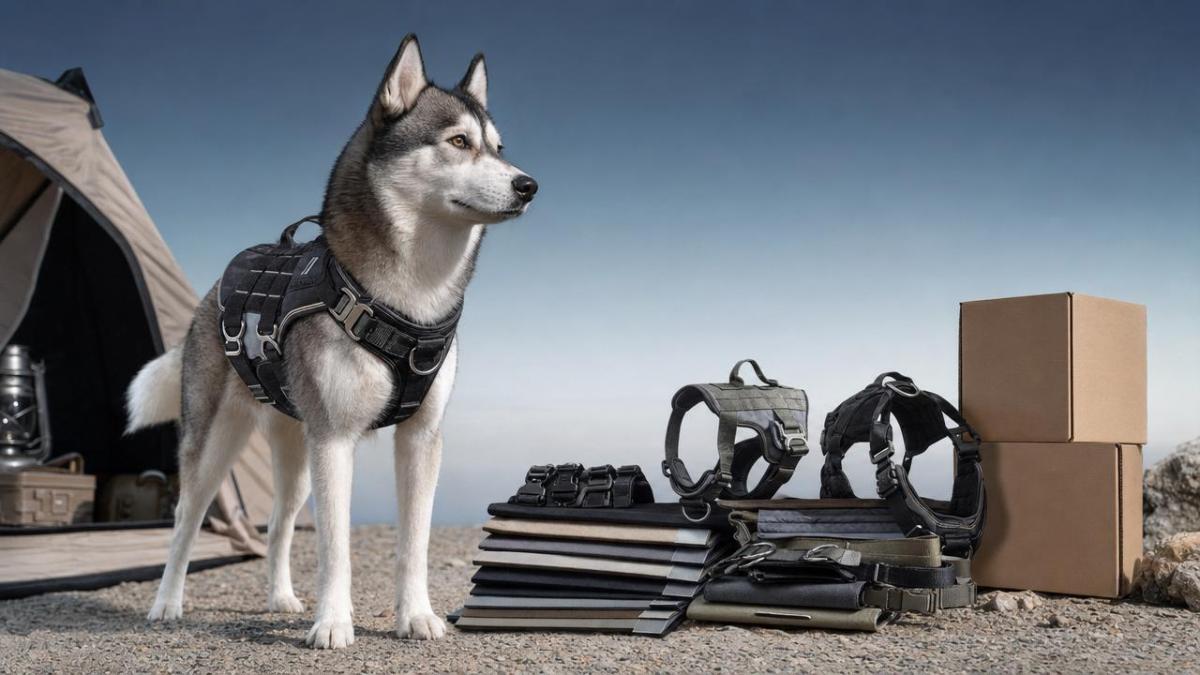
4. Fit, adjustability, and dog comfort
Check whether adjustment straps move smoothly without slipping after tension. Review padding thickness, edge finishing, mesh breathability, and pressure distribution around the chest and shoulders. For active travel scenarios, poor ergonomic design can lead to chafing, overheating, or restricted movement, which quickly generates returns and negative reviews.
5. Functional attachments and accessories
If the design includes MOLLE panels, patch areas, top handles, control loops, or side pouches, confirm that every feature has a defined load and use condition. Decorative tactical styling should not be confused with actual functional performance. Clarify whether attachments are load-bearing, decorative, or intended only for light accessories.
Factory readiness checklist: what project managers should audit before PO release
Even a well-developed product can fail if the production system is weak. Before releasing a tactical dog harness OEM bulk order, evaluate the manufacturer using practical operational criteria.
For sourcing teams serving travel and outdoor retail, factory flexibility is also important. Seasonal launches, promotional bundles, or destination-specific packaging may require last-minute changes. A supplier that can communicate engineering changes clearly is often more valuable than one offering the lowest initial quote.
Compliance and labeling checks that are often underestimated
Compliance for tactical dog harness OEM is not only about avoiding legal issues. It also affects listing approval, customs clearance, retail acceptance, and brand trust. Project managers should verify:
- Material safety documentation for restricted substances, dyes, coatings, and heavy metals where relevant.
- Fiber content or material declarations required by destination markets.
- Country of origin marking, care labels, barcode placement, and retail packaging language accuracy.
- Warnings related to pet use, load limits, non-climbing statements, or supervised-use claims if applicable.
- Any marketplace-specific documentation needed for online retail platforms.
A common issue is that the product itself passes internal testing, but the packaging or label copy is incomplete. That can delay shipments just as easily as a failed pull test.
Different use scenarios require different decision standards
Not every tactical dog harness OEM brief should be judged by the same criteria. Project leaders should adjust the checklist based on commercial context:
- Outdoor travel retail: prioritize comfort, lightweight structure, weather resistance, reflective safety, and packable packaging.
- Premium pet e-commerce: focus on finish consistency, fit clarity, unboxing quality, and review-sensitive details such as stitching neatness and odor control.
- Utility or working-dog styling: verify true load-bearing claims, hardware durability, and clear communication on intended use versus decorative features.
- Private-label chain retail: emphasize barcode accuracy, carton standardization, replenishment repeatability, and line-side quality discipline.
This scenario-based filtering keeps the tactical dog harness OEM process efficient. Teams avoid over-testing low-risk features while giving critical applications the validation they require.
Common blind spots that create expensive production problems
Several issues are repeatedly overlooked in tactical dog harness OEM programs:
- Approving hand-made development samples that do not reflect bulk sewing conditions.
- Ignoring tolerance stacking across padding, fabric layers, and webbing folds, which changes fit in production.
- Failing to lock color standards for mixed materials, resulting in visible shade variation.
- Not testing packaging compression, which can deform foam structures or crease presentation panels.
- Using alternate hardware after sample approval without a formal engineering change process.
- Skipping wear simulation for repeated adjustment, washing exposure, or travel-related abrasion.
These are not minor details. In many cases, they are the exact reasons a promising launch turns into a delayed replenishment cycle or a return-heavy first season.
A practical execution plan for project managers
To move a tactical dog harness OEM project forward with control, use a staged approval process:
- Freeze product requirements, target market, and intended use claims.
- Approve the final BOM, color standards, measurement specs, and packaging map.
- Request a golden sample built with production-intent materials and normal line methods.
- Complete material, function, fit, and compliance document review.
- Run a pilot or pre-production order and inspect both product and packed cartons.
- Release bulk only after corrective actions are closed and quality criteria are signed off.
This approach is especially useful when coordinating international sourcing timelines, seasonal travel retail windows, or multi-market private-label launches. It gives engineering, procurement, and QA teams a shared rhythm instead of a reactive one.
Final decision guide: what to prepare before the next supplier discussion
If you are about to advance a tactical dog harness OEM program, prepare a supplier discussion pack before the next meeting. It should include your approved use case, target price band, technical drawings, size chart, BOM priorities, compliance expectations, packaging requirements, test needs, and delivery milestones. Also define which points are non-negotiable, such as hardware strength, labeling format, or material substitutions.
For project managers and engineering leads, the best next step is not simply asking for a quote. It is asking the supplier to prove production readiness. Confirm parameters, sample-to-bulk consistency, QC workflow, lead time reliability, and change-control discipline before committing volume. That is how a tactical dog harness OEM project moves from attractive prototype to dependable commercial product with lower risk and better long-term margin.
Related Intelligence
 Pet Grooming & TravelMay 06, 2026Custom Printed Dog Collars: Design Choices That Improve Repeat OrdersCustom printed dog collars that drive repeat orders: explore durable materials, lasting print methods, safer hardware, and private-label design choices that boost retail appeal.
 Smart Pet DevicesMay 06, 2026Aquarium LED Lighting OEM: What Impacts Energy Use and Plant GrowthAquarium led lighting oem guide for travel service projects: compare energy use, PAR, spectrum, thermal control, and OEM reliability to improve plant growth and reduce operating costs.
 Skincare OEMMay 06, 2026Private Label Pet Shampoo: How to Balance Formula, Scent, and PositioningPrivate label pet shampoo strategies for travel brands: learn how to balance formula, scent, compliance, and positioning to boost guest experience, retail appeal, and brand value.
 Pet Grooming & TravelMay 06, 2026Airline Approved Pet Carrier: Common Mistakes Before You FlyAirline approved pet carrier guide: avoid common pre-flight mistakes, compare airline rules, size, ventilation, and comfort to choose a safer, stress-free travel carrier.
 Activewear OEMMay 06, 2026Custom Dog Sweaters: What Changes the Final Price MostCustom dog sweaters pricing explained for travel service buyers: compare materials, MOQ, customization, compliance, and supplier costs to cut risk, protect margins, and source smarter.
 Pet Furniture & EnrichmentMay 06, 2026Bird Cage Wholesale: Which Styles Fit Small Stores BestBird cage wholesale guide for small stores: discover compact, decorative, and foldable styles that save space, sell faster, and suit tourism-driven retail demand.
 Smart Pet DevicesMay 06, 2026LED Dog Collar Manufacturer: How to Judge Visibility and Battery LifeLED dog collar manufacturer selection starts with visibility and battery life. Learn how to compare suppliers, verify safety, and choose reliable collars for travel and outdoor use.
 Pet Grooming & TravelMay 06, 2026Pet Nail Grinder Manufacturer: 6 Safety Details You Should Not IgnorePet nail grinder manufacturer selection affects safety, compliance, and brand trust. Discover 6 critical details buyers in travel services should review before choosing a supplier.
 Pet Grooming & TravelMay 06, 2026Dog Grooming Clippers Wholesale: A Practical Guide to Motor and Blade OptionsDog grooming clippers wholesale guide covering motor types, blade options, noise, durability, and maintenance—helping buyers compare specs, reduce sourcing risk, and choose better-performing products.
 Pet Grooming & TravelMay 06, 2026Retractable Dog Leash Wholesale: Which Mechanisms Cause Fewer ComplaintsRetractable dog leash wholesale guide: discover which mechanisms cause fewer complaints, reduce returns, and improve buyer trust with smarter sourcing for travel retail channels.
 Smart Pet DevicesMay 06, 2026Canister Filter for Aquarium: How to Size It Correctly the First TimeCanister filter for aquarium sizing made simple: learn how to match flow, media capacity, and bioload for clear water, healthier fish, and fewer costly upgrade mistakes.
 Smart Pet DevicesMay 06, 2026Smart Pet Tag Tracker: What to Look for Beyond GPS ClaimsSmart pet tag tracker buying guide for travel: compare battery life, coverage, app usability, durability, and compliance beyond GPS claims to choose with confidence.
 Pet Grooming & TravelMay 06, 2026How a Pet Raincoat Manufacturer Handles Sizing and WaterproofingPet raincoat manufacturer insights for travel retail buyers: learn how suppliers manage sizing logic, waterproof testing, seam sealing, and scalable QC for reliable sourcing.