
Ningbo Port Launches 'Green Clearance Code' for Infant Products
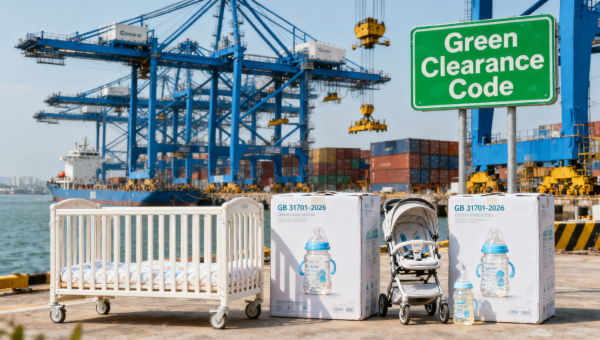
Ningbo Port has introduced a specialized digital clearance mechanism for infant and toddler products, effective May 13, 2026. The initiative—jointly launched by Ningbo Customs and the Ningbo Municipal Market Supervision Administration—aims to accelerate export compliance verification for goods subject to China’s updated national safety standard GB 31701-2026. Its rollout reflects growing regulatory emphasis on traceability, pre-market conformity, and risk-based customs facilitation in high-sensitivity consumer categories.
Event Overview
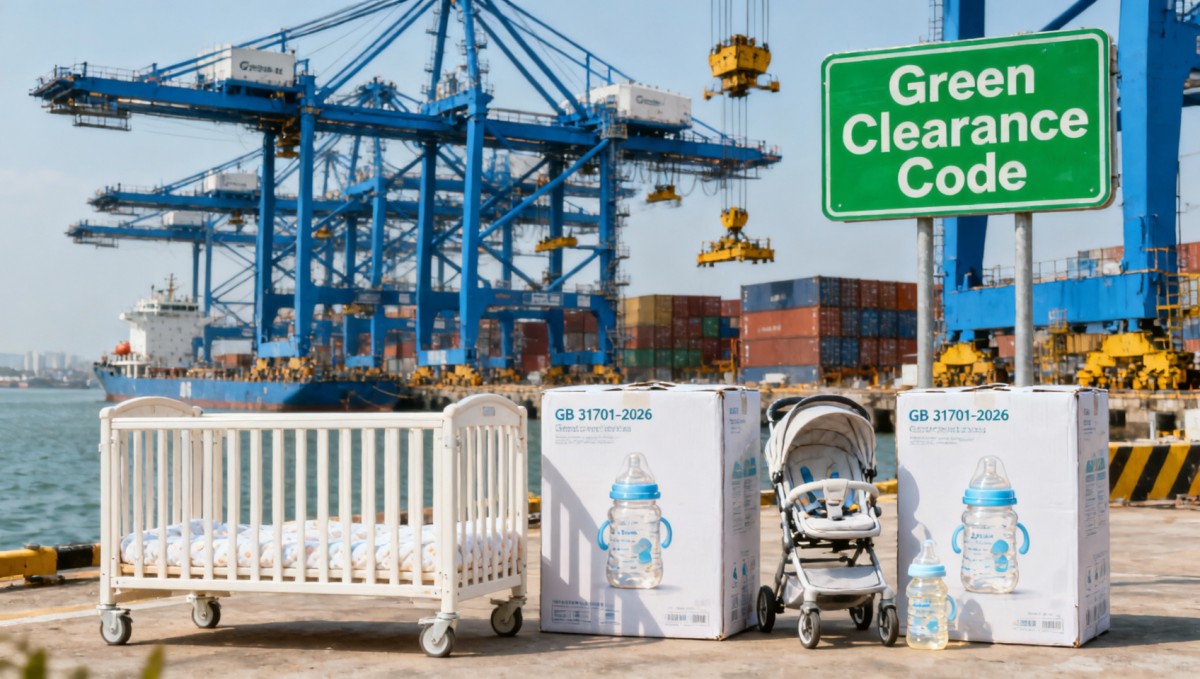
On May 13, 2026, Ningbo Customs and the Ningbo Municipal Market Supervision Administration officially launched an exclusive clearance channel for infant and toddler products. Enterprises submitting valid full-scope test reports confirming compliance with all 12 requirements of GB 31701-2026—including phthalates, heavy metals, flammability, small parts, and mechanical/physical performance—receive an automatically generated ‘Green Clearance Code’ via the integrated customs-trading platform. This triggers zero-wait inspection and sub-second release upon declaration. The scheme currently covers 37 product categories, such as infant cribs, baby walkers, and pacifiers. Average export clearance time has dropped to 4.2 hours—62% faster than the national average.
Industries Affected
Direct Exporters (Trading Enterprises): These firms experience immediate operational impact—not only in reduced clearance duration but also in heightened documentation accountability. Because the ‘Green Clearance Code’ is contingent on submission of a complete, accredited GB 31701-2026 report, exporters must now verify testing scope and lab accreditation prior to shipment. Non-compliant or partial reports trigger manual review, negating time savings and increasing uncertainty.
Raw Material Suppliers: While not directly subject to GB 31701-2026, suppliers of plastics, paints, textiles, and silicone compounds face upstream pressure. Manufacturers increasingly require material-level declarations of phthalate-free status, heavy metal thresholds (
Contract Manufacturers & OEMs: Factories producing under private labels or white-label agreements must align internal quality control checkpoints with the 12 test parameters. Notably, mechanical tests (e.g., stability, hinge strength) and flammability assessments often require prototype-level validation before mass production—a shift from post-production sampling. This increases pre-launch lead time and testing cost burden unless embedded early in design-for-compliance workflows.
Supply Chain Service Providers: Third-party testing labs, certification bodies, and customs brokers are seeing rising demand for GB 31701-2026–specific support—including report translation, CNAS-accredited lab coordination, and real-time code-status tracking integrations. Brokers without API connectivity to Ningbo’s new clearance platform may struggle to offer end-to-end visibility, risking client attrition.
Key Focus Areas and Recommended Actions
Verify Testing Scope Against All 12 GB 31701-2026 Requirements
Many existing test reports reference earlier versions (e.g., GB 31701-2015) or omit critical parameters like burn rate measurement (Clause 4.11) or torque testing for detachable parts (Clause 4.8). Firms should cross-check lab reports against the official 2026 annex listing all mandatory tests—not assume ‘full compliance’ based on branding or lab marketing language.
Integrate Clearance Code Eligibility into Order Acceptance Workflows
Exporters should embed automatic eligibility checks—such as report validity window (≤90 days), issuing lab accreditation (CNAS ID verification), and product-category alignment—into their ERP or order management systems. Manual verification introduces delays that offset the speed benefit of the green code.
Engage Testing Labs Early in Product Development
Because mechanical and flammability tests often require functional prototypes—not just finished units—delaying lab engagement until final production risks failed validation. Design teams should share CAD files and material specs with accredited labs at the concept stage to identify non-compliant configurations ahead of tooling.
Editorial Perspective / Industry Observation
This initiative is not merely a procedural upgrade—it signals a structural pivot toward ‘compliance-by-design’ enforcement in China’s consumer goods trade infrastructure. Observably, Ningbo’s model departs from traditional ex-post supervision; instead, it rewards pre-verified conformity with tangible efficiency gains. Analysis shows similar mechanisms are under feasibility study in Shenzhen (for electronics) and Qingdao (for food-contact materials), suggesting this may evolve into a national template. However, current implementation remains highly dependent on local lab capacity and digital interoperability—factors that vary significantly across regions. From an industry perspective, the policy better reflects market readiness than regulatory stringency: it assumes firms already possess testing capability, then incentivizes its systematic use.
Conclusion
The ‘Green Clearance Code’ represents a calibrated step toward smarter, data-driven trade facilitation—particularly for categories where safety perception directly influences international buyer trust. It does not lower substantive safety requirements but raises the operational cost of non-compliance transparency. For global supply chains sourcing infant products from Zhejiang and Jiangsu provinces, the change reinforces that speed and compliance are no longer trade-offs—but interdependent enablers.
Source Attribution
Official announcement: Ningbo Customs Notice No. 2026-017 (May 13, 2026); Ningbo Municipal Market Supervision Administration Implementation Guidelines for GB 31701-2026 Enforcement (Version 1.2, issued May 10, 2026). Note: Full technical interpretation of Clause 4.12 (‘Simulated Use Durability Testing’) remains pending issuance by SAC; ongoing monitoring advised.
Related Intelligence
 Skincare OEMAug 16, 2026Amazon Enforces AI Human Metadata Rule for Beauty and Personal Care SellersAmazon now enforces AI human metadata rules for beauty sellers. Learn how to protect listings, traffic, and compliance in skincare, cosmetics, and beauty devices.
 Beauty DevicesAug 15, 2026China to Roll Out Nationwide Cross-Border Cash Pooling for MultinationalsChina to roll out nationwide cross-border cash pooling for multinationals from Sept. 14. Discover how this policy could improve treasury efficiency, liquidity management, and China-linked supply chains.
 Beauty DevicesAug 14, 2026China Imposes Temporary Export Ban on Helium, Affecting Cooling Supply ChainsChina's temporary helium export ban may disrupt cooling supply chains for beauty RF devices and laser systems. Learn what ODMs, buyers, and procurement teams should check now.
![]() Cosmetics & PkgAug 13, 2026PPWR becomes mandatory: Beauty and personal care packaging materials usher in new EPR and PFAS compliance requirementsPPWR takes effect for cosmetics packaging in the EU, bringing EPR registration and PFAS limits. Learn what brands, importers, and suppliers must do now.
Cosmetics & PkgAug 13, 2026PPWR becomes mandatory: Beauty and personal care packaging materials usher in new EPR and PFAS compliance requirementsPPWR takes effect for cosmetics packaging in the EU, bringing EPR registration and PFAS limits. Learn what brands, importers, and suppliers must do now. Cosmetics & PkgAug 12, 2026EU PPWR Now Enforced for Beauty Packaging ComplianceEU PPWR now enforced for beauty packaging compliance: learn how EPR, ERN, heavy metals and PFAS rules affect EU exports, customs clearance and platform sales.
 Cosmetics & PkgAug 11, 2026EU PPWR Rules Take Effect on Aug. 12 for Beauty PackagingEU PPWR rules for beauty packaging take effect on Aug. 12, 2026. Learn key compliance steps, EPR, labeling, PFAS limits, and how to avoid customs delays and fines.
 Smart Pet DevicesAug 10, 2026EU EPR Rules to Cover Smart Pet Devices on Aug. 15EU EPR Rules will cover smart pet devices from Aug. 15, 2026. Learn how smart collars, feeders, and monitoring devices can avoid delisting, customs delays, and compliance risks in the EU.
 Infant Feeding & CareAug 09, 2026CPSC Recalls Baby Sleep Sacks Over Undeclared TDCPPCPSC Recalls Baby Sleep Sacks Over Undeclared TDCPP: learn how this 2026 recall impacts CPC documents, third-party testing, and U.S. baby product compliance for exporters.
 Infant Feeding & CareAug 08, 2026ECHA Adds 5 SVHCs, Importer Notices Due From Oct 2026ECHA adds 5 SVHCs to the Candidate List, with importer notices due from October 2026. Learn how REACH affects exporters, supply chains, and documentation readiness.
 Baby Gear & StrollersAug 07, 2026CPSC Revises Crib Rail Standard for November 2026CPSC revises crib rail standard for November 2026, adding dynamic impact tests and mandatory third-party lab testing. Learn how the new rule affects U.S. market access, compliance, and shipments.
 Electronic & RC ToysAug 06, 2026EU to Require EN IEC 62115:2025 for Electronic ToysEU to Require EN IEC 62115:2025 for Electronic Toys from Oct 1, 2026. Learn scope, battery and AI safety updates, CE compliance risks, and how exporters can avoid customs delays.
 Baby Gear & StrollersAug 05, 2026US Stroller Stability Rule Takes Effect Aug. 15US Stroller Stability Rule Takes Effect Aug. 15: learn how new U.S. stroller compliance, ASTM F833-26a, and CPSC testing rules may affect imports, certification, and shipment readiness.
 Infant Feeding & CareAug 04, 2026ECHA Adds 5 SVHCs, Triggering Baby Care Export ReviewECHA adds 5 SVHCs, prompting an urgent baby care export review for EU-bound products. Learn the 0.1% threshold risks, compliance steps, and how to avoid customs delays and fines.












