
Ningbo Port Launches Green Fast-Check Channel for Baby Gear
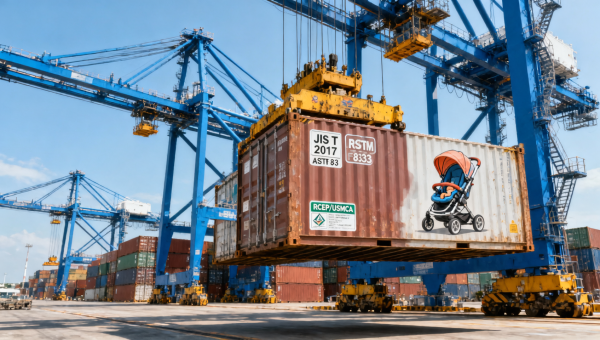
On May 17, 2026, Ningbo Port Group and Ningbo Customs jointly activated the ‘Baby Gear & Strollers Green Fast-Check Channel’, a targeted customs facilitation measure for infant products exported to Japan and the United States. The initiative directly addresses growing compliance pressure on exporters amid tightening regulatory scrutiny in key overseas markets — particularly around mechanical safety and chemical migration standards — and reflects broader port-level efforts to strengthen trade competitiveness under RCEP and USMCA frameworks.
Event Overview
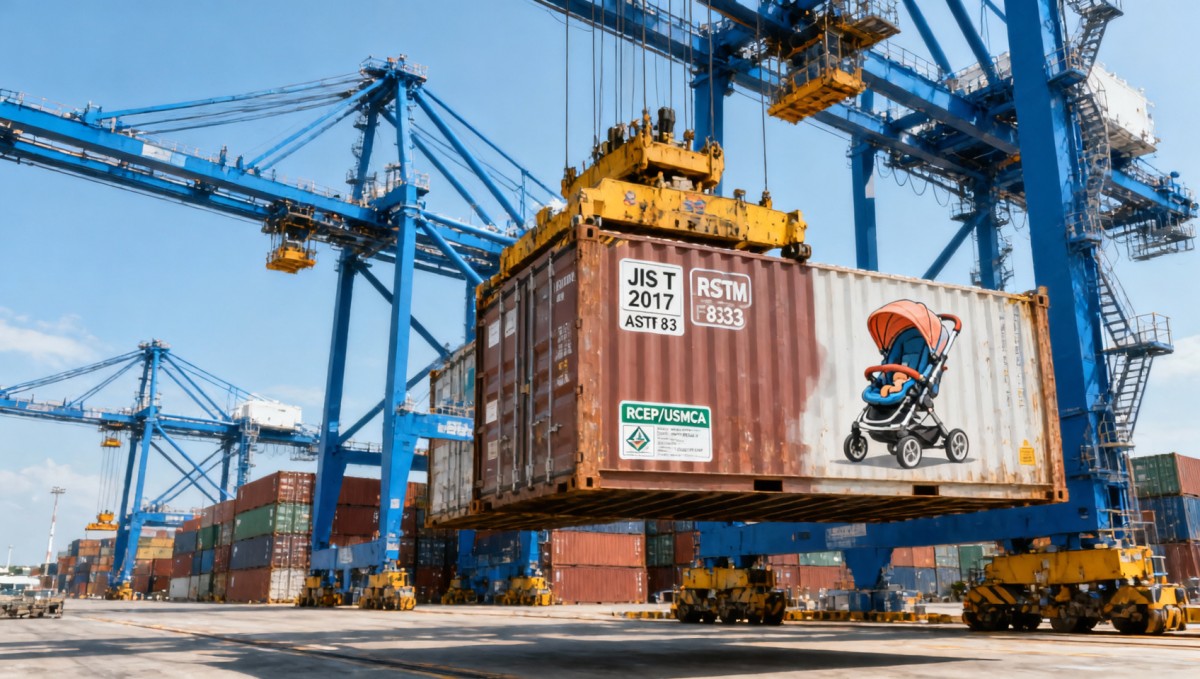
Ningbo Port Group and Ningbo Customs officially launched the ‘Baby Gear & Strollers Green Fast-Check Channel’ on May 17, 2026. For baby strollers, child safety seats, and related infant mobility products destined for Japan or the U.S., exporters presenting valid JIS T 2017 (Japan) or ASTM F833 (U.S.) test reports are eligible for expedited clearance: immediate inspection upon arrival, report verification within 24 hours, and vessel loading completed within 48 hours. The channel has a daily capacity of 300 TEUs and prioritizes shipments covered under RCEP and the U.S.-Mexico-Canada Agreement (USMCA).
Industries Affected
Direct Exporters (Trading Companies): These firms bear primary responsibility for documentation accuracy and regulatory alignment. The fast-check channel reduces average port dwell time by 60–70% compared to standard clearance — significantly lowering demurrage costs and improving order fulfillment predictability, especially for time-sensitive retail cycles (e.g., back-to-school or holiday seasons). However, eligibility is strictly conditional on holding up-to-date, jurisdiction-specific test reports; expired, incomplete, or non-aligned reports disqualify shipments entirely.
Raw Material Suppliers: While not subject to direct customs clearance, upstream suppliers of plastics (e.g., flame-retardant polypropylene), metal chassis components, and harness webbing face heightened traceability demands. Exporters increasingly require material declarations compliant with JIS T 2017 Annex B (restricted substances) or ASTM F833 Section 7 (chemical testing), prompting suppliers to upgrade internal compliance documentation and third-party verification protocols.
Manufacturers (OEM/ODM Factories): Production planning must now synchronize with testing timelines. Since JIS/ASTM reports must be issued prior to shipment, factories need tighter coordination with accredited labs — especially those with JIS-certified scope (e.g., JAB-accredited labs) or CPSC-recognized status for ASTM. Delays in lab turnaround now directly bottleneck port clearance, shifting quality assurance timelines earlier in the supply chain.
Supply Chain Service Providers (Freight Forwarders, Customs Brokers, Testing Labs): Forwarders and brokers must verify report validity (issuing lab accreditation, test scope coverage, issue date) before booking — a new pre-clearance checkpoint. Meanwhile, testing labs with dual JIS/ASTM capability and Ningbo-based reporting infrastructure are seeing increased demand for bundled ‘test + report + port coordination’ packages. Capacity constraints at accredited labs may emerge as adoption scales.
Key Considerations and Recommended Actions
Verify Report Validity Against Jurisdiction-Specific Requirements
Not all JIS or ASTM reports qualify: only those issued by labs accredited under Japan’s JAB (for JIS T 2017) or recognized by the U.S. CPSC (for ASTM F833) are accepted. Reports must explicitly cover the exact product model and configuration being shipped — generic or family-level reports are insufficient.
Align Internal QA Timelines with 24-Hour Verification Window
Exporters should submit complete documentation (including scanned test reports, commercial invoices, packing lists, and product photos) to their customs broker no later than 12 hours after container gate-in. Late submissions forfeit same-day verification and default to standard clearance.
Prioritize RCEP/USMCA Documentation Alongside Test Reports
While the green channel accelerates customs inspection, preferential tariff treatment under RCEP or USMCA requires separate origin certification (e.g., Form REX or USMCA Certificate of Origin). These documents must be prepared concurrently — delays here do not delay inspection but will delay duty savings realization.
Editorial Perspective / Industry Observation
Observably, this initiative is less about broad regulatory relaxation and more about institutional calibration: Ningbo Port is reallocating existing inspection resources toward high-compliance, high-documentation readiness cases. Analysis shows that only ~35% of current baby gear exports from Ningbo meet both the technical (report validity) and procedural (pre-submission timing) thresholds — suggesting near-term uptake will be selective rather than systemic. From an industry perspective, the channel functions best as a ‘compliance premium’ tool: it rewards firms already investing in rigorous pre-shipment testing and documentation discipline. It does not lower standards — it raises the operational cost of non-compliance.
Conclusion
The launch marks a concrete step toward outcome-oriented trade facilitation in infant product logistics — one that ties speed to verifiable compliance, not procedural shortcuts. For the sector, it reinforces a structural shift: competitive advantage increasingly resides not in lowest-cost production, but in integrated regulatory intelligence, lab coordination, and documentation agility. A rational conclusion is that this model may expand to other regulated consumer goods (e.g., toys, children’s apparel) — but only where standardized, jurisdiction-specific test frameworks already exist and are widely adopted.
Source Attribution
Official announcement issued by Ningbo Port Group and Ningbo Customs, May 17, 2026. Confirmed via Ningbo Customs Public Notice No. 2026-021 and Ningbo Port Operational Bulletin Q2-2026. Note: Lab accreditation status verification portals (JAB Database, CPSC Lab Recognition List) and real-time channel utilization metrics remain under development; ongoing monitoring advised.
Related Intelligence
 Skincare OEMAug 16, 2026Amazon Enforces AI Human Metadata Rule for Beauty and Personal Care SellersAmazon now enforces AI human metadata rules for beauty sellers. Learn how to protect listings, traffic, and compliance in skincare, cosmetics, and beauty devices.
 Beauty DevicesAug 15, 2026China to Roll Out Nationwide Cross-Border Cash Pooling for MultinationalsChina to roll out nationwide cross-border cash pooling for multinationals from Sept. 14. Discover how this policy could improve treasury efficiency, liquidity management, and China-linked supply chains.
 Beauty DevicesAug 14, 2026China Imposes Temporary Export Ban on Helium, Affecting Cooling Supply ChainsChina's temporary helium export ban may disrupt cooling supply chains for beauty RF devices and laser systems. Learn what ODMs, buyers, and procurement teams should check now.
![]() Cosmetics & PkgAug 13, 2026PPWR becomes mandatory: Beauty and personal care packaging materials usher in new EPR and PFAS compliance requirementsPPWR takes effect for cosmetics packaging in the EU, bringing EPR registration and PFAS limits. Learn what brands, importers, and suppliers must do now.
Cosmetics & PkgAug 13, 2026PPWR becomes mandatory: Beauty and personal care packaging materials usher in new EPR and PFAS compliance requirementsPPWR takes effect for cosmetics packaging in the EU, bringing EPR registration and PFAS limits. Learn what brands, importers, and suppliers must do now. Cosmetics & PkgAug 12, 2026EU PPWR Now Enforced for Beauty Packaging ComplianceEU PPWR now enforced for beauty packaging compliance: learn how EPR, ERN, heavy metals and PFAS rules affect EU exports, customs clearance and platform sales.
 Cosmetics & PkgAug 11, 2026EU PPWR Rules Take Effect on Aug. 12 for Beauty PackagingEU PPWR rules for beauty packaging take effect on Aug. 12, 2026. Learn key compliance steps, EPR, labeling, PFAS limits, and how to avoid customs delays and fines.
 Smart Pet DevicesAug 10, 2026EU EPR Rules to Cover Smart Pet Devices on Aug. 15EU EPR Rules will cover smart pet devices from Aug. 15, 2026. Learn how smart collars, feeders, and monitoring devices can avoid delisting, customs delays, and compliance risks in the EU.
 Infant Feeding & CareAug 09, 2026CPSC Recalls Baby Sleep Sacks Over Undeclared TDCPPCPSC Recalls Baby Sleep Sacks Over Undeclared TDCPP: learn how this 2026 recall impacts CPC documents, third-party testing, and U.S. baby product compliance for exporters.
 Infant Feeding & CareAug 08, 2026ECHA Adds 5 SVHCs, Importer Notices Due From Oct 2026ECHA adds 5 SVHCs to the Candidate List, with importer notices due from October 2026. Learn how REACH affects exporters, supply chains, and documentation readiness.
 Baby Gear & StrollersAug 07, 2026CPSC Revises Crib Rail Standard for November 2026CPSC revises crib rail standard for November 2026, adding dynamic impact tests and mandatory third-party lab testing. Learn how the new rule affects U.S. market access, compliance, and shipments.
 Electronic & RC ToysAug 06, 2026EU to Require EN IEC 62115:2025 for Electronic ToysEU to Require EN IEC 62115:2025 for Electronic Toys from Oct 1, 2026. Learn scope, battery and AI safety updates, CE compliance risks, and how exporters can avoid customs delays.
 Baby Gear & StrollersAug 05, 2026US Stroller Stability Rule Takes Effect Aug. 15US Stroller Stability Rule Takes Effect Aug. 15: learn how new U.S. stroller compliance, ASTM F833-26a, and CPSC testing rules may affect imports, certification, and shipment readiness.
 Infant Feeding & CareAug 04, 2026ECHA Adds 5 SVHCs, Triggering Baby Care Export ReviewECHA adds 5 SVHCs, prompting an urgent baby care export review for EU-bound products. Learn the 0.1% threshold risks, compliance steps, and how to avoid customs delays and fines.












