Global Li-ion Battery Recycling Rate Hits 62.3%
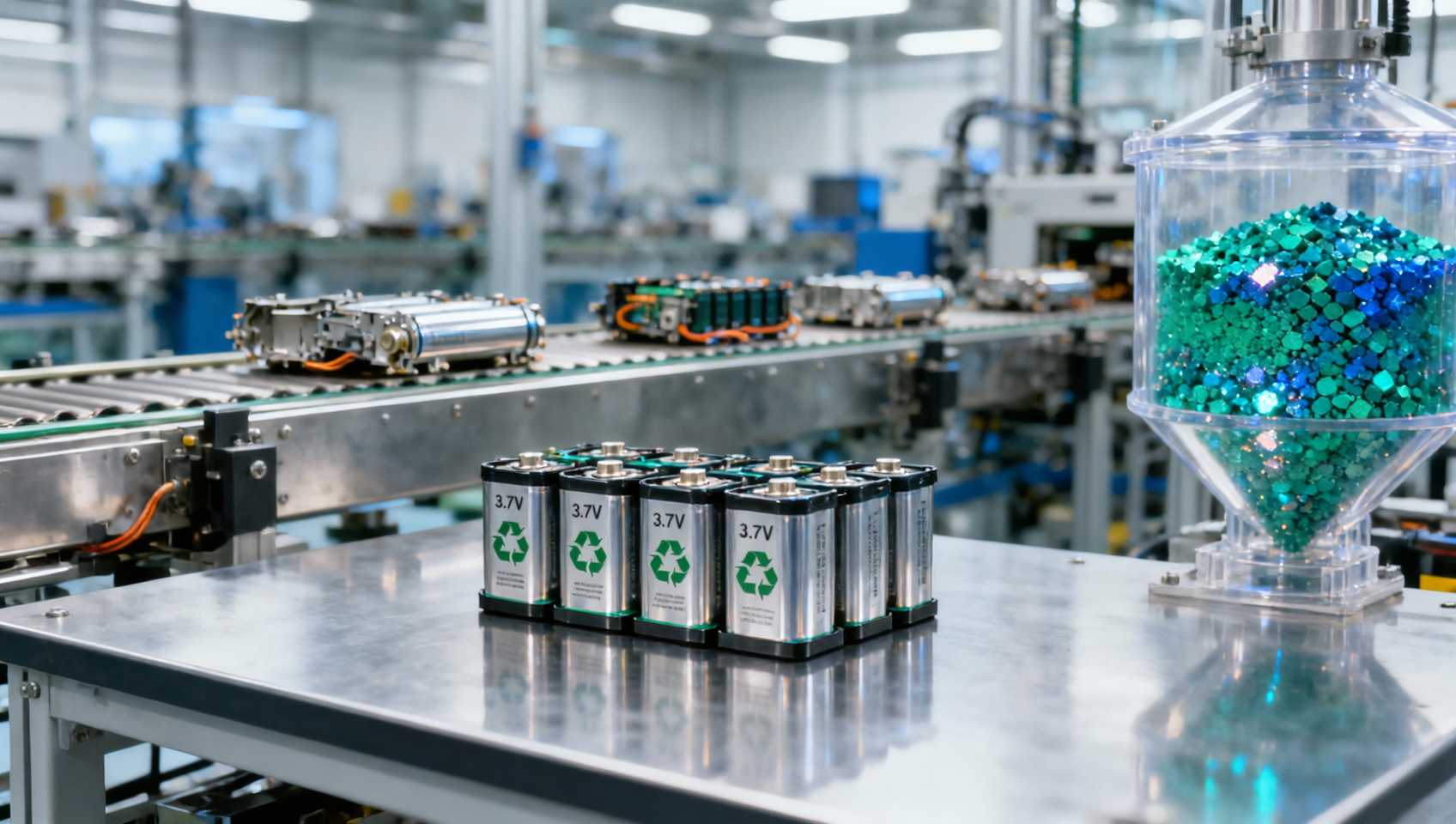
Global lithium-ion battery recycling rate has surpassed 62%, according to the International Battery Association’s (IBA) 2026 Global Lithium Battery Circular Economy Annual Report, released on April 16. This milestone signals tangible progress in circular supply chains — particularly for manufacturers of beauty devices and smart pet devices relying on 3.7V lithium battery modules, whose bill-of-materials (BOM) costs have declined by 9% quarter-on-quarter.
Event Overview
On April 16, the International Battery Association (IBA) published its 2026 Global Lithium Battery Circular Economy Annual Report. The report states that the global end-of-life lithium-ion battery recycling rate reached 62.3%. This recovery effort contributed to a 27% year-on-year increase in supply of regenerated cobalt, nickel, and manganese cathode materials. Chinese manufacturers of beauty devices and smart pet devices reported a 9% reduction in procurement cost for 3.7V lithium battery modules using regenerated cathode materials; some module variants now have lead times shortened to six weeks — supporting timely product launches for European and U.S. customers’ Q3 2024 new models.
Industries Affected
Raw Material Procurement Enterprises
These enterprises are directly exposed to price and availability shifts in regenerated transition metals. With recycled cobalt, nickel, and manganese supplies up 27%, procurement teams may face revised vendor qualification criteria, updated material certification requirements (e.g., traceability documentation for regenerated content), and recalibrated cost-benefit analyses for blended vs. virgin material sourcing.
Electronics Manufacturing Service (EMS) Providers & OEMs
OEMs producing battery-powered personal care or pet-tech hardware benefit from lower BOM costs and shorter lead times. However, integration of regenerated-material-based cells requires verification of cycle life consistency, safety compliance under IEC 62133-2, and potential revalidation of thermal management designs — especially where cell-level specifications differ slightly from prior generations.
Export-Oriented Device Brands (Beauty & Pet-Tech)
Brands targeting North American and European markets gain supply chain elasticity for seasonal product cycles. The six-week lead time enables tighter alignment with Q3 launch windows — but only if logistics, customs clearance, and regional regulatory filings (e.g., EU Battery Regulation Annex II declarations) remain synchronized with accelerated procurement timelines.
Supply Chain Logistics & Certification Service Providers
With rising demand for verified recycled content, third-party auditors and logistics partners handling battery shipments may see increased requests for chain-of-custody documentation, ISO 14001-aligned transport protocols, and battery-specific hazardous goods classification support — particularly for air freight to EU/US destinations.
What Enterprises and Practitioners Should Monitor and Act On
Track official updates on recycled content disclosure frameworks
Current IBA data reflects aggregated industry performance — not mandatory reporting. But the EU Battery Regulation (effective February 2027) will require declared recycled content percentages per battery model. Enterprises should monitor national transposition timelines and begin internal mapping of material flow tracing capabilities.
Assess cost-performance trade-offs for specific battery SKUs
The 9% BOM reduction applies to select 3.7V modules using regenerated cathodes — not across all chemistries or form factors. Procurement and engineering teams should isolate which SKUs qualify, verify cycle count retention versus original specs, and document any design or testing adjustments required.
Align inventory planning with compressed lead times — without overcommitting
A six-week lead time improves responsiveness but also reduces buffer for demand volatility or quality hold-ups. Teams should stress-test reorder triggers, evaluate dual-sourcing feasibility for critical SKUs, and confirm supplier capacity ramp-up plans before scaling orders.
Prepare for upstream traceability requirements
Regenerated material suppliers are increasingly asked to provide origin documentation (e.g., source battery type, collection region, refining route). Forward-looking enterprises should initiate pilot data exchange with top-tier battery module vendors to assess compatibility with ERP or PLM systems.
Editorial Observation / Industry Perspective
This 62.3% recycling rate is best understood as an inflection point — not yet a systemic shift. Analysis来看, it reflects growing infrastructure maturity in key geographies (e.g., China’s licensed smelters, EU pre-collection pilots), but remains heavily concentrated among consumer electronics batteries, not EV traction packs. From industry角度, the 9% BOM cost decline is meaningful but narrow: it applies only to specific voltage-class modules using regenerated NMC-type cathodes, not LFP or high-nickel variants. Current更值得关注的是 whether this trend sustains through H2 2024 — especially as raw material spot prices fluctuate — and whether downstream brands begin labeling or marketing recycled-content claims to end users.
It is more accurately interpreted as an early-stage supply-side signal: evidence that circular inputs can deliver measurable commercial benefits in targeted applications, provided technical and compliance guardrails are in place.
Conclusion
The 62.3% global lithium-ion battery recycling rate marks measurable progress in material circularity — but its immediate impact is selective and conditional. For beauty and pet-tech device makers, it translates into tangible cost and timing advantages for certain battery modules. For the broader supply chain, it underscores the need to treat recycled content not as a compliance checkbox, but as a technically nuanced input requiring verification, integration, and traceability readiness. This development is better understood as a benchmark — not a turning point — and warrants ongoing monitoring rather than strategic pivoting at this stage.
Source Attribution
Main source: International Battery Association (IBA), 2026 Global Lithium Battery Circular Economy Annual Report, published April 16.
Points requiring continued observation: (1) Whether the 62.3% figure includes only commercially operational facilities or also pilot-scale operations; (2) Regional breakdowns of recycling rates beyond aggregate global data; (3) Independent verification of the 27% growth in regenerated material supply.
Related Intelligence
 Infant Feeding & CareApr 17, 2026Canton Fair Phase II 2026 Focuses on Health ConsumptionCanton Fair Phase II 2026 highlights surging global demand for Health Consumption—Infant Feeding & Care, Beauty Devices, and Camping & Water lead buyer pre-registrations.
 Smart Pet DevicesApr 17, 2026JIS T 0901:2026 Enforces 3m Drop & Salt Spray for Pet Smart CollarsJIS T 0901:2026 mandates 3m drop & salt spray tests for pet smart collars — critical for Japan market access. Learn compliance steps, impact on exporters, and urgent actions.
 Nursery Furniture & MonitorsApr 17, 2026Vietnam Requires ISO 13485 for Imported Used Baby Beds from July 2026ISO 13485 required for imported used baby beds in Vietnam from July 2026 — critical for exporters, OEMs & retailers. Act now to ensure compliance and market access.
 Corporate & Seasonal GiftsApr 17, 2026TÜV Rheinland Launches Green Gift Packaging Certification in ShenzhenGreen Gift Packaging certification by TÜV Rheinland in Shenzhen unlocks 18% price premiums & Amazon EU visibility — act now to meet EU retail sustainability demands.
 Camping & WaterApr 17, 2026CPSC Targets Chinese Camping Water Bladders for TPU Cold-Resistance ChecksCPSC targets Chinese camping water bladders for TPU cold-resistance checks — verify ASTM F2332-23 compliance now to avoid recalls, delays & reputational risk.
 Beauty DevicesApr 17, 2026Global Li-ion Battery Recycling Rate Hits 62.3%Li-ion battery recycling rate hits 62.3% — discover how beauty & pet-tech brands cut BOM costs by 9% and shorten lead times to 6 weeks with regenerated cathode materials.
 STEM & Educational ToysApr 17, 2026SASO ISO 8124-1:2026 Enforced for STEM Toys in Saudi ArabiaSASO ISO 8124-1:2026 now mandates IEC 61000-4-3 EMC testing for AI voice–enabled STEM toys entering Saudi Arabia — secure SABER clearance fast with SASO-recognized labs.
 Fitness EquipmentApr 17, 2026RCEP Cuts China Fitness Equipment Tariffs to 2.8% in Vietnam, Thailand, MalaysiaRCEP cuts China fitness equipment tariffs to 2.8% in Vietnam, Thailand & Malaysia—boosting margins and slashing lead times to 8–10 weeks. Act now!
 Skincare OEMApr 17, 2026FDA VCRP Electronic System Mandatory from April 16, 2026FDA VCRP electronic system becomes mandatory April 16, 2026 — register cosmetics & packaging now to ensure U.S. market access, Amazon listing, and FDA compliance.
 Baby Gear & StrollersApr 17, 2026EU Ban on PFAS in Children's Products Takes Effect Apr 17, 2026EU PFAS ban on children's products takes effect Apr 17, 2026 — impact on strollers, pacifiers, feeding gear & infant monitors. Act now to ensure compliance.
 Infant Feeding & CareApr 16, 2026Potty training seat OEM: why non-slip base patterns differ by regionPotty training seat OEM solutions with region-specific non-slip bases—plus diaper changing pad wholesale, baby safety gates wholesale & more. Get compliant, scalable sourcing now.
 Baby Gear & StrollersApr 16, 2026Baby safety gates wholesale: hinge fatigue after 5,000+ open/close cyclesBaby safety gates wholesale with hinge fatigue tested to 7,500+ cycles—plus cabinet locks, corner protectors, bamboo washcloths & more certified baby proofing essentials.
 Baby Gear & StrollersApr 16, 2026Corner protectors for babies: silicone vs. TPE performance in high-humidity zonesCorner protectors for babies: Compare silicone vs. TPE durability in humid climates—critical for cabinet locks baby proofing, baby safety gates wholesale & more.