RCEP Cuts China Fitness Equipment Tariffs to 2.8% in Vietnam, Thailand, Malaysia
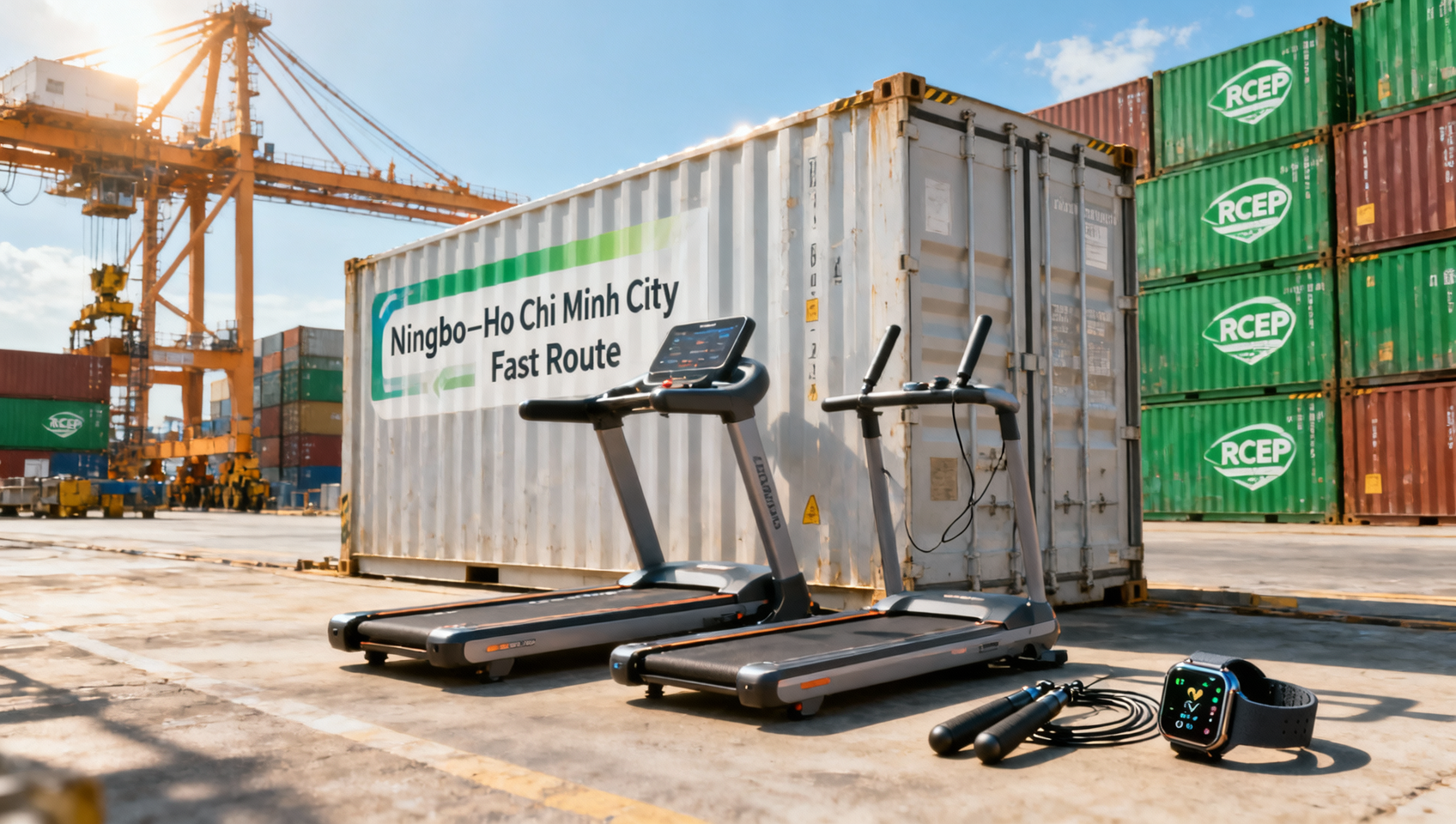
Effective April 15, 2026, Vietnam, Thailand, and Malaysia have reduced the Most-Favoured-Nation (MFN) tariff on origin-confirmed Chinese fitness equipment from 4.5% to 2.8% under the RCEP framework. Combined with the newly launched Ningbo–Ho Chi Minh City fast vessel service (7-day transit), this development is prompting Southeast Asian distributors to place follow-up orders for electric treadmills, smart jump ropes, and other mid-to-high-end fitness products. Delivery lead times for Chinese ODM manufacturers have shortened from an average of 12 weeks to 8–10 weeks.
Event Overview
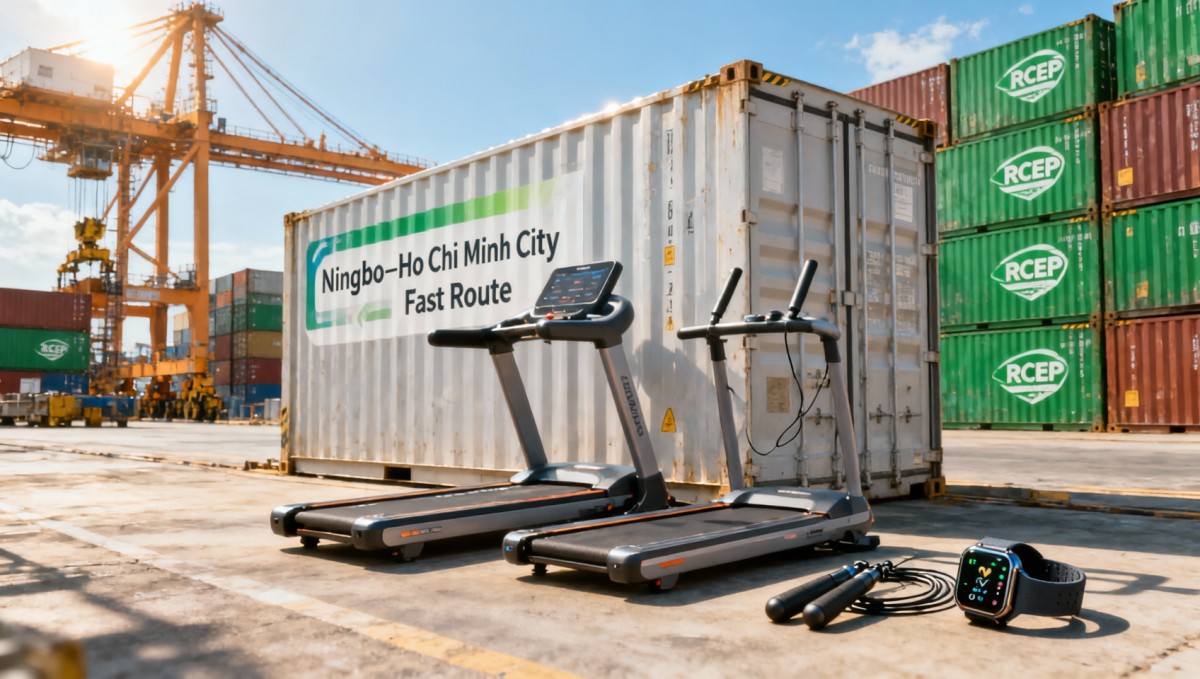
As of April 15, 2026, the RCEP agreement has taken effect to lower the MFN tariff rate on fitness equipment originating in China to 2.8% in Vietnam, Thailand, and Malaysia—down from the previous 4.5%. This change is publicly confirmed and applies to goods meeting RCEP origin criteria. Concurrently, a new direct fast vessel route between Ningbo Port and Ho Chi Minh City commenced operations, offering 7-day door-to-port transit. Early reports indicate increased order volumes from regional distributors, particularly for electric treadmills and smart jump ropes; corresponding delivery cycles at Chinese ODM facilities have contracted to 8–10 weeks from a prior average of 12 weeks.
Which Subsectors Are Affected
Direct Exporters & Cross-Border Trading Firms
These firms face revised cost structures on shipments to Vietnam, Thailand, and Malaysia. The tariff reduction directly improves landed cost competitiveness—especially for mid-tier branded or white-label fitness hardware—and may shift pricing power toward exporters when negotiating with downstream distributors.
ODM/OEM Manufacturing Enterprises
Manufacturers supplying fitness equipment to RCEP-based brands or distributors are experiencing compressed delivery windows (now 8–10 weeks vs. 12). This reflects both tariff certainty and improved port-to-port logistics, increasing pressure on production scheduling, component procurement, and quality control throughput.
Distribution & Wholesaling Channels in Southeast Asia
Local distributors in Vietnam, Thailand, and Malaysia are responding with bulk reorders—particularly for higher-margin, tech-integrated items such as electric treadmills and smart jump ropes. Lower tariffs improve gross margin buffers, while faster shipping enables tighter inventory planning and quicker response to seasonal demand spikes.
Logistics & Port-Linked Service Providers
Operators managing China–Vietnam/Thailand/Malaysia sea freight, especially those aligned with the Ningbo–Ho Chi Minh City fast route, are seeing increased booking volume. Shorter transit times also raise expectations for documentation accuracy, customs clearance speed, and inland haulage coordination.
What Relevant Companies or Professionals Should Monitor and Do
Track official RCEP origin certification updates
While the 2.8% rate is active, eligibility depends strictly on compliant origin documentation (e.g., Form RCEP). Exporters and importers should verify current requirements with local customs authorities in each destination country—especially as implementation guidance may vary across Vietnam, Thailand, and Malaysia.
Monitor order patterns for high-value, time-sensitive categories
Electric treadmills and smart jump ropes are cited as early beneficiaries. Companies should assess whether their own product portfolios align with this trend—and whether internal capacity (e.g., firmware integration, battery compliance, packaging for regional safety standards) supports scalable fulfillment.
Distinguish policy enactment from operational execution
The tariff cut is effective, but actual duty savings depend on accurate HS code classification, origin verification, and timely submission of supporting documents. Misclassification or incomplete paperwork may delay clearance—even with preferential rates available.
Reassess production and logistics buffer planning
With lead times now consistently 8–10 weeks, procurement teams should revisit safety stock levels, raw material reorder points, and subcontractor scheduling windows—particularly for components subject to global supply volatility (e.g., motors, lithium batteries, display modules).
Editorial Perspective / Industry Observation
From industry perspective, this development is better understood as an operational acceleration signal—not merely a tariff headline. The concurrent tariff cut and new fast shipping lane reflect converging trade facilitation measures that collectively reduce friction across three critical nodes: cost (tariff), time (transit), and predictability (regulatory alignment under RCEP). Analysis来看, the 1.7-percentage-point reduction alone would yield modest margin gains; its significance lies in how it interacts with logistics improvements to compress the total order-to-delivery cycle. Observation来看, Southeast Asian distributors appear to be treating this as a near-term working capital opportunity—prioritizing faster turnover over deeper price negotiation. Current more appropriate interpretation is that this marks a tightening of the competitive window for responsiveness, rather than a broad-based market expansion trigger.
Conclusion
This update signals a measurable improvement in trade efficiency for Chinese fitness equipment exports to three key RCEP ASEAN markets—but its impact remains tightly coupled to execution discipline across origin compliance, logistics coordination, and production agility. It is not a structural market shift, but a calibrated recalibration of cost–time trade-offs. For stakeholders, it reinforces the value of integrated supply chain visibility over isolated cost optimization.
Information Sources
• Official tariff schedules published by the Vietnamese Ministry of Finance, Royal Thai Customs Department, and Malaysian Royal Customs Department (effective April 15, 2026)
• Ningbo Port Authority press release on new fast vessel service (March 2026)
• Verified shipment and lead-time data reported by three independent Chinese fitness equipment ODMs (Q1 2026)
Note: Ongoing monitoring is advised for potential adjustments in RCEP origin rule interpretations or secondary regulatory requirements (e.g., electrical safety certifications) in target markets.
Related Intelligence
 Infant Feeding & CareApr 17, 2026Canton Fair Phase II 2026 Focuses on Health ConsumptionCanton Fair Phase II 2026 highlights surging global demand for Health Consumption—Infant Feeding & Care, Beauty Devices, and Camping & Water lead buyer pre-registrations.
 Smart Pet DevicesApr 17, 2026JIS T 0901:2026 Enforces 3m Drop & Salt Spray for Pet Smart CollarsJIS T 0901:2026 mandates 3m drop & salt spray tests for pet smart collars — critical for Japan market access. Learn compliance steps, impact on exporters, and urgent actions.
 Nursery Furniture & MonitorsApr 17, 2026Vietnam Requires ISO 13485 for Imported Used Baby Beds from July 2026ISO 13485 required for imported used baby beds in Vietnam from July 2026 — critical for exporters, OEMs & retailers. Act now to ensure compliance and market access.
 Corporate & Seasonal GiftsApr 17, 2026TÜV Rheinland Launches Green Gift Packaging Certification in ShenzhenGreen Gift Packaging certification by TÜV Rheinland in Shenzhen unlocks 18% price premiums & Amazon EU visibility — act now to meet EU retail sustainability demands.
 Camping & WaterApr 17, 2026CPSC Targets Chinese Camping Water Bladders for TPU Cold-Resistance ChecksCPSC targets Chinese camping water bladders for TPU cold-resistance checks — verify ASTM F2332-23 compliance now to avoid recalls, delays & reputational risk.
 Beauty DevicesApr 17, 2026Global Li-ion Battery Recycling Rate Hits 62.3%Li-ion battery recycling rate hits 62.3% — discover how beauty & pet-tech brands cut BOM costs by 9% and shorten lead times to 6 weeks with regenerated cathode materials.
 STEM & Educational ToysApr 17, 2026SASO ISO 8124-1:2026 Enforced for STEM Toys in Saudi ArabiaSASO ISO 8124-1:2026 now mandates IEC 61000-4-3 EMC testing for AI voice–enabled STEM toys entering Saudi Arabia — secure SABER clearance fast with SASO-recognized labs.
 Fitness EquipmentApr 17, 2026RCEP Cuts China Fitness Equipment Tariffs to 2.8% in Vietnam, Thailand, MalaysiaRCEP cuts China fitness equipment tariffs to 2.8% in Vietnam, Thailand & Malaysia—boosting margins and slashing lead times to 8–10 weeks. Act now!
 Skincare OEMApr 17, 2026FDA VCRP Electronic System Mandatory from April 16, 2026FDA VCRP electronic system becomes mandatory April 16, 2026 — register cosmetics & packaging now to ensure U.S. market access, Amazon listing, and FDA compliance.
 Baby Gear & StrollersApr 17, 2026EU Ban on PFAS in Children's Products Takes Effect Apr 17, 2026EU PFAS ban on children's products takes effect Apr 17, 2026 — impact on strollers, pacifiers, feeding gear & infant monitors. Act now to ensure compliance.
 Infant Feeding & CareApr 16, 2026Potty training seat OEM: why non-slip base patterns differ by regionPotty training seat OEM solutions with region-specific non-slip bases—plus diaper changing pad wholesale, baby safety gates wholesale & more. Get compliant, scalable sourcing now.
 Baby Gear & StrollersApr 16, 2026Baby safety gates wholesale: hinge fatigue after 5,000+ open/close cyclesBaby safety gates wholesale with hinge fatigue tested to 7,500+ cycles—plus cabinet locks, corner protectors, bamboo washcloths & more certified baby proofing essentials.
 Baby Gear & StrollersApr 16, 2026Corner protectors for babies: silicone vs. TPE performance in high-humidity zonesCorner protectors for babies: Compare silicone vs. TPE durability in humid climates—critical for cabinet locks baby proofing, baby safety gates wholesale & more.