TÜV Rheinland Launches Green Gift Packaging Certification in Shenzhen
On April 15, 2026, TÜV Rheinland launched its ‘Green Gift Packaging’ certification service in Shenzhen, China — a development with direct implications for Corporate & Seasonal Gifts OEMs, packaging material suppliers, and export-focused retail channel operators targeting premium European markets.
Event Overview
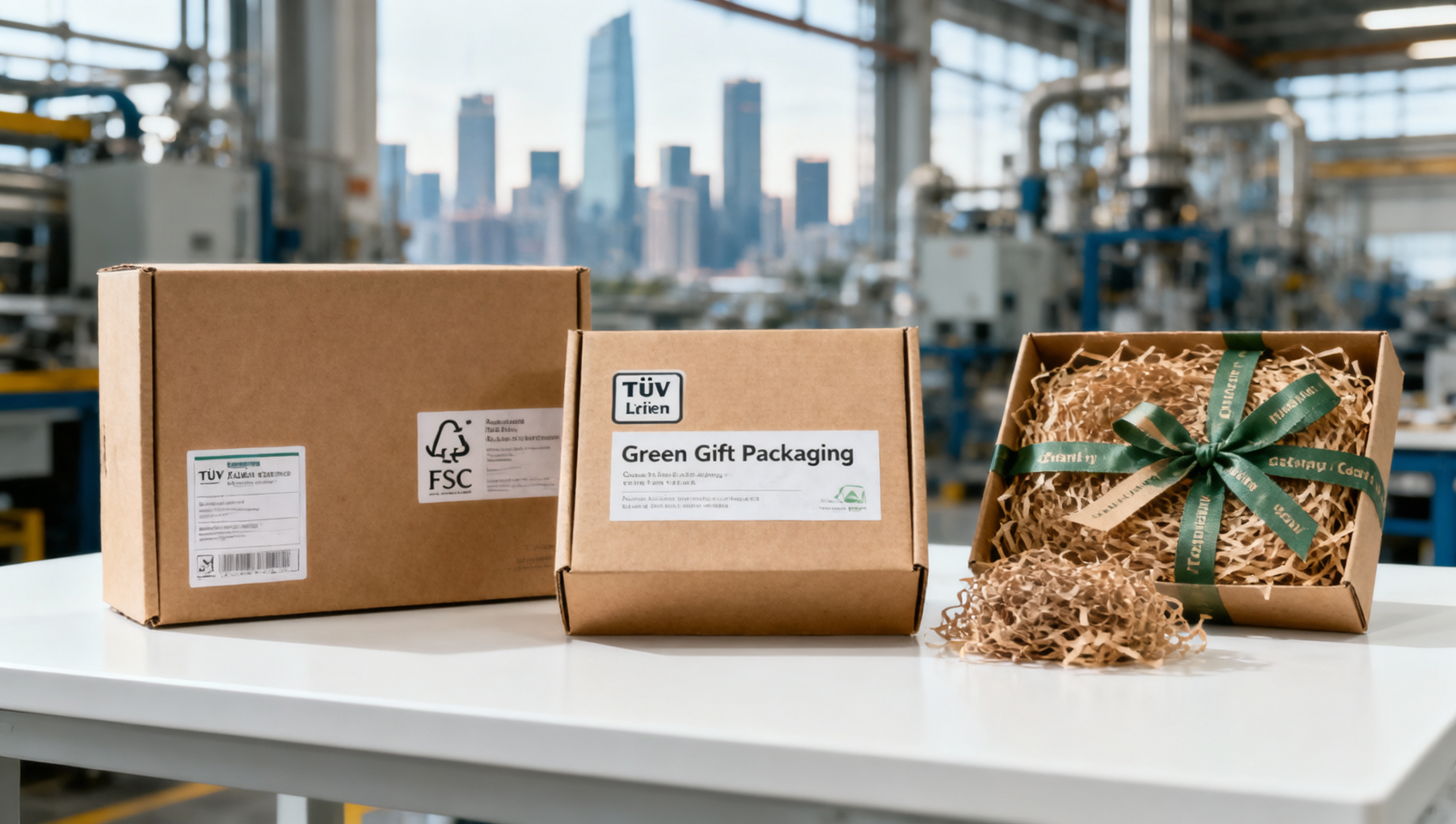
TÜV Rheinland officially initiated its ‘Green Gift Packaging’ certification service on April 15, 2026, in Shenzhen. The program evaluates packaging against 12 defined criteria, including biodegradable inks, FSC-certified paperboard, and plastic-free lamination. Certified products gain eligibility for an 18% average price premium in high-end supermarket channels across Germany and the Netherlands, as well as priority visibility under Amazon’s ‘Climate Pledge Friendly’ label. Chinese OEM manufacturers serving the Corporate & Seasonal Gifts segment have begun submitting initial certification applications.
Which Sub-Sectors Are Affected
Direct Exporters & Brand Owners (Corporate & Seasonal Gifts OEMs)
These firms face new upstream compliance expectations when supplying to EU-based retailers or Amazon EU marketplaces. The certification is not mandatory but functions as a de facto commercial differentiator: without it, access to premium shelf placement and pricing uplift may be constrained in key Western European retail environments.
Packaging Material Suppliers
Suppliers of paperboard, inks, laminates, and adhesives are affected because the 12-point criteria explicitly reference input-level attributes — e.g., FSC chain-of-custody documentation, third-party verification of ink biodegradability, and absence of polyethylene-based coatings. Demand for compliant inputs may shift procurement patterns toward pre-qualified vendors.
Contract Packaging & Secondary Packaging Converters
Manufacturers performing printing, die-cutting, folding, or assembly must verify that all process steps — including surface treatments and finishing — align with the certification’s technical scope. This includes validating that no non-compliant films or varnishes are introduced during final production.
Retail Channel Operators & E-commerce Enablers
EU-based importers, private-label distributors, and Amazon sellers sourcing from China now have a standardized, third-party-verified benchmark to assess packaging sustainability claims. The certification simplifies due diligence for platforms requiring ‘Climate Pledge Friendly’ eligibility — particularly where internal sustainability audits lack scalability.
What Relevant Enterprises or Practitioners Should Focus On — And How to Respond
Monitor official scope documents and audit protocols
The current announcement confirms 12 criteria but does not publish full test methods or sampling requirements. Enterprises should track TÜV Rheinland’s official updates for technical annexes — especially regarding verification timelines, acceptable test labs, and whether self-declaration is permitted for any sub-criteria.
Assess exposure by destination market and channel
The 18% premium applies specifically to German and Dutch high-end supermarkets; no data is provided for France, Italy, or other EU countries. Similarly, Amazon’s ‘Climate Pledge Friendly’ priority applies to EU storefronts — not US or JP. Companies should map current shipments by country and sales channel before prioritizing certification investment.
Distinguish between signal and operational readiness
This launch signals growing retailer-level pressure on packaging sustainability — but it does not indicate imminent regulatory mandates. From industry perspective, it reflects voluntary commercial alignment rather than compliance necessity. Firms should avoid treating certification as a substitute for broader EPR or PPWR preparedness.
Review supplier documentation and traceability systems now
Because certification requires evidence for inputs (e.g., FSC certificates, ink toxicity reports), OEMs should begin auditing their Tier-1 packaging suppliers’ documentation completeness. Gaps in traceability — such as missing batch-level FSC transaction certificates — may delay application processing even if materials are technically compliant.
Editorial Perspective / Industry Observation
Analysis来看, this initiative is best understood as a market-led standardization effort — not a regulatory requirement nor a universally applicable sustainability framework. It consolidates existing environmental claims into a single, retailer-recognized verification pathway, lowering verification friction for buyers but raising evidentiary thresholds for suppliers. From industry angle, its significance lies less in novelty and more in timing: it arrives amid tightening EU due diligence expectations (e.g., CSDDD implementation) and increasing buyer requests for auditable packaging data. Current more appropriate interpretation is that it serves as an early indicator of how sustainability assurance may become embedded in B2B commercial terms — especially for mid-tier OEMs without in-house sustainability teams.
Conclusion
This certification does not change legal obligations, but it does reshape competitive dynamics in specific export corridors. Its immediate value is transactional — enabling price premiums and digital shelf advantages in defined markets — rather than strategic or systemic. For affected firms, the most rational stance is pragmatic evaluation: assess whether target customers or channels explicitly reference or incentivize this certification before committing resources. It is not yet a baseline requirement — but it is becoming a visible differentiator in selective, high-value segments.
Information Source
Main source: Official announcement by TÜV Rheinland regarding the April 15, 2026 launch of ‘Green Gift Packaging’ certification in Shenzhen. No additional background data, policy context, or third-party validation has been confirmed or cited. Ongoing observation is recommended for updates on certification fees, audit frequency, and geographic expansion beyond Germany/Netherlands/Amazon EU.
Related Intelligence
 Infant Feeding & CareApr 17, 2026Canton Fair Phase II 2026 Focuses on Health ConsumptionCanton Fair Phase II 2026 highlights surging global demand for Health Consumption—Infant Feeding & Care, Beauty Devices, and Camping & Water lead buyer pre-registrations.
 Smart Pet DevicesApr 17, 2026JIS T 0901:2026 Enforces 3m Drop & Salt Spray for Pet Smart CollarsJIS T 0901:2026 mandates 3m drop & salt spray tests for pet smart collars — critical for Japan market access. Learn compliance steps, impact on exporters, and urgent actions.
 Nursery Furniture & MonitorsApr 17, 2026Vietnam Requires ISO 13485 for Imported Used Baby Beds from July 2026ISO 13485 required for imported used baby beds in Vietnam from July 2026 — critical for exporters, OEMs & retailers. Act now to ensure compliance and market access.
 Corporate & Seasonal GiftsApr 17, 2026TÜV Rheinland Launches Green Gift Packaging Certification in ShenzhenGreen Gift Packaging certification by TÜV Rheinland in Shenzhen unlocks 18% price premiums & Amazon EU visibility — act now to meet EU retail sustainability demands.
 Camping & WaterApr 17, 2026CPSC Targets Chinese Camping Water Bladders for TPU Cold-Resistance ChecksCPSC targets Chinese camping water bladders for TPU cold-resistance checks — verify ASTM F2332-23 compliance now to avoid recalls, delays & reputational risk.
 Beauty DevicesApr 17, 2026Global Li-ion Battery Recycling Rate Hits 62.3%Li-ion battery recycling rate hits 62.3% — discover how beauty & pet-tech brands cut BOM costs by 9% and shorten lead times to 6 weeks with regenerated cathode materials.
 STEM & Educational ToysApr 17, 2026SASO ISO 8124-1:2026 Enforced for STEM Toys in Saudi ArabiaSASO ISO 8124-1:2026 now mandates IEC 61000-4-3 EMC testing for AI voice–enabled STEM toys entering Saudi Arabia — secure SABER clearance fast with SASO-recognized labs.
 Fitness EquipmentApr 17, 2026RCEP Cuts China Fitness Equipment Tariffs to 2.8% in Vietnam, Thailand, MalaysiaRCEP cuts China fitness equipment tariffs to 2.8% in Vietnam, Thailand & Malaysia—boosting margins and slashing lead times to 8–10 weeks. Act now!
 Skincare OEMApr 17, 2026FDA VCRP Electronic System Mandatory from April 16, 2026FDA VCRP electronic system becomes mandatory April 16, 2026 — register cosmetics & packaging now to ensure U.S. market access, Amazon listing, and FDA compliance.
 Baby Gear & StrollersApr 17, 2026EU Ban on PFAS in Children's Products Takes Effect Apr 17, 2026EU PFAS ban on children's products takes effect Apr 17, 2026 — impact on strollers, pacifiers, feeding gear & infant monitors. Act now to ensure compliance.
 Infant Feeding & CareApr 16, 2026Potty training seat OEM: why non-slip base patterns differ by regionPotty training seat OEM solutions with region-specific non-slip bases—plus diaper changing pad wholesale, baby safety gates wholesale & more. Get compliant, scalable sourcing now.
 Baby Gear & StrollersApr 16, 2026Baby safety gates wholesale: hinge fatigue after 5,000+ open/close cyclesBaby safety gates wholesale with hinge fatigue tested to 7,500+ cycles—plus cabinet locks, corner protectors, bamboo washcloths & more certified baby proofing essentials.
 Baby Gear & StrollersApr 16, 2026Corner protectors for babies: silicone vs. TPE performance in high-humidity zonesCorner protectors for babies: Compare silicone vs. TPE durability in humid climates—critical for cabinet locks baby proofing, baby safety gates wholesale & more.