SASO Launches 24-Hour AI Module Certification for STEM Toys in Saudi Arabia
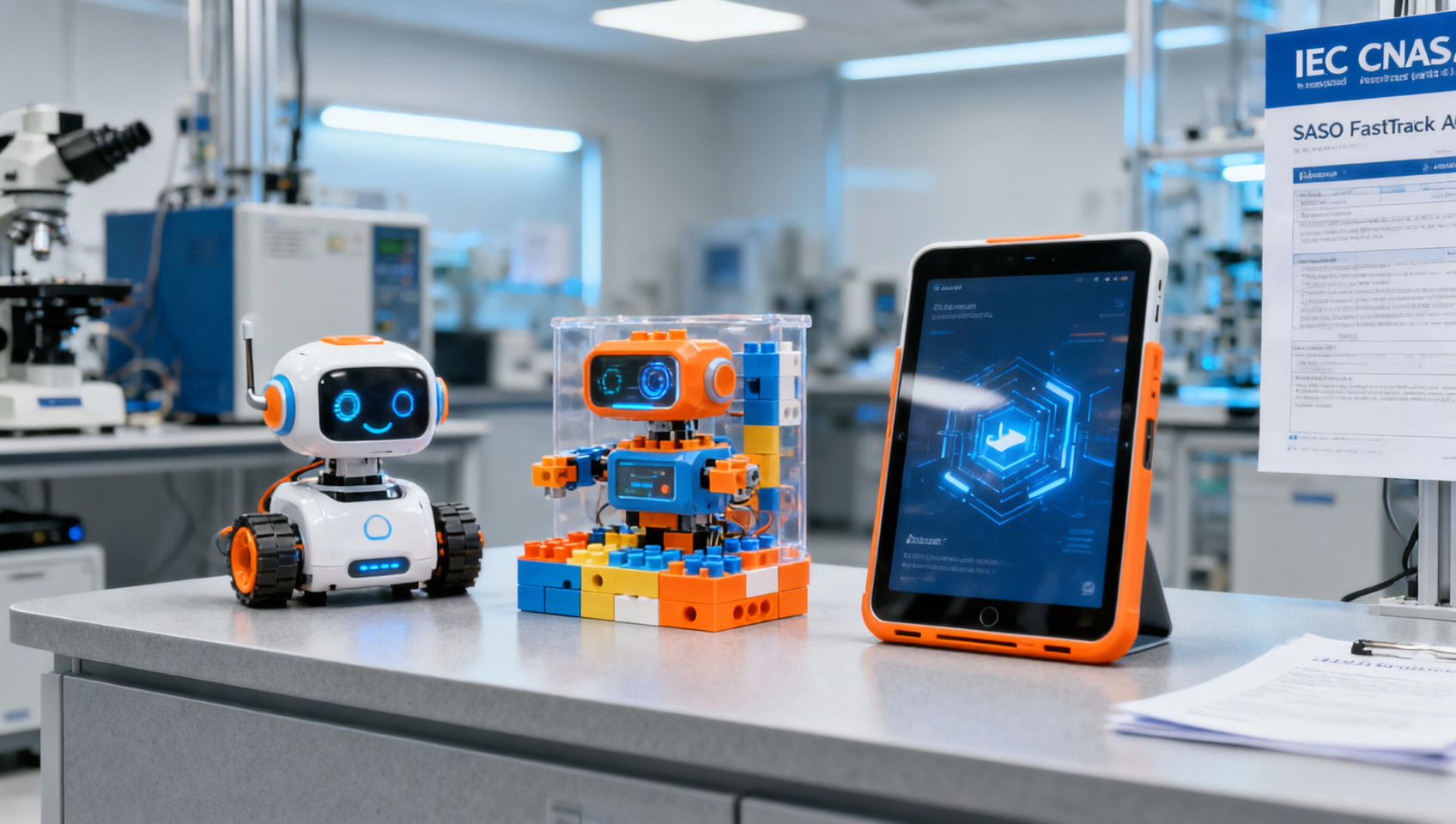
Saudi Arabia’s Standards, Metrology and Quality Organization (SASO) announced on April 20, 2026, the launch of a ‘FastTrack AI’ certification channel for STEM educational toys featuring AI-powered voice interaction and image recognition. This initiative compresses the full certification timeline—from submission to certificate issuance—to just 24 hours. The channel is exclusively available to suppliers whose test reports are issued by China National Accreditation Service (CNAS)-accredited laboratories and cover both IEC 62368-1 and the supplementary IEC 62115-2 requirements. Exporters targeting the Middle East—particularly manufacturers and trade service providers handling AI-integrated children’s learning products—should monitor this development closely, as it directly affects time-to-market, compliance workflows, and regional competitiveness.
Event Overview
On April 20, 2026, SASO introduced the ‘FastTrack AI’ certification pathway for STEM toys incorporating AI functionalities such as voice interaction and image recognition. Under this pathway, certification is completed within 24 hours from submission, provided the applicant submits a valid test report conforming to IEC 62368-1 and IEC 62115-2, issued by a laboratory accredited by China’s CNAS. No further details regarding eligibility criteria, fees, or application interface have been publicly released as of the announcement date.
Industries Affected
Direct Exporters and Trade Enterprises
These businesses face immediate implications for market entry timing and documentation alignment. The 24-hour window applies only when pre-submission testing fully satisfies SASO’s technical requirements—meaning any deviation in report scope, lab accreditation status, or standard version may disqualify an application. Delays will revert to standard processing timelines, potentially offsetting the FastTrack benefit.
Manufacturers of AI-Enabled STEM Toys
Producers must ensure their product design, firmware behavior, and labeling comply with both IEC 62368-1 (audio/video/ICT safety) and IEC 62115-2 (supplementary requirements for smart toy functions). Since the FastTrack channel does not relax technical thresholds—only accelerates administrative review—non-compliant units risk rejection despite expedited submission.
Testing and Certification Service Providers
Laboratories accredited by CNAS—and those seeking alignment with SASO’s new pathway—must verify that their IEC 62115-2 testing protocols explicitly cover AI-specific hazards (e.g., unintended voice activation, data handling during recognition, response latency under network fluctuation). Absent documented coverage of these aspects, reports may be deemed insufficient even if technically labeled as compliant.
Supply Chain and Compliance Coordination Teams
Internal teams managing cross-border regulatory handoffs must now synchronize test planning, report generation, and SASO submission with tighter precision. A mismatch between lab report issuance date, translation accuracy, or document formatting could invalidate FastTrack eligibility—making version control and pre-submission validation essential.
What Stakeholders Should Monitor and Do Now
Track official SASO guidance on implementation scope
Current information confirms eligibility criteria but lacks operational detail—for example, whether the 24-hour clock starts upon upload completion, payment confirmation, or initial system validation. Stakeholders should subscribe to SASO’s official notifications and monitor updates on its e-platform (Saber) for clarifications.
Verify CNAS lab capability for IEC 62115-2 AI-specific testing
Not all CNAS-accredited labs currently perform IEC 62115-2 assessments covering AI modules. Suppliers should request written confirmation from their lab that test reports include explicit evaluation of speech recognition reliability, visual processing boundaries, and fail-safe behaviors—per clause 22.3 and Annex D of IEC 62115-2:2023.
Distinguish policy signal from operational readiness
The FastTrack AI channel signals SASO’s prioritization of intelligent educational products—but does not indicate broader regulatory simplification. It remains limited to a narrow product category and strict preconditions. Companies should avoid extrapolating this to other toy types or general electronics certification pathways.
Prepare documentation templates aligned with Saber platform requirements
Since FastTrack relies on error-free first submission, stakeholders should pre-validate Arabic translations of user manuals, safety warnings, and technical summaries against SASO’s published Saber checklist. Any inconsistency—even in punctuation or unit notation—may trigger manual review and exit from the 24-hour flow.
Editorial Observation / Industry Perspective
From an industry perspective, this move is best understood as a targeted process optimization—not a regulatory relaxation. SASO is streamlining administrative throughput for a high-priority, well-defined segment: AI-enhanced STEM toys tested under a specific bilateral recognition framework (CNAS–SASO). Analysis来看, the 24-hour claim reflects internal workflow automation rather than reduced technical scrutiny. Observation来看, the restriction to CNAS-issued reports suggests an initial phase focused on quality-controlled data inputs, likely to expand only after performance metrics and fraud prevention mechanisms are validated. Current more appropriate interpretation is that this is a pilot-grade efficiency measure—valuable for qualified applicants, but not yet indicative of systemic certification reform across consumer electronics or general toy categories.
In summary, SASO’s FastTrack AI certification represents a meaningful reduction in administrative lead time for a narrowly defined product class—but one that demands rigorous upstream preparation. Its significance lies less in broad regulatory change and more in reinforcing the growing importance of standardized, internationally recognized test evidence in Gulf markets. For affected stakeholders, the most rational stance is to treat this as a time-sensitive opportunity requiring precise execution—not a structural shift in compliance strategy.
Source: Official announcement by Saudi Standards, Metrology and Quality Organization (SASO), dated April 20, 2026. Note: Details on fee structure, Saber integration timeline, and eligibility verification procedures remain pending official publication and are subject to ongoing observation.
Related Intelligence
 Cosmetics & PkgApr 21, 2026SAMR Penalizes 7 Platforms for 'Ghost Kitchen' Packaging ViolationsSAMR penalizes 7 platforms for 'ghost kitchen' packaging violations—key alert for food packaging exporters, converters & brands on licensing compliance.
 Cosmetics & PkgApr 21, 2026EU EPR Dual-Country Registration Effective for Beauty PackagingEU EPR Dual-Country Registration is now live for beauty packaging in France & Germany — act now to avoid shipment delays, fees, and customs holds.
 Cosmetics & PkgApr 21, 2026FDA MoCRA Rule: Cosmetic Packaging Must File Separate VCRPFDA MoCRA Rule requires cosmetic packaging—vacuum bottles, pumps, tubes—to file separate VCRP registration by April 17, 2026. Stay compliant & avoid shipment delays!
 Beauty DevicesApr 21, 2026Global Li-ion Recycling Rate Hits 62%; Beauty Device Battery Costs Down 9%Li-ion recycling rate hits 62%—driving 9% lower battery costs for beauty devices. Discover how ODMs, suppliers & logistics teams gain cost, speed & compliance advantages.
 Nursery Furniture & MonitorsApr 21, 2026Canton Fair Phase III: Infant Monitor Inquiries Surge, EN60601-1-12 Gains Traction in Middle EastEN60601-1-12:2023 compliance surges at Canton Fair Phase III — Middle East buyers demand certified infant monitors for clinical-grade home use.
 Smart Pet DevicesApr 21, 2026Vietnam Mandates ISO 13485 & Vietnamese Instructions for Smart Pet CollarsVietnam mandates ISO 13485 & Vietnamese instructions for smart pet collars—key compliance update for exporters, importers, and tech documentation providers.
 Infant Feeding & CareApr 21, 2026JETRO Spring 2026: Blockchain Batch Code Mandatory for Infant Silicone Feeding ProductsBlockchain batch code mandatory for infant silicone feeding products in Japan from Apr 18, 2026—ensure JP-Trace compliance now to avoid port detention & shipment delays.
 STEM & Educational ToysApr 21, 2026SASO Launches 24-Hour AI Module Certification for STEM Toys in Saudi ArabiaSASO FastTrack AI certification for STEM toys: Get SASO AI module certification in just 24 hours—exclusively for CNAS-tested, IEC-compliant smart educational toys.
 Corporate & Seasonal GiftsApr 21, 2026TÜV Germany Enforces LCA Carbon Heatmaps for Gift PackagingLCA carbon heatmaps now mandatory for gift packaging in Germany—TÜV Germany enforces ISO-compliant lifecycle assessments from April 2026. Act now to avoid delisting.
 Camping & WaterApr 21, 2026RCEP Cuts Tariff on Camping Water Bags to Indonesia by 0.8%RCEP cuts tariff on camping water bags to Indonesia by 0.8%—but new LPSE tender demands TPU+aluminum composite & EN13593 certification. Act now to align sourcing, testing, and origin compliance.
 Corporate & Seasonal GiftsApr 20, 2026Crystal Paperweights Wholesale Looks Simple Until Shipping BeginsCrystal paperweights wholesale looks easy until shipping starts. Explore travel retail sourcing risks, packaging, customs, and smarter supplier planning to protect margins and delivery timelines.
 Corporate & Seasonal GiftsApr 20, 2026Sublimation Blank Gifts That Sell Better Than Generic Promo ItemsSublimation blank gifts outperform generic travel promos with higher personalization, better margins, and easier sourcing—plus insights on crystal paperweights wholesale and led fairy lights wholesale.
 STEM & Educational ToysApr 20, 2026Why CPC Toys Get Flagged Even When the Product Looks FineCPC toys can be flagged even when they look fine. Learn hidden toy compliance risks affecting playpen manufacturers, stroller OEM, pet private label, and tourism retail launches.