
Amazon Launches STEM Toy AI Ethics Label
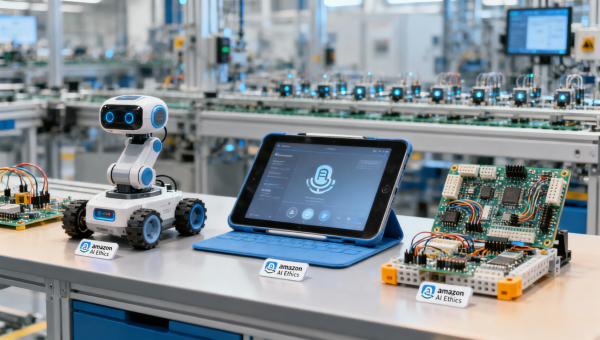
Amazon has introduced a new regulatory requirement for STEM educational toys featuring generative AI capabilities, effective May 17, 2026. The policy mandates third-party-reviewed AI algorithm white papers for all such products listed on its U.S. marketplace — marking one of the first platform-level AI governance frameworks targeting children’s learning tools. Its implications extend across global supply chains, especially for manufacturers and exporters in China and Southeast Asia supplying to Amazon’s ecosystem.
Event Overview
On May 17, 2026, Amazon implemented a new listing requirement for STEM educational toys sold on its U.S. platform: any product incorporating generative AI functionality — including AI-powered coding assistants and conversational learning engines — must submit a third-party-verified AI Algorithm White Paper prior to launch. The white paper must detail data provenance, model training logic, child–AI interaction boundary design (e.g., response latency limits, content filtering thresholds, no persistent memory), and bias mitigation protocols. Products failing to comply will be removed from sale.
Industries Affected
Direct Trading Enterprises
Export-oriented trading companies acting as brand agents or private-label distributors face immediate compliance pressure. Their role as listing owners means they bear full accountability for white paper submission — yet most lack in-house AI governance capacity. Impact manifests in delayed time-to-market, increased third-party audit costs (estimated at USD $8,000–$15,000 per SKU), and heightened risk of listing suspension during seasonal peaks (e.g., back-to-school season).
Raw Material Procurement Enterprises
Firms sourcing AI-related components — such as edge inference chips, voice recognition modules, or pre-trained LLM microservices — are indirectly affected. While not directly responsible for documentation, their supplier contracts now require traceability statements (e.g., ‘data used for fine-tuning complies with COPPA-compliant synthetic datasets’). This shifts procurement criteria from cost and lead time toward audit-readiness and documentation interoperability.
Contract Manufacturing & OEM Enterprises
Chinese and Vietnamese STEM OEMs — many of which integrate off-the-shelf AI SDKs into hardware — must now formalize previously implicit design decisions. For example, ‘how chat history is truncated’ or ‘how image prompts are sanitized’ must be codified, tested, and certified. This represents a structural shift from firmware delivery to AI assurance delivery — requiring new internal roles (e.g., AI Compliance Liaison) and updated quality management systems aligned with ISO/IEC 42001 principles.
Supply Chain Service Providers
Third-party testing labs, certification bodies, and AI documentation consultants are experiencing rising demand — particularly those with dual expertise in children’s product safety (ASTM F963, ISO 8124) and AI risk management (NIST AI RMF, EU AI Act Annex III alignment). However, standardized evaluation criteria for ‘child-safe generative AI behavior’ remain emergent; service providers currently rely on custom checklists rather than harmonized benchmarks.
Key Focus Areas & Recommended Actions
Map AI Functionality to Regulatory Triggers
Brands and OEMs should conduct a functional inventory: does the device generate novel responses (e.g., open-ended explanations), adapt to user input over sessions, or synthesize multi-modal outputs? Only those meeting the ‘generative’ threshold — not rule-based or static-response logic — fall under the white paper mandate.
Prioritize White Paper Development for High-Volume SKUs
Given resource constraints, prioritize documentation for top 20% of revenue-generating SKUs first. Use modular templates (e.g., shared data sourcing section across product families) to reduce redundant effort. Engage auditors early — some accept draft submissions for gap analysis before formal review.
Update Supplier Agreements with AI Documentation Clauses
OEMs integrating third-party AI services (e.g., cloud-based LLM APIs or embedded speech models) must revise procurement terms to require upstream documentation — including data license scope, model versioning logs, and child-interaction constraint specifications — as inputs to their own white paper.
Editorial Perspective / Industry Observation
Observably, Amazon’s move functions less as a standalone compliance hurdle and more as a de facto standard-setting intervention. Unlike national legislation, it applies immediately to thousands of active listings and carries direct commercial consequence (delisting). Analysis shows this accelerates convergence between toy safety norms and AI governance — especially around transparency for non-technical stakeholders (e.g., parents reviewing ‘AI ethics labels’). From an industry perspective, it also reveals a growing bifurcation: brands investing in vertical AI integration (own models, curated data) gain audit efficiency, while those relying on generic AI middleware face escalating documentation debt.
Conclusion
This policy signals a broader transition: AI in children’s products is shifting from ‘feature differentiation’ to ‘baseline responsibility’. It does not ban generative AI — but conditions its use on demonstrable safeguards. For global suppliers, the takeaway is pragmatic: AI compliance is no longer optional R&D overhead; it is embedded infrastructure, requiring cross-functional coordination between engineering, legal, and supply chain teams. The long-term impact may be measured less in near-term delays and more in strengthened trust architecture across the edtech value chain.
Source Attribution
Official announcement: Amazon Seller Central Policy Update (May 17, 2026), accessible via Seller Central > Policy Library > STEM Toy Requirements. Third-party verification standards referenced in guidance align with ISO/IEC 42001:2023 and NIST AI Risk Management Framework (Version 1.1). Note: Amazon has not published a full list of approved auditing bodies; this remains under active observation.
Related Intelligence
 Skincare OEMAug 16, 2026Amazon Enforces AI Human Metadata Rule for Beauty and Personal Care SellersAmazon now enforces AI human metadata rules for beauty sellers. Learn how to protect listings, traffic, and compliance in skincare, cosmetics, and beauty devices.
 Beauty DevicesAug 15, 2026China to Roll Out Nationwide Cross-Border Cash Pooling for MultinationalsChina to roll out nationwide cross-border cash pooling for multinationals from Sept. 14. Discover how this policy could improve treasury efficiency, liquidity management, and China-linked supply chains.
 Beauty DevicesAug 14, 2026China Imposes Temporary Export Ban on Helium, Affecting Cooling Supply ChainsChina's temporary helium export ban may disrupt cooling supply chains for beauty RF devices and laser systems. Learn what ODMs, buyers, and procurement teams should check now.
![]() Cosmetics & PkgAug 13, 2026PPWR becomes mandatory: Beauty and personal care packaging materials usher in new EPR and PFAS compliance requirementsPPWR takes effect for cosmetics packaging in the EU, bringing EPR registration and PFAS limits. Learn what brands, importers, and suppliers must do now.
Cosmetics & PkgAug 13, 2026PPWR becomes mandatory: Beauty and personal care packaging materials usher in new EPR and PFAS compliance requirementsPPWR takes effect for cosmetics packaging in the EU, bringing EPR registration and PFAS limits. Learn what brands, importers, and suppliers must do now. Cosmetics & PkgAug 12, 2026EU PPWR Now Enforced for Beauty Packaging ComplianceEU PPWR now enforced for beauty packaging compliance: learn how EPR, ERN, heavy metals and PFAS rules affect EU exports, customs clearance and platform sales.
 Cosmetics & PkgAug 11, 2026EU PPWR Rules Take Effect on Aug. 12 for Beauty PackagingEU PPWR rules for beauty packaging take effect on Aug. 12, 2026. Learn key compliance steps, EPR, labeling, PFAS limits, and how to avoid customs delays and fines.
 Smart Pet DevicesAug 10, 2026EU EPR Rules to Cover Smart Pet Devices on Aug. 15EU EPR Rules will cover smart pet devices from Aug. 15, 2026. Learn how smart collars, feeders, and monitoring devices can avoid delisting, customs delays, and compliance risks in the EU.
 Infant Feeding & CareAug 09, 2026CPSC Recalls Baby Sleep Sacks Over Undeclared TDCPPCPSC Recalls Baby Sleep Sacks Over Undeclared TDCPP: learn how this 2026 recall impacts CPC documents, third-party testing, and U.S. baby product compliance for exporters.
 Infant Feeding & CareAug 08, 2026ECHA Adds 5 SVHCs, Importer Notices Due From Oct 2026ECHA adds 5 SVHCs to the Candidate List, with importer notices due from October 2026. Learn how REACH affects exporters, supply chains, and documentation readiness.
 Baby Gear & StrollersAug 07, 2026CPSC Revises Crib Rail Standard for November 2026CPSC revises crib rail standard for November 2026, adding dynamic impact tests and mandatory third-party lab testing. Learn how the new rule affects U.S. market access, compliance, and shipments.
 Electronic & RC ToysAug 06, 2026EU to Require EN IEC 62115:2025 for Electronic ToysEU to Require EN IEC 62115:2025 for Electronic Toys from Oct 1, 2026. Learn scope, battery and AI safety updates, CE compliance risks, and how exporters can avoid customs delays.
 Baby Gear & StrollersAug 05, 2026US Stroller Stability Rule Takes Effect Aug. 15US Stroller Stability Rule Takes Effect Aug. 15: learn how new U.S. stroller compliance, ASTM F833-26a, and CPSC testing rules may affect imports, certification, and shipment readiness.
 Infant Feeding & CareAug 04, 2026ECHA Adds 5 SVHCs, Triggering Baby Care Export ReviewECHA adds 5 SVHCs, prompting an urgent baby care export review for EU-bound products. Learn the 0.1% threshold risks, compliance steps, and how to avoid customs delays and fines.












