
Ningbo Port Launches Green Fast-Check Channel for Infant Products

Ningbo Port has introduced a green fast-check channel for infant products effective May 17, 2026 — a targeted regulatory facilitation measure responding to rising export demand and tightening compliance expectations in key overseas markets, particularly Japan and the U.S. The initiative directly impacts manufacturers, exporters, and service providers across the infant feeding and care supply chain, offering measurable time savings in customs clearance while reinforcing technical due diligence as a competitive prerequisite.
Event Overview
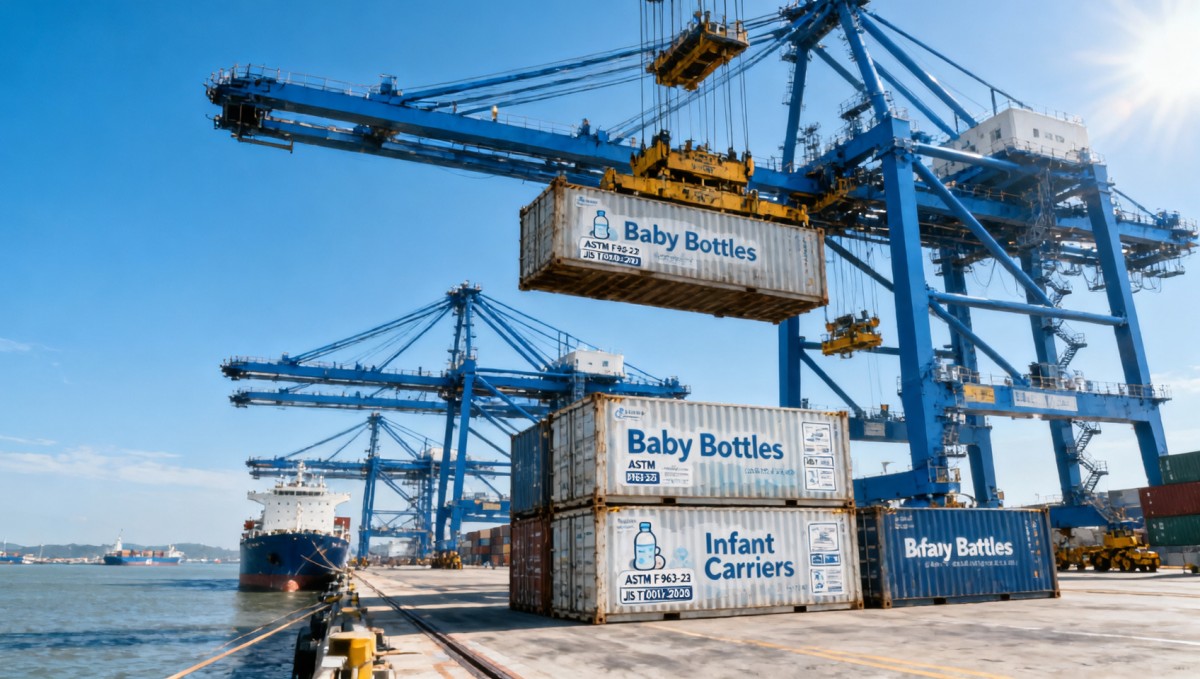
Starting May 17, 2026, Ningbo Port has implemented a dedicated green fast-check channel for infant products—including baby bottles, pacifiers, infant carriers, and toddler walkers. Enterprises holding valid test reports compliant with JIS T 0601-2:2026, ASTM F963-23, or ISO 8124 series standards may submit documentation at customs declaration; laboratory verification and release are completed within 24 hours post-filing. This is an administrative optimization—not a relaxation of safety requirements—and applies exclusively to pre-verified documentation meeting specified international standards.
Industries Affected
Direct Trading Enterprises
Exporters and trading companies handling infant feeding and care goods face compressed lead times during peak seasons (e.g., Q3–Q4 shipments for U.S. holiday retail or Japanese fiscal-year procurement cycles). The 24-hour verification window reduces dwell time at port, improving on-time delivery performance and reducing demurrage exposure. However, eligibility hinges entirely on report validity and alignment with the three designated standards—meaning firms relying on outdated, non-accredited, or regionally scoped testing (e.g., GB 38252–2019 alone) do not qualify.
Raw Material Procurement Enterprises
Suppliers of food-grade silicone, BPA-free polymers, flame-retardant fabrics, or certified metal components must now anticipate upstream traceability demands. Buyers increasingly require material-level compliance documentation (e.g., supplier declarations referencing ASTM F963-23 migration limits or ISO 8124-3 extractables data) to support final product reports. Failure to provide auditable, standard-aligned material certifications may delay report issuance—and thus disqualify downstream exporters from the fast channel.
Contract Manufacturing Enterprises
OEM/ODM factories producing under global brand mandates (e.g., for U.S. mass retailers or Japanese department store private labels) experience intensified pressure to institutionalize standardized testing protocols—not just per batch, but per SKU family and production line. The fast channel does not waive physical testing; it accelerates verification of *existing* reports. Hence, manufacturers must ensure lab partners issue reports explicitly citing JIS T 0601-2:2026, ASTM F963-23, or ISO 8124 parts (not generic ‘safety tested’ statements), with full test parameters, sample IDs, and accredited lab signatures.
Supply Chain Service Enterprises
Third-party inspection agencies, customs brokers specializing in consumer goods, and logistics integrators must update client advisories and internal checklists. Notably, the channel requires report submission *at declaration*, not post-clearance—making pre-filing validation a new operational checkpoint. Brokers lacking technical familiarity with JIS/ASTM/ISO clause structures risk misfiling or rejection. Meanwhile, inspection firms see growing demand for gap assessments: verifying whether existing reports meet the precise scope, edition year, and accreditation criteria required by Ningbo Port’s protocol.
Key Considerations and Recommended Actions
Verify Report Edition Compliance Immediately
ASTM F963-23 (not -17 or -20) and JIS T 0601-2:2026 (not earlier JIS T 0601-2:2019) are mandatory. Reports must be issued by CNAS-accredited labs (or ILAC-MRA signatory equivalents) and include explicit pass/fail conclusions against each applicable clause—not summary statements. Firms should audit all active reports before May 17 and retest if editions or scopes are outdated.
Align Internal Documentation with Standard-Specific Requirements
For example, ASTM F963-23 includes updated heavy metal limits for surface coatings and new mechanical requirements for infant carriers. ISO 8124-1:2022 adds revised small parts testing protocols. Product technical files and factory QC records must reflect these exact parameters—not just general conformance language—to support rapid verification.
Engage Accredited Labs Early in Product Development
Testing lead time remains unchanged; only verification is accelerated. To avoid bottlenecks, manufacturers should initiate testing at prototype stage—not pre-shipment—and confirm lab capacity for JIS/ASTM/ISO-aligned reporting. Prioritize labs with documented experience issuing reports accepted by Ningbo Customs (e.g., those previously used by top-tier Japanese importers).
Editorial Perspective / Industry Observation
Observably, this is not an isolated port-level convenience measure—it signals a broader shift toward ‘compliance-by-design’ as infrastructure-level competitiveness. Unlike ad hoc exemptions, the green channel codifies technical rigor as a throughput enabler. Analysis shows that ports adopting such mechanisms (e.g., Shenzhen’s prior electronics fast lane) tend to attract higher-value, standards-compliant exporters while accelerating market consolidation among less prepared SMEs. Current evidence suggests the policy better serves vertically integrated exporters with in-house regulatory affairs teams than fragmented trading consortia reliant on reactive compliance.
Conclusion
The Ningbo Port green fast-check channel represents a pragmatic calibration between regulatory enforcement and trade efficiency—but its benefits accrue selectively. It rewards foresight, standard literacy, and upstream investment in technical documentation. For the infant feeding and care sector, this marks a step toward treating international safety standards not as external hurdles, but as embedded operational benchmarks. A rational interpretation is that speed-to-market is now inextricably linked to depth-of-compliance—not just breadth.
Source Attribution
Official announcement issued by Ningbo Customs (Customs Notice No. NBGZ-2026-021), confirmed via Ningbo Port Group’s operational bulletin dated May 15, 2026. Standards referenced are publicly available through ASTM International, JISC (Japanese Industrial Standards Committee), and ISO. Note: Eligibility criteria, lab accreditation recognition lists, and potential expansion to additional product categories remain subject to official updates; stakeholders are advised to monitor Ningbo Customs’ dedicated portal for infant product trade facilitation (https://customs.ningbo.gov.cn/infant-facilitation) for real-time revisions.
Related Intelligence
 Skincare OEMAug 16, 2026Amazon Enforces AI Human Metadata Rule for Beauty and Personal Care SellersAmazon now enforces AI human metadata rules for beauty sellers. Learn how to protect listings, traffic, and compliance in skincare, cosmetics, and beauty devices.
 Beauty DevicesAug 15, 2026China to Roll Out Nationwide Cross-Border Cash Pooling for MultinationalsChina to roll out nationwide cross-border cash pooling for multinationals from Sept. 14. Discover how this policy could improve treasury efficiency, liquidity management, and China-linked supply chains.
 Beauty DevicesAug 14, 2026China Imposes Temporary Export Ban on Helium, Affecting Cooling Supply ChainsChina's temporary helium export ban may disrupt cooling supply chains for beauty RF devices and laser systems. Learn what ODMs, buyers, and procurement teams should check now.
![]() Cosmetics & PkgAug 13, 2026PPWR becomes mandatory: Beauty and personal care packaging materials usher in new EPR and PFAS compliance requirementsPPWR takes effect for cosmetics packaging in the EU, bringing EPR registration and PFAS limits. Learn what brands, importers, and suppliers must do now.
Cosmetics & PkgAug 13, 2026PPWR becomes mandatory: Beauty and personal care packaging materials usher in new EPR and PFAS compliance requirementsPPWR takes effect for cosmetics packaging in the EU, bringing EPR registration and PFAS limits. Learn what brands, importers, and suppliers must do now. Cosmetics & PkgAug 12, 2026EU PPWR Now Enforced for Beauty Packaging ComplianceEU PPWR now enforced for beauty packaging compliance: learn how EPR, ERN, heavy metals and PFAS rules affect EU exports, customs clearance and platform sales.
 Cosmetics & PkgAug 11, 2026EU PPWR Rules Take Effect on Aug. 12 for Beauty PackagingEU PPWR rules for beauty packaging take effect on Aug. 12, 2026. Learn key compliance steps, EPR, labeling, PFAS limits, and how to avoid customs delays and fines.
 Smart Pet DevicesAug 10, 2026EU EPR Rules to Cover Smart Pet Devices on Aug. 15EU EPR Rules will cover smart pet devices from Aug. 15, 2026. Learn how smart collars, feeders, and monitoring devices can avoid delisting, customs delays, and compliance risks in the EU.
 Infant Feeding & CareAug 09, 2026CPSC Recalls Baby Sleep Sacks Over Undeclared TDCPPCPSC Recalls Baby Sleep Sacks Over Undeclared TDCPP: learn how this 2026 recall impacts CPC documents, third-party testing, and U.S. baby product compliance for exporters.
 Infant Feeding & CareAug 08, 2026ECHA Adds 5 SVHCs, Importer Notices Due From Oct 2026ECHA adds 5 SVHCs to the Candidate List, with importer notices due from October 2026. Learn how REACH affects exporters, supply chains, and documentation readiness.
 Baby Gear & StrollersAug 07, 2026CPSC Revises Crib Rail Standard for November 2026CPSC revises crib rail standard for November 2026, adding dynamic impact tests and mandatory third-party lab testing. Learn how the new rule affects U.S. market access, compliance, and shipments.
 Electronic & RC ToysAug 06, 2026EU to Require EN IEC 62115:2025 for Electronic ToysEU to Require EN IEC 62115:2025 for Electronic Toys from Oct 1, 2026. Learn scope, battery and AI safety updates, CE compliance risks, and how exporters can avoid customs delays.
 Baby Gear & StrollersAug 05, 2026US Stroller Stability Rule Takes Effect Aug. 15US Stroller Stability Rule Takes Effect Aug. 15: learn how new U.S. stroller compliance, ASTM F833-26a, and CPSC testing rules may affect imports, certification, and shipment readiness.
 Infant Feeding & CareAug 04, 2026ECHA Adds 5 SVHCs, Triggering Baby Care Export ReviewECHA adds 5 SVHCs, prompting an urgent baby care export review for EU-bound products. Learn the 0.1% threshold risks, compliance steps, and how to avoid customs delays and fines.












