What Documents Should Pet Product Suppliers Provide to Buyers?
What documents should pet product suppliers provide? A useful supplier file should establish who makes the product, what it contains, how its safety and quality have been assessed, how it should be labeled, and which production batch is being shipped. The exact paperwork depends on the product, its intended use, and the destination market.
A fabric pet bed, a rechargeable grooming tool, and a bag of dog treats need different supporting evidence. Requesting the same certificate bundle for all three can leave important gaps. The practical approach is to build a document checklist around the actual product, then connect every relevant report and specification to the item you intend to order.
Define the product before requesting certificates
Start with a short product brief covering the intended animal, size range, materials or ingredients, intended use, sales destination, packaging, and proposed claims. Include features that change the documentation needed, such as batteries, wireless connectivity, food contact, or ingredients of animal origin.
Claims deserve particular attention. A shampoo marketed for routine cleaning raises different questions from one claiming to treat a skin condition. A chew intended to be eaten needs a different assessment from a rubber toy designed for supervised play. Product names alone are not enough to establish the correct category.
Ask the supplier to explain which documents support that specific product and market. A response consisting only of certificate logos or a generic “fully compliant” statement does not show how the item meets the requirements relevant to your order.
The core documents to request from a pet product supplier
The following records form a practical starting point. Some establish the supplier’s identity; others describe the product or provide evidence about its manufacture. They serve different purposes and should be reviewed separately.
Establish who is responsible for manufacturing
Request business registration details, the factory address, and clarification of whether the seller manufactures the goods or uses another facility. A trading company can be a suitable partner, but the production arrangement should be transparent enough to support inspections, traceability, and corrective action.
Compare the legal names appearing on quotations, contracts, invoices, and factory documents. Different names may reflect a legitimate group structure or export arrangement; obtain a written explanation of those relationships. You need to know which entity accepts the order and which facility produces it.
Factory audits and quality-management certificates can help assess production controls. Review their scope and covered location. They provide information about the facility or management system, but do not establish that an individual pet product is safe or suitable for a particular market.
Turn the product specification into an acceptance standard
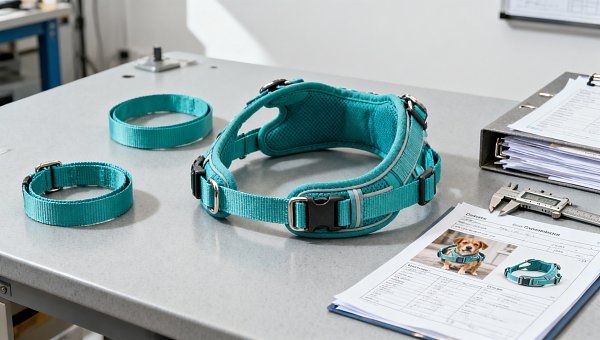
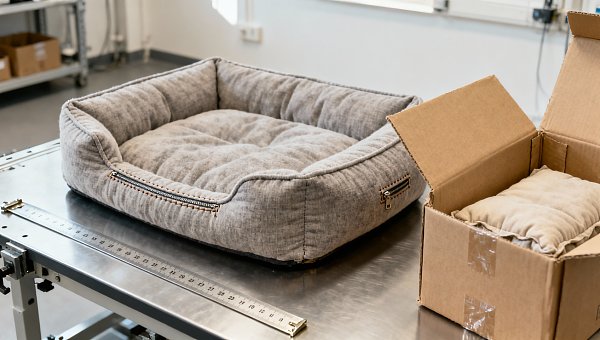
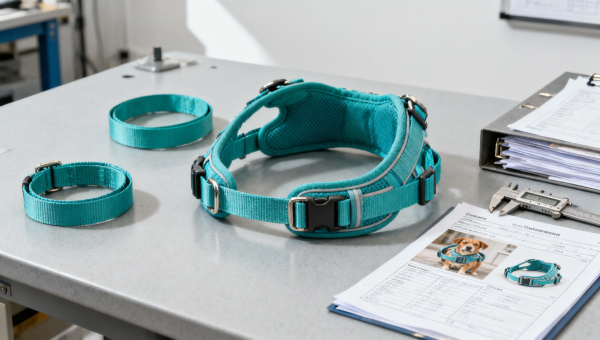
A catalog page usually lacks enough detail to control production. For a harness, request dimensions, webbing composition, buckle materials, stitching construction, adjustment range, and agreed strength criteria. For a pet bed, include filling, cover fabric, seam construction, washing instructions, and any removable components.
The specification should identify the approved version and describe acceptable variation. Terms such as “durable,” “premium,” or “heavy duty” are difficult to inspect unless they are supported by measurable requirements or an agreed assessment method.
Keep an approved sample reference alongside the written specification. Neither replaces the other: the sample helps communicate appearance and feel, while the specification captures details that may be invisible, including material composition and internal construction.
Match the supporting evidence to the product category
Pet product documentation becomes more useful when it addresses realistic exposure and failure risks. A dog may chew a seam, swallow a detached component, or repeatedly mouth a coated surface. Those conditions should influence the information requested.
Pet toys, collars, beds, and feeding accessories
For non-electrical accessories, request a material breakdown and evidence addressing relevant chemical and mechanical risks. Depending on the item, this may include restricted-substance testing, seam strength, attachment security, buckle performance, or assessment of detachable parts.
For bowls and other feeding accessories, ask which materials contact food and what evidence supports their suitability under the intended conditions. Hot food, repeated washing, and dishwasher use can matter. A report for one plastic resin may not represent a finished bowl containing colorants, coatings, or additional components.
Product sizing also affects safe use. A toy suitable for a small dog may become a swallowing hazard for a larger one. Request sizing guidance and limitations that reflect the product’s construction rather than relying on a broad “suitable for all pets” claim.
Pet food, treats, and ingestible supplements
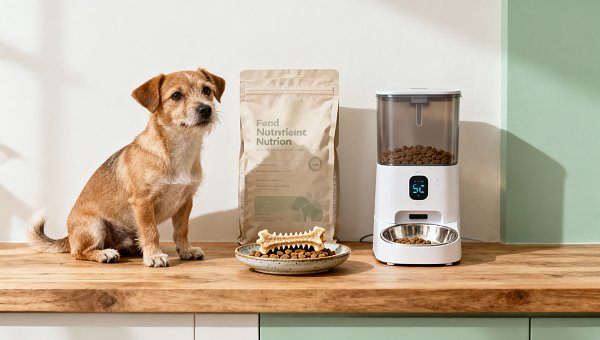
Request the ingredient declaration, nutritional specification where relevant, manufacturing-site information, shelf-life basis, storage conditions, and batch identification method. Ask for documentation supporting applicable feed-safety controls and any product or facility registrations required for the destination.
A certificate of analysis, or COA, records results for a particular batch against defined specifications. Its value depends on what was measured. Check the lot number, test methods, acceptance limits, and results for relevant factors such as microbiological quality, composition, or contaminants. A generic COA template provides no evidence about the shipment.
For animal-origin ingredients, additional health or import documentation may apply. Identify those needs before confirming the order because they can affect the eligible manufacturing location and shipping route. Shelf-life claims should also have a documented basis consistent with the formulation and packaging.
Grooming liquids and electrical products
For shampoos, sprays, and similar products, request ingredient information, finished-product specifications, stability evidence, and microbiological controls where relevant. A safety data sheet may be needed depending on the formulation and its classification. It communicates hazard and handling information; it does not establish animal suitability or prove treatment claims.
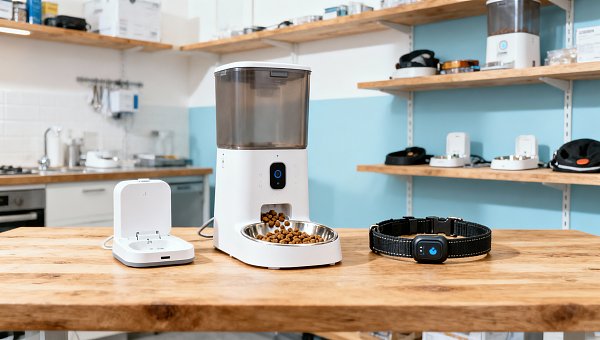
For clippers, heated beds, automatic feeders, and other electrical items, request documentation addressing the applicable electrical, electromagnetic, battery, and wireless requirements. The supporting file should match the supplied power adapter, battery, voltage configuration, and model. Where lithium batteries are shipped, obtain the relevant transport documentation as well.
Do not assume every pet product requires CE marking, a Children’s Product Certificate, or an “FDA certificate.” CE marking applies only to products within relevant EU legislation. A Children’s Product Certificate concerns applicable US children’s products, so its relevance depends on classification. FDA-related obligations depend on the product category and activity; a general certificate bearing the agency’s name does not establish approval.
Check whether a test report covers the item you will receive
Request the complete report, including sample descriptions, results, photographs where available, and any qualifications. A cover page or cropped screenshot can conceal missing tests or limitations.
Compare the report with the product specification using a simple review sequence:
- Identify the sample: Match model numbers, photographs, materials, dimensions, and components.
- Read the scope: Check which hazards and requirements were assessed and which were excluded.
- Review the results: Look for failures, exceptions, and conditions attached to the conclusion.
- Connect it to production: Establish whether the current product uses the same design, materials, and manufacturing arrangement.
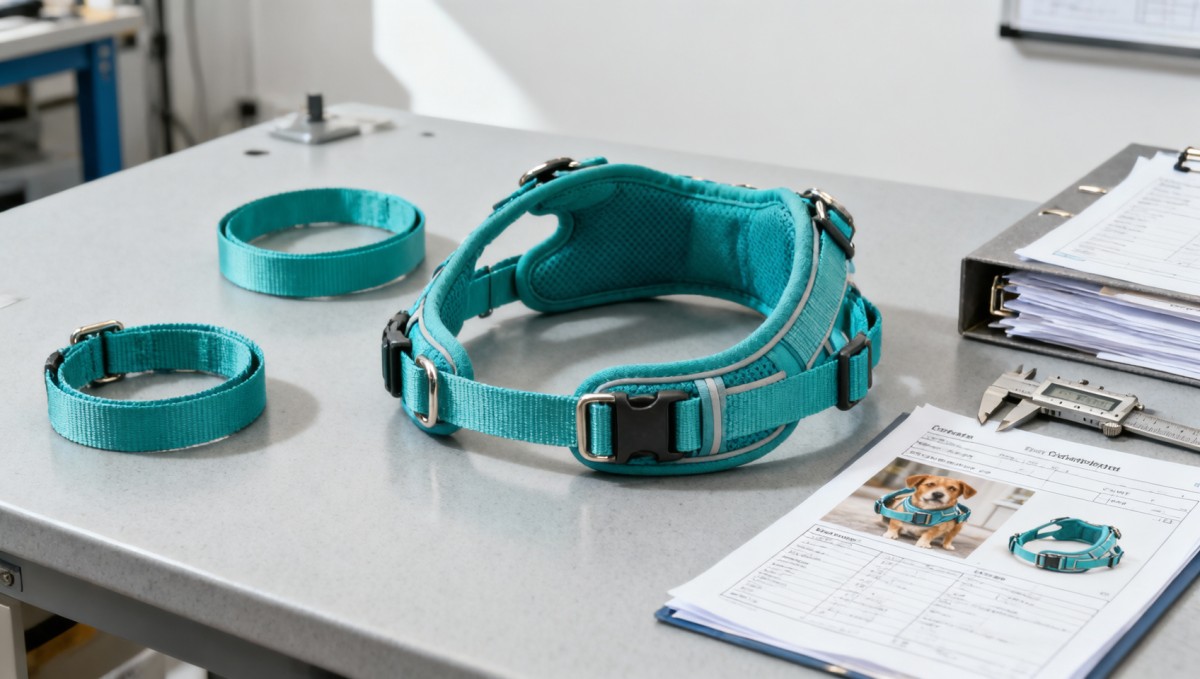
For example, a report for an unprinted silicone bowl may not support a version with a decorative coating. Testing a small harness does not automatically establish the strength of a larger version with different hardware. Product-family coverage can be reasonable, but the relationship between tested and supplied variants should be documented.
Report age alone is not a reliable pass-or-fail rule. Changes to materials, construction, applicable requirements, or production can make earlier evidence less useful. Request a written change history and establish when updated assessment is necessary. Laboratory accreditation is helpful when its scope covers the relevant testing, but the report still needs to match your product.
Agree on labeling and batch records before production
Request final label artwork and instructions before packaging is printed. Review the product name, composition statements, warnings, care instructions, storage conditions, lot coding, and responsible-party information where applicable. Required information and languages vary by market and product category.
Warnings should describe practical limits clearly. A chew toy may need guidance about supervision and removal when damaged. A grooming tool may need cleaning and charging instructions. Warnings cannot compensate for a poorly designed product, but they help communicate safe use.
Claims such as “non-toxic,” “hypoallergenic,” “biodegradable,” or “indestructible” need evidence that supports their scope. Ask what was assessed and under which conditions. Evidence about one ingredient or packaging component should not be expanded into a claim about the entire product.
For traceability, establish how a finished unit or package connects to its production lot. Request relevant batch-release records, inspection results, and a complaint or recall contact. For food and liquids, the lot reference should connect to the corresponding analysis and manufacturing records.
Request documents at the stage when they can prevent a problem
Collect business credentials, product specifications, and available compliance evidence during supplier evaluation. Resolve missing product information before committing to tooling or production. Finalize artwork, instructions, and acceptance criteria before the manufacturing run begins.
Before shipment, request the agreed inspection report, relevant batch records or COA, commercial invoice, packing list, and transport document as available. Depending on the goods and route, additional records may include a certificate of origin, health documentation, import permits, or dangerous-goods paperwork.
Shipping descriptions, quantities, carton counts, weights, and product references should agree across the documents. Clarify who prepares each record and who handles export and import responsibilities. Routine commercial paperwork cannot replace missing product-safety evidence.
Put document delivery into the purchase agreement: name the required records, the product versions they must cover, and their delivery deadlines. Include notification requirements for changes to materials, components, formulation, factories, and packaging. Otherwise, a repeat order can arrive with changes that invalidate the original assessment.
If a document is missing, respond according to the gap. An absent packing list may be resolved before dispatch. Missing evidence for an electrical hazard, an unidentified food batch, or an undisclosed manufacturing change warrants holding the affected order until the issue is resolved. Keep the approved specification, supporting reports, artwork, and shipment records together by SKU and revision so future orders can be checked against the same documented requirements.
Related Intelligence
 Cosmetics & PkgOct 28, 2026China’s September Cosmetics Exports to Russia Hit Record, Doubling Year on YearChina’s cosmetics exports to Russia reportedly doubled to a record $33.6 million in September 2026. Explore the implications for sourcing, compliance checks and delivery planning.
 Cosmetics & PkgOct 27, 2026China’s Cosmetics Exports to Russia Hit Record High in September 2026China’s cosmetics exports to Russia reportedly hit $33.6 million in September 2026. Explore category trends and key checks for order planning, documentation and delivery readiness.
 Corporate & Seasonal GiftsOct 26, 2026140th Canton Fair Phase Two in Full Swing as Green, Smart Home Products Secure OrdersExplore 140th Canton Fair Phase Two green and smart home products, reported buyer demand, and key procurement checks to turn orders into reliable export deliveries.
 STEM & Educational ToysOct 25, 2026Malaysia’s KPDN Seizes 5,801 Non-Compliant Squishy Toys in Nationwide ActionMalaysia’s KPDN reportedly seized 5,801 squishy toys lacking safety compliance marks. Discover key checks to help toy suppliers assess stock and verify compliance before distribution.
 Infant Feeding & CareOct 24, 2026FDA Issues Draft Guidance on Cadmium Action Levels in Baby FoodsFDA draft guidance on cadmium action levels in baby foods proposes category-specific targets. Explore potential impacts on sourcing, testing and compliance planning—and how to prepare.
 STEM & Educational ToysOct 23, 20262026 China Toy Expo Gives AI Toys a Dedicated Hall as Practical Features Take Priority2026 China Toy Expo spotlights AI toys with a dedicated hall. Explore how practical features and everyday play experiences are reshaping manufacturers’ product priorities.
 STEM & Educational ToysOct 22, 2026Blokees Showcases Over 900 Products at the 2026 China International Toy FairBlokees showcases over 900 products at the 2026 China International Toy Fair. Explore Model Kits, BLOKEES WHEELS and key sourcing checks to guide your next purchase.
 Cosmetics & PkgOct 21, 2026BASF Plans Beauty Innovation Showcase at in-cosmetics Asia 2026Explore BASF’s planned beauty innovations at in-cosmetics Asia 2026 in Bangkok, with a focus on skin protection, repair and sustainable solutions for personal care formulators.
 Cosmetics & PkgOct 20, 2026Beauty Tops Amazon’s 2026 Prime Big Deal Days Shopping CategoriesBeauty tops Amazon’s 2026 Prime Big Deal Days at 32% of shoppers, according to Market Defense. Explore what the findings could mean for product selection, inventory and promotional planning.
 Pet Grooming & TravelOct 14, 2026What Documents Should Pet Product Suppliers Provide to Buyers?What documents should pet product suppliers provide? Explore essential safety reports, product specs, batch records, and shipping paperwork to verify suppliers and buy with confidence.
 Smart Pet DevicesOct 14, 2026Is Smart Pet Hardware a Good Category Expansion for Retailers?Is smart pet hardware a good category expansion for retailers? Discover how to assess demand, reliability, supplier support, and real margins before committing to new inventory.
 Pet Grooming & TravelOct 14, 2026Which Pet Care Product Categories Are Growing Fastest in 2026?Which pet care categories are growing fastest in 2026? Explore functional nutrition, preventive wellness, and smart devices to uncover opportunities and build a profitable retail assortment.
 Pet Furniture & EnrichmentOct 14, 2026How Can Retailers Reduce Pet Bed Damage Claims?How can retailers reduce pet bed damage claims? Discover practical quality controls, packaging tests, and care tips to cut returns, protect margins, and build customer trust.