Wholesale Camping Lanterns Cost Guide for Bulk Outdoor Orders
For procurement teams planning bulk outdoor orders, understanding the true cost of wholesale camping lanterns goes far beyond unit price. Battery type, brightness, durability, safety certifications, packaging, MOQ, and freight terms can all affect landed cost and long-term retail margins. This guide breaks down the key pricing factors, supplier considerations, and sourcing risks to help buyers compare offers more confidently, negotiate smarter, and build a reliable lantern product line for outdoor, travel, and retail channels.
Why Unit Price Is Not Enough When Buying Wholesale Camping Lanterns
Procurement teams often receive quotations that look similar on the surface. One supplier may offer a lower FOB price, while another includes better batteries, stronger housing, and retail-ready packaging.
For travel retailers, outdoor tour operators, campsite stores, and e-commerce brands, wholesale camping lanterns must survive seasonal demand spikes, variable weather, and customer reviews after real field use.
A good buying decision compares total landed cost, functional reliability, compliance exposure, and resale positioning. The cheapest lantern may create higher after-sales costs if it fails during camping, hiking, fishing, or emergency use.
Key cost layers buyers should separate
- Factory unit cost, including LED chips, battery system, housing material, switch design, charging port, and waterproof structure.
- Customization cost, such as private label printing, color matching, molded logos, instruction manuals, and retail gift boxes.
- Compliance and inspection cost, especially for rechargeable models, lithium battery transport, CE, RoHS, FCC, or destination-specific documentation.
- Logistics cost, including carton volume, battery shipping restrictions, consolidation, duty, warehousing, and last-mile distribution.
Which Lantern Types Fit Different Travel and Outdoor Sales Channels?
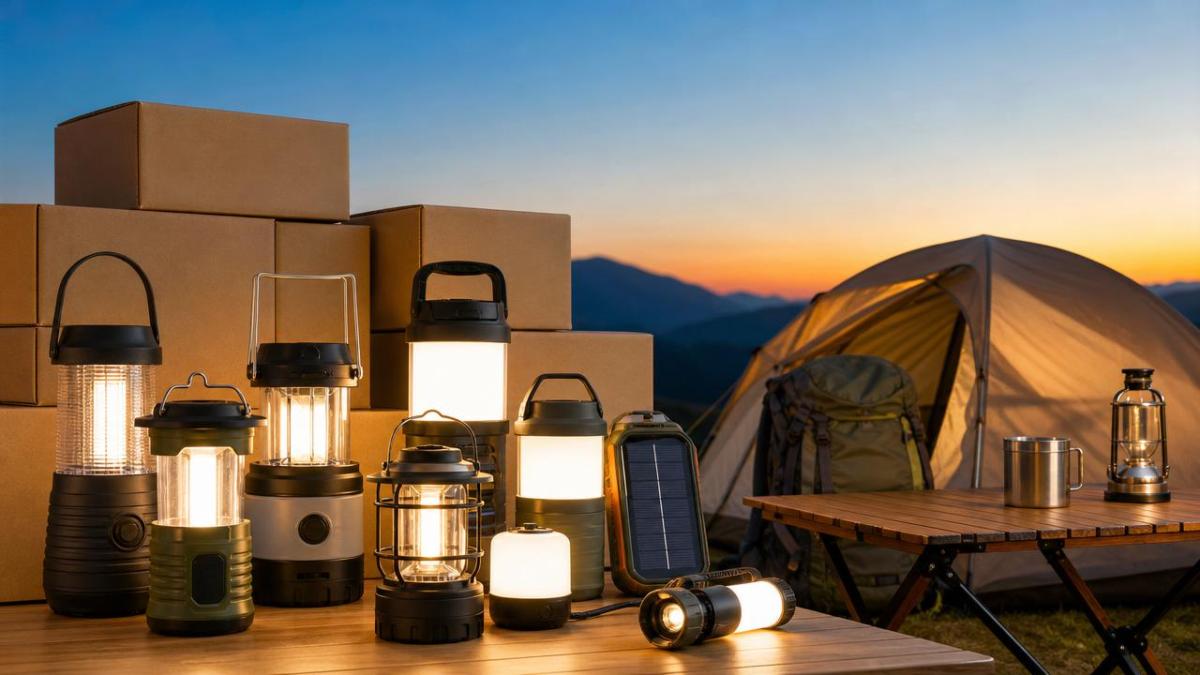
Wholesale camping lanterns are not one product category. The right model depends on the buyer’s channel, target traveler, price band, and expected usage conditions.
A campground convenience shop may prefer simple battery lanterns with low defect risk. A premium outdoor retailer may need USB-C rechargeable models with dimming, power bank function, and higher ingress protection.
The table below helps procurement teams match product formats with realistic outdoor and travel-service scenarios before requesting samples or negotiating MOQ.
This selection step protects margin. When wholesale camping lanterns match the sales environment, buyers reduce markdown risk and avoid stocking products that look attractive but fail customer expectations.
What Drives the Cost of Wholesale Camping Lanterns?
Cost differences usually come from components hidden inside the product. Brightness claims, runtime claims, and waterproof ratings should be translated into procurement specifications.
For bulk outdoor orders, the cost structure becomes especially important because small specification changes can multiply across thousands of units, affecting margin, freight, and warranty reserves.
Common specification factors behind price gaps
Before comparing wholesale camping lanterns, buyers should ask suppliers to quote against the same technical baseline. Otherwise, a low offer may simply reflect weaker materials.
The lowest price is rarely the most useful benchmark. A better benchmark is cost per reliable hour of light, especially for tourism operators and retailers serving family campers.
How Should Buyers Calculate Landed Cost and Margin?
Landed cost combines product cost, packaging, inspection, freight, duties, compliance, and local handling. It is the number that determines whether wholesale camping lanterns can support retail margins.
A lantern with a slightly higher unit price may ship in a more compact carton, reduce breakage, and pass compliance review faster. Those advantages can improve total profitability.
Practical landed cost checklist
- Compare EXW, FOB, and CIF quotes using the same quantity, packaging, battery inclusion, and customization scope.
- Estimate carton cubic volume, because bulky lanterns can become expensive under air freight or peak-season sea freight.
- Add third-party inspection cost when selling through large retailers, marketplaces, or regulated travel accessory channels.
- Set a warranty reserve for rechargeable models, especially when the product will be promoted as a premium outdoor item.
The following framework helps procurement teams compare cost scenarios without relying only on the supplier’s headline price.
For wholesale camping lanterns, procurement should model at least two landed-cost cases: one for entry-level demand and one for differentiated retail positioning.
Supplier Selection: What Procurement Teams Should Ask Before Ordering
Supplier capability matters because lanterns combine electrical safety, plastic processing, battery handling, and outdoor usability. Weak process control can create inconsistent runtime and higher returns.
Global Consumer Sourcing helps buyers evaluate suppliers through market intelligence, category analysis, compliance awareness, and structured comparison across sports and outdoor consumer goods.
Questions to include in an RFQ
- What is the exact battery type, capacity, charging current, protection design, and expected runtime at each brightness mode?
- Can the supplier provide product photos, material details, packaging dimensions, carton weight, and sample lead time?
- Which test reports or declarations are available for the target market, and are they linked to the quoted model?
- What are the MOQ levels for neutral stock, logo printing, custom colors, molded branding, and custom retail packaging?
- How does the factory control LED consistency, battery sourcing, water-resistance assembly, and final inspection before shipment?
When sourcing wholesale camping lanterns, buyers should avoid accepting vague answers such as “standard certificate available” or “long runtime.” Specific documents and measurable parameters reduce risk.
Compliance, Certification, and Shipping Risks Buyers Cannot Ignore
Outdoor lighting products may fall under electrical, battery, chemical, packaging, and labeling requirements. Requirements vary by destination market and sales channel.
For tourism service buyers, compliance failures can delay seasonal launches. A shipment arriving after camping season or holiday travel demand can damage the whole procurement plan.
Common documentation areas
The table below is not a substitute for local legal review, but it gives buyers a practical starting point when requesting wholesale camping lanterns from overseas suppliers.
Documentation should be reviewed before deposit payment. For private-label wholesale camping lanterns, packaging artwork must also be checked before printing begins.
Private Label and Packaging Choices That Affect Retail Performance
Packaging is not only a cost item. In travel retail and outdoor e-commerce, packaging communicates brightness, battery life, weather resistance, portability, and safe use.
A well-positioned package can also reduce customer confusion. Clear icons for lumens, runtime, charging method, hanging options, and water resistance improve conversion and reduce returns.
Customization options to evaluate
- Logo printing is suitable for small to medium runs, but buyers should test abrasion resistance on curved or textured surfaces.
- Custom color matching can strengthen brand recognition, yet it may increase MOQ and require additional approval time.
- Gift box packaging is useful for retail shelves, while compact brown-box packaging can be better for tour operators and kit assemblers.
- Instruction manuals should explain charging, battery replacement, water exposure limits, and safe storage during travel.
For wholesale camping lanterns sold online, packaging dimensions also affect fulfillment fees. Procurement should involve merchandising and logistics teams before approving final artwork.
Common Buying Mistakes That Increase Hidden Costs
Many sourcing problems appear after the product is already produced. The main issue is not always supplier dishonesty; it is often an incomplete specification.
Risks to prevent before purchase order confirmation
- Buying by photo only can lead to unexpected size, weight, material feel, beam spread, or switch quality differences.
- Ignoring carton strength may cause damage during long-distance ocean freight and multiple warehouse transfers.
- Accepting unverified lumen claims can result in customer complaints when lantern brightness drops quickly during use.
- Skipping pre-shipment inspection may allow inconsistent charging ports, missing accessories, or incorrect packaging to reach retail inventory.
Procurement teams should treat wholesale camping lanterns as functional travel equipment, not simple promotional items. The cost of field failure is often higher than the cost of better controls.
FAQ for Bulk Buyers of Wholesale Camping Lanterns
How do I choose between rechargeable and dry-battery lanterns?
Rechargeable models fit premium outdoor retail, D2C travel brands, and repeat-use camping. Dry-battery lanterns suit emergency kits, remote campsites, and budget channels where battery replacement is convenient.
What MOQ should I expect for wholesale camping lanterns?
MOQ depends on stock status and customization depth. Neutral stock may require lower quantities, while custom colors, molded logos, or printed retail boxes usually require higher production runs.
Which specifications matter most for travel and camping channels?
Focus on brightness, runtime, battery safety, water resistance, hanging stability, drop resistance, carton strength, and clear user instructions. These factors directly affect customer satisfaction outdoors.
How long does a bulk lantern order usually take?
Lead time varies by supplier workload, components, packaging, and inspection. Buyers should reserve time for sample approval, artwork confirmation, mass production, testing, and freight booking.
Can wholesale camping lanterns be bundled with other outdoor products?
Yes. Lanterns often pair well with camping cookware, sleeping accessories, emergency tools, RV items, and family travel kits. Bundle planning should consider carton size and compliance documents.
Why Work With Global Consumer Sourcing for Outdoor Procurement?
Global Consumer Sourcing supports retail buyers, brand owners, and procurement directors with category intelligence across fast-moving consumer sectors, including sports and outdoor products.
For wholesale camping lanterns, GCS can help buyers clarify specification priorities, compare supplier positioning, understand compliance checkpoints, and align product choices with channel strategy.
Consult us when you need clarity on
- Parameter confirmation, including lumens, runtime, battery type, waterproof level, material choice, and packaging dimensions.
- Product selection for campground retail, travel-service kits, e-commerce assortments, RV channels, or private-label outdoor lines.
- Delivery planning, including MOQ assessment, sample timelines, production milestones, inspection windows, and freight constraints.
- Certification and documentation review for rechargeable lanterns, lithium battery shipment, labeling, and destination-market expectations.
- Quotation comparison, so your team can evaluate landed cost, not just the factory unit price.
If your next outdoor category plan includes wholesale camping lanterns, contact GCS to discuss samples, specifications, custom packaging, supplier comparison, and quotation review before committing to bulk orders.
Related Intelligence
 Corporate & Seasonal GiftsSep 20, 2026What Should Be Approved Before Placing a Custom Gift Order?What should be approved before placing a custom gift order? Explore the essential checks for safe, compliant, retail-ready custom pet gifts.
 Corporate & Seasonal GiftsSep 20, 2026Which Custom Gift Materials Have the Lowest Defect Rates?Which custom gift materials have the lowest defect rate? Explore why silicone, stainless steel, polypropylene, and polyester help pet gift brands reduce rejects and improve quality.
 Skincare OEMAug 16, 2026Amazon Enforces AI Human Metadata Rule for Beauty and Personal Care SellersAmazon now enforces AI human metadata rules for beauty sellers. Learn how to protect listings, traffic, and compliance in skincare, cosmetics, and beauty devices.
 Beauty DevicesAug 15, 2026China to Roll Out Nationwide Cross-Border Cash Pooling for MultinationalsChina to roll out nationwide cross-border cash pooling for multinationals from Sept. 14. Discover how this policy could improve treasury efficiency, liquidity management, and China-linked supply chains.
 Beauty DevicesAug 14, 2026China Imposes Temporary Export Ban on Helium, Affecting Cooling Supply ChainsChina's temporary helium export ban may disrupt cooling supply chains for beauty RF devices and laser systems. Learn what ODMs, buyers, and procurement teams should check now.
![]() Cosmetics & PkgAug 13, 2026PPWR becomes mandatory: Beauty and personal care packaging materials usher in new EPR and PFAS compliance requirementsPPWR takes effect for cosmetics packaging in the EU, bringing EPR registration and PFAS limits. Learn what brands, importers, and suppliers must do now.
Cosmetics & PkgAug 13, 2026PPWR becomes mandatory: Beauty and personal care packaging materials usher in new EPR and PFAS compliance requirementsPPWR takes effect for cosmetics packaging in the EU, bringing EPR registration and PFAS limits. Learn what brands, importers, and suppliers must do now. Cosmetics & PkgAug 12, 2026EU PPWR Now Enforced for Beauty Packaging ComplianceEU PPWR now enforced for beauty packaging compliance: learn how EPR, ERN, heavy metals and PFAS rules affect EU exports, customs clearance and platform sales.
 Cosmetics & PkgAug 11, 2026EU PPWR Rules Take Effect on Aug. 12 for Beauty PackagingEU PPWR rules for beauty packaging take effect on Aug. 12, 2026. Learn key compliance steps, EPR, labeling, PFAS limits, and how to avoid customs delays and fines.
 Smart Pet DevicesAug 10, 2026EU EPR Rules to Cover Smart Pet Devices on Aug. 15EU EPR Rules will cover smart pet devices from Aug. 15, 2026. Learn how smart collars, feeders, and monitoring devices can avoid delisting, customs delays, and compliance risks in the EU.
 Infant Feeding & CareAug 09, 2026CPSC Recalls Baby Sleep Sacks Over Undeclared TDCPPCPSC Recalls Baby Sleep Sacks Over Undeclared TDCPP: learn how this 2026 recall impacts CPC documents, third-party testing, and U.S. baby product compliance for exporters.
 Infant Feeding & CareAug 08, 2026ECHA Adds 5 SVHCs, Importer Notices Due From Oct 2026ECHA adds 5 SVHCs to the Candidate List, with importer notices due from October 2026. Learn how REACH affects exporters, supply chains, and documentation readiness.
 Baby Gear & StrollersAug 07, 2026CPSC Revises Crib Rail Standard for November 2026CPSC revises crib rail standard for November 2026, adding dynamic impact tests and mandatory third-party lab testing. Learn how the new rule affects U.S. market access, compliance, and shipments.
 Electronic & RC ToysAug 06, 2026EU to Require EN IEC 62115:2025 for Electronic ToysEU to Require EN IEC 62115:2025 for Electronic Toys from Oct 1, 2026. Learn scope, battery and AI safety updates, CE compliance risks, and how exporters can avoid customs delays.