Golf Clubs Manufacturer Comparison: MOQ, Lead Time, and Custom Options

Why does a golf clubs manufacturer comparison matter so much?
Choosing a golf clubs manufacturer shapes cost, launch timing, and product identity. In travel retail, those factors carry extra weight because seasonal demand shifts fast.
Golf products often sell through resort shops, airport retail, destination pro stores, and golf travel packages. Supply gaps can damage guest experience and reduce high-margin add-on sales.
That is why a simple price check is rarely enough. MOQ, lead time, and custom options usually reveal more about real sourcing risk than a headline quotation.
A reliable golf clubs manufacturer should match commercial goals with operational reality. That includes factory stability, material consistency, packaging readiness, and smooth export coordination.
In practice, better comparisons come from structured questions. Global Consumer Sourcing often frames supplier research this way because supply chain decisions need evidence, not assumptions.
The most useful comparison starts with three basics: how many units must be ordered, how long production takes, and how far customization can go without delaying shipment.
Is MOQ the first filter, or just one piece of the puzzle?
MOQ is often the first screen because it affects cash flow and inventory exposure. Still, the lowest MOQ does not always mean the best golf clubs manufacturer.
Some factories offer low entry volumes but limit shaft choices, head finishes, or branded accessories. Others require higher volume yet support stronger product differentiation.
For travel-linked sales channels, balanced MOQ matters more than absolute MOQ. Demand can be uneven across resorts, golf events, and regional tourism peaks.
A practical way to compare offers is to ask how MOQ changes across product categories. Full sets, wedges, putters, and junior clubs often follow different volume rules.
You should also confirm whether MOQ applies per model, per loft, per color, or per logo version. This detail changes the real purchasing commitment.
More experienced sourcing teams usually compare MOQ against expected sell-through speed. Slow-moving stock is expensive, especially when storage and cross-border fulfillment are involved.
Questions worth asking about MOQ
- Is the MOQ set by club type, full collection, or total order value?
- Can stock components reduce the MOQ for an initial pilot order?
- Does packaging customization increase the minimum quantity?
- Are repeat orders allowed at a lower MOQ after tooling approval?
How should lead time be judged when launch windows are tight?
Lead time is more than factory production days. For a golf clubs manufacturer, it usually includes sampling, material confirmation, assembly, testing, packaging, and shipment release.
This becomes especially important for tourism-driven retail. A late delivery before a holiday season or tournament period can erase the value of a promising product line.
Standard lead times for stock-based models are often much shorter than for fully customized clubs. New molds, premium shafts, and retail-ready gift packaging add time quickly.
A dependable golf clubs manufacturer should separate sample lead time from bulk lead time. Factories that mix those answers often create planning confusion later.
It also helps to ask what causes delay most often. Common reasons include raw material shortages, peak season congestion, logo approval changes, and export document revisions.
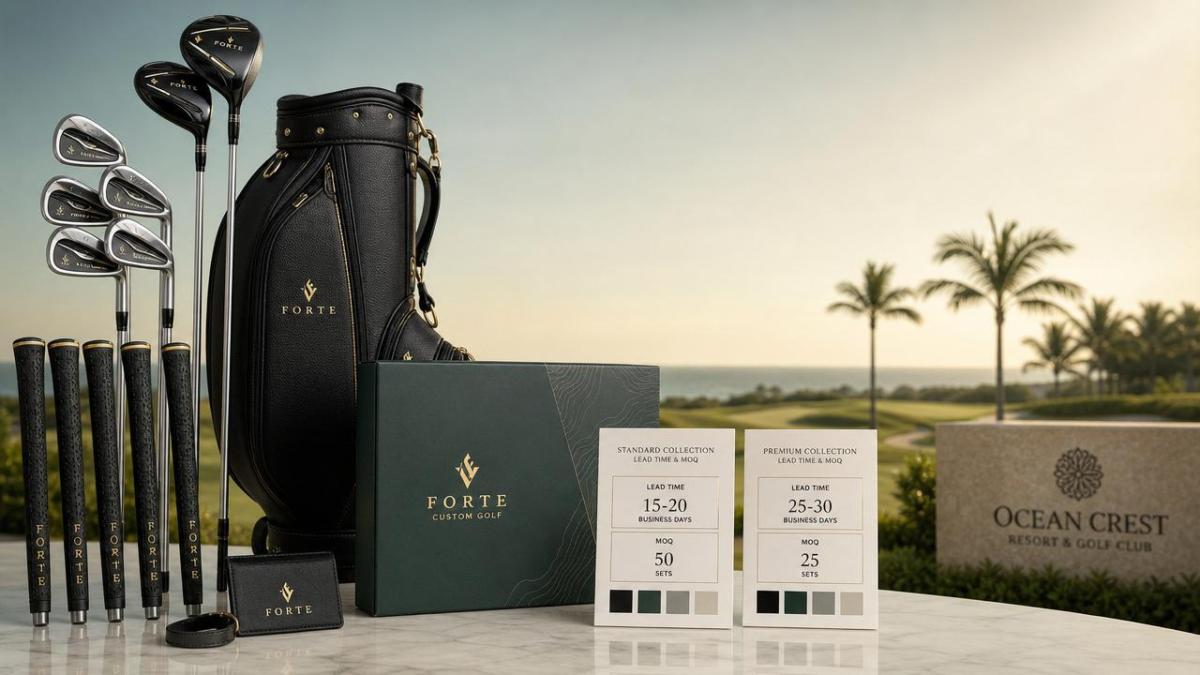
The table below gives a practical comparison framework.
The stronger factories do not just promise speed. They explain their calendar, material dependencies, and buffer time with clarity.
What custom options actually create value for golf travel retail?
Customization only works when it supports a clear commercial use. A golf clubs manufacturer may offer dozens of options, but not all of them improve sell-through.
In tourism-related channels, compact collections and destination-specific branding often outperform overbuilt product ranges. Travelers usually respond to convenience, story, and gift appeal.
Useful custom options often include logo engraving, shaft flex selection, grip color, headcover branding, and packaging designed for resort or duty-free display.
There is also growing interest in private-label sets built for golf holidays, rental upgrades, and premium welcome packages. These require coordination beyond the club itself.
A capable golf clubs manufacturer should explain which elements use standard components and which require new tooling. That distinction affects both price and speed.
If sustainability matters to your brand position, ask about recycled packaging, low-waste finishing, and material traceability. Those details increasingly support premium travel merchandising.
Customization areas that deserve closer review
- Club performance options such as loft, lie, shaft, and grip combinations
- Visual branding through logos, color accents, and engraved finishes
- Retail presentation including boxes, gift sets, and travel-safe packaging
- Accessory bundles for resorts, events, and golf vacation promotions
When comparing suppliers, what warning signs usually get missed?
Many sourcing problems appear after sampling, not before. A polished prototype can hide weak production controls or limited consistency across larger runs.
One common mistake is comparing only unit cost. A slightly cheaper golf clubs manufacturer may create higher freight waste, more defects, or slower replenishment.
Another missed issue is communication depth. If technical answers stay vague, future changes to grips, shafts, or artwork can become expensive and slow.
Documentation also matters. Clear specifications, inspection standards, and packaging approvals reduce disputes, especially in multi-country travel distribution.
GCS often highlights this point in supply chain reviews: trust grows from verifiable detail. Certifications, process records, and quality checkpoints usually matter more than broad claims.
If a supplier avoids discussing warranty handling or replacement policy, that is worth noting early. After-sales friction can damage both margins and brand reputation.
A quick warning checklist
- MOQ sounds flexible, but customization choices become severely restricted
- Lead time is quoted without material sourcing or inspection steps
- Samples look strong, yet no bulk quality standard is documented
- Packaging support is weak for resort retail or travel shipment needs
What is the smartest next step before choosing a golf clubs manufacturer?
Start by narrowing the product goal. A premium resort collection, event giveaway set, and rental fleet upgrade all need different MOQ and customization strategies.
Then compare suppliers using one identical brief. That should include target price, expected order volume, finish level, packaging requirements, and required delivery window.
A short comparison sheet usually works better than scattered email threads. It reveals which golf clubs manufacturer understands the project and which one is only quoting fast.
Where possible, test one pilot order before expanding the range. Small-scale validation is often the safest way to check consistency, transit durability, and actual sell-through.
Reliable sourcing is rarely about finding the cheapest factory. It is about matching MOQ, lead time, and custom options to a realistic sales environment.
If you are reviewing the market through a research-driven lens, keep a record of lead time assumptions, component limits, and packaging details. That makes later decisions far easier.
The best golf clubs manufacturer is usually the one that can support repeatable quality, practical flexibility, and timely delivery without forcing unnecessary complexity into the project.
From here, the useful next move is simple: define the product scope, compare real production terms, and validate every promise that affects timing, cost, and guest-facing quality.
Related Intelligence
 Cosmetics & PkgOct 21, 2026BASF Plans Beauty Innovation Showcase at in-cosmetics Asia 2026Explore BASF’s planned beauty innovations at in-cosmetics Asia 2026 in Bangkok, with a focus on skin protection, repair and sustainable solutions for personal care formulators.
 Cosmetics & PkgOct 20, 2026Beauty Tops Amazon’s 2026 Prime Big Deal Days Shopping CategoriesBeauty tops Amazon’s 2026 Prime Big Deal Days at 32% of shoppers, according to Market Defense. Explore what the findings could mean for product selection, inventory and promotional planning.
 Baby Gear & StrollersOct 14, 2026How Long Does Custom Diaper Bag Production Usually Take?How long does custom diaper bag production usually take? Plan for 30–60 days after sample approval. Discover key lead-time factors and practical tips to avoid delays and launch on schedule.
 Baby Gear & StrollersOct 14, 2026Which Diaper Bag Features Justify a Higher Wholesale Price?What diaper bag features justify a higher wholesale price? Discover durability, comfort, and easy-clean upgrades worth paying for—and source smarter with practical buyer tips.
 Infant Feeding & CareOct 14, 2026How Can Retailers Prevent Baby Clothing Color Bleeding Claims?How can retailers avoid color bleeding claims on baby clothing? Discover testing, supplier controls, and care-label strategies to reduce returns and protect customer trust.
 Infant Feeding & CareOct 14, 2026Which Baby Clothing Materials Are Easier to Source Compliantly?What materials make baby clothing easier to source compliantly? Compare cotton, blends, and certified options, with practical supplier checks to reduce risk and make smarter sourcing decisions.
 Baby Gear & StrollersOct 14, 2026Are Baby Carrier Buckle Failures a Common Reason for Returns?Are baby carrier buckle failures a common return issue? Explore defects, usability complaints, and safety checks to make informed sourcing decisions before your next order.
 Baby Gear & StrollersOct 14, 2026How Do You Compare Baby Carrier Suppliers on Safety and Cost?How do I compare baby carrier suppliers on safety and cost? Learn to verify safety evidence, assess factory controls, and compare total landed costs to make a confident sourcing decision.
 STEM & Educational ToysSep 20, 2026How Do I Verify Age Grading for Educational Toys?How do I verify educational toy age grading? Learn how to assess safety risks, test reports, packaging, and market compliance before buying or selling.
 Corporate & Seasonal GiftsSep 20, 2026Are Promotional Items Worth Ordering for Short Campaigns?Are promotional items worth ordering for short campaigns? Learn how pet brands can choose useful, compliant giveaways that drive measurable engagement, sales, and loyalty.
 STEM & Educational ToysSep 20, 2026What Safety Checks Should Wooden Toy Suppliers Pass?What safety checks should wooden toy suppliers pass? Explore essential compliance, material traceability, chemical testing, and quality controls to source safer toys with confidence.
 Infant Feeding & CareSep 20, 2026Which Teething Toy Materials Are Easiest to Clean?Which teething toy materials are easiest to clean? Discover why silicone and natural rubber lead for hygienic, easy-care pet chew toys.
 Infant Feeding & CareSep 20, 2026How Can Retailers Prevent Mold Complaints About Bath Toys?How can retailers prevent mold complaints about bath toys? Explore drainable designs, supplier controls, testing, and care guidance to reduce moisture risks.