FDA CPIS Mandate Effective July 2026 for US Cosmetic Imports
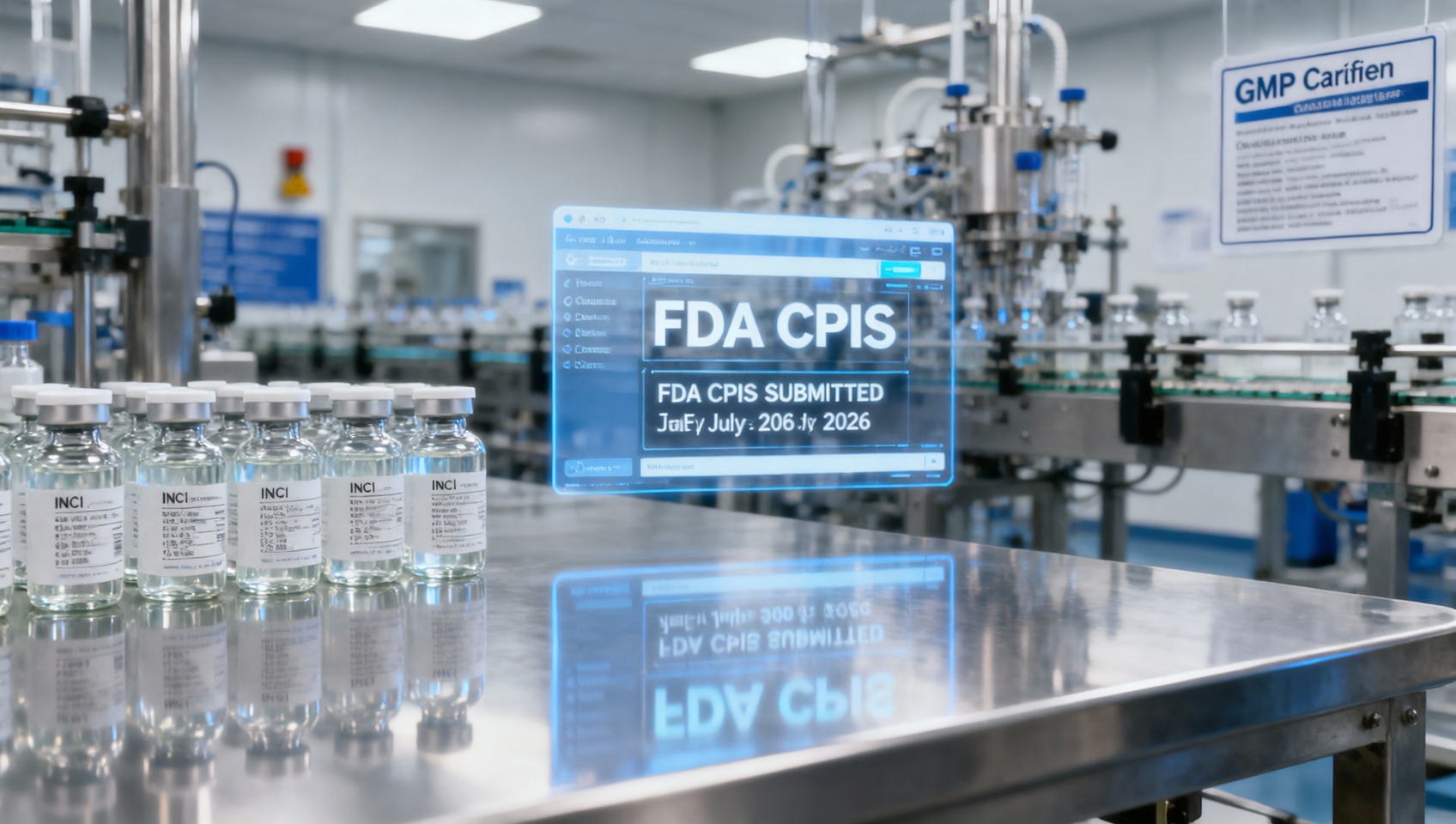
On April 26, 2026, the U.S. Food and Drug Administration (FDA) updated its guidance on cosmetic ingredient safety reporting, mandating use of the new Cosmetic Product Ingredient Statement (CPIS) system starting July 1, 2026. This requirement directly impacts skincare OEMs, cosmetics manufacturers, and packaging suppliers exporting to the U.S.—particularly those based in China—by tying customs clearance to timely online submission of ingredient data, GMP compliance declarations, and responsible party credentials.
Event Overview
On April 26, 2026, the FDA formally issued the updated Cosmetic Producer and Importer Safety Reporting Guidance. The update specifies that, effective July 1, 2026, all cosmetic products imported into the United States must be registered via the newly launched Cosmetic Product Information Submission (CPIS) system. Required submissions include full ingredient listings, a signed statement confirming adherence to current Good Manufacturing Practice (cGMP) standards, and verification of the designated U.S. agent or responsible party. Products lacking valid CPIS registration will be denied entry at U.S. ports of entry.
Industries Affected
Skincare OEMs and Contract Manufacturers
These entities are directly responsible for initiating CPIS submissions when acting as the foreign manufacturer or responsible party. Because CPIS requires granular ingredient-level disclosure—including INCI names, concentrations (where applicable), and functional roles—their formulation documentation and internal compliance workflows must now align with FDA’s digital reporting structure. Delays in system onboarding or incomplete data may halt shipment timelines.
Cosmetics & Packaging Exporters
Companies exporting finished goods—including combined product-and-packaging units—must ensure their brand clients or U.S. importers have completed CPIS registration before shipment. Under the rule, the importer of record is ultimately liable for CPIS compliance; however, OEMs and exporters often supply critical documentation (e.g., ingredient specifications, manufacturing site certifications). Any misalignment between supplier-provided data and CPIS entries risks rejection upon arrival.
U.S.-Based Importers and Brand Owners
Importers bear legal responsibility for CPIS registration under the Modernization of Cosmetics Regulation Act (MoCRA). They must verify that all foreign suppliers provide accurate, up-to-date information—including batch-level consistency across SKUs—and maintain records supporting each submission. Failure to validate upstream data increases exposure to FDA enforcement actions, including detention or refusal of entry.
Key Focus Areas and Recommended Actions
Monitor official FDA communications for CPIS technical specifications
The FDA has not yet published final technical documentation for CPIS API integration, file format requirements, or validation rules for multi-ingredient formulations. Companies should subscribe to FDA’s Cosmetic Registration and Listing Program email alerts and review updates posted to fda.gov/cosmetics to anticipate system readiness timelines and testing windows.
Map CPIS requirements to current product portfolios by Q2 2025
Businesses should inventory all SKUs destined for the U.S. market and identify which require CPIS registration (e.g., leave-on skincare, rinse-off cleansers, color cosmetics). Prioritize high-volume or high-risk categories—such as products containing preservatives, botanical extracts, or nanomaterials—where ingredient transparency and stability documentation are most likely to trigger FDA scrutiny during initial reviews.
Distinguish between MoCRA’s existing listing obligations and new CPIS mandates
Since December 2023, MoCRA has required cosmetic facility registration and product listing. CPIS introduces a separate, mandatory layer: ingredient-level safety reporting. Companies should avoid conflating the two systems—CPIS does not replace facility registration or product listing, nor does it accept abbreviated ingredient disclosures. Each CPIS submission must reflect the exact composition used in production.
Initiate cross-functional alignment between regulatory, QA, and supply chain teams
CPIS implementation depends on reliable access to formulation masters, GMP audit reports, and authorized signatory authority. Teams should confirm internal ownership of data governance, assign CPIS submission responsibilities, and draft standard operating procedures (SOPs) for data collection, validation, and version control—especially for contract-manufactured items where formulation changes may occur without direct oversight.
Editorial Perspective / Industry Observation
From an industry perspective, the July 2026 CPIS deadline represents a procedural escalation—not a policy shift. It operationalizes long-anticipated MoCRA provisions by introducing a structured, digital mechanism for ingredient traceability. Analysis来看, this is less a sudden compliance shock and more a formalized checkpoint in an evolving regulatory continuum. Observation来看, early adopters who treat CPIS as a data infrastructure project—not just a filing task—will gain measurable advantages in speed-to-market and audit readiness. Current更值得关注的是 how FDA interprets ‘responsible party’ accountability across complex supply chains, particularly when multiple contractors handle formulation, filling, labeling, and packaging.
Conclusion
This mandate signals a structural tightening of U.S. cosmetic import controls—not merely a paperwork update. It reinforces that ingredient transparency, documented GMP adherence, and verifiable U.S. representation are now non-negotiable conditions of market access. Rather than viewing CPIS as an isolated deadline, stakeholders should recognize it as the first enforceable application of MoCRA’s core safety framework. A measured, process-oriented response—grounded in data accuracy and interdepartmental coordination—is more appropriate than reactive compliance.
Information Sources
Main source: U.S. FDA, Cosmetic Producer and Importer Safety Reporting Guidance (updated April 26, 2026).
Areas requiring ongoing observation: CPIS technical documentation release schedule, FDA’s definition of ‘batch-level consistency’ for multi-SKU formulations, and enforcement posture during the first six months post-implementation.
Related Intelligence
 Baby Gear & StrollersApr 27, 2026Global Shipping Alliances Cut Shanghai–Rotterdam Capacity by 15%Global shipping alliances cut Shanghai–Rotterdam capacity by 15%—impacting baby strollers & gear exporters, EU retailers, and forwarders. Act now to secure space, assess rail/air alternatives, and build resilient supply chains.
 Camping & WaterApr 27, 2026SASO IEC 62368-3:2026 Released for GCC: IP6X Dust Testing Required for Camping & Water PumpsSASO IEC 62368-3:2026 now mandates IP6X dust testing for camping & water pumps in GCC — act now to avoid customs delays and ensure compliance by Oct 1, 2026.
 Nursery Furniture & MonitorsApr 27, 2026Indonesia BPOM Fast-Tracks Baby Monitor Registration to 14 Working DaysIndonesia BPOM Fast-Tracks Baby Monitor Registration to 14 working days—leverage CNAS reports & ID-SNI 7203:2025 for rapid market entry.
 Corporate & Seasonal GiftsApr 27, 2026TÜV Rheinland Releases Sustainable Gift Packaging White Paper 2026Sustainable gift packaging white paper 2026 by TÜV Rheinland: New LCA rules for VOCs, container loading & last-mile transport — act now to meet IKEA, Douglas Q3 2026 requirements.
 Smart Pet DevicesApr 27, 2026JETRO Summer Inspection: Smart Pet Collars Must Pass JIS T 1002:2026 Bluetooth TestSmart Pet Collars must pass JIS T 1002:2026 Bluetooth 5.4 coexistence testing for JETRO’s 2026 summer inspection — avoid delays, recalls & lost sales in Japan.
 Fitness EquipmentApr 27, 2026CPSC Mandates Emergency Stop & Thermal Cutoff for US Fitness MirrorsCPSC mandates emergency stop & thermal cutoff for US fitness mirrors—urgent compliance required by July 2026. Learn implications for OEMs, importers & suppliers.
 STEM & Educational ToysApr 27, 2026SASO Updates Toy Certification: EN71-3:2026 for STEM Toys in Saudi ArabiaSASO EN71-3:2026 toy certification now mandatory for STEM toys in Saudi Arabia—nickel, cobalt & antimony limits tightened. Act before Aug 1, 2026!
 Infant Feeding & CareApr 27, 2026RCEP Update: Vietnam Cuts Tariffs on Silicone Nipples, Smart Bottles from ChinaRCEP Update: Vietnam cuts tariffs on silicone nipples & smart bottles from China—save 9–13% import costs starting May 1, 2026. Act now!
 Beauty DevicesApr 27, 2026EU EPR Carbon Fee for Smart Beauty Devices Starts June 2026EU EPR Carbon Fee for Smart Beauty Devices starts June 2026 — learn how the new Green Packaging Regulation Fee impacts OEMs, suppliers & EU importers.
 Skincare OEMApr 27, 2026FDA CPIS Mandate Effective July 2026 for US Cosmetic ImportsFDA CPIS mandate takes effect July 2026—learn how skincare OEMs, cosmetic exporters & U.S. importers must comply to avoid shipment delays and entry denials.
 Beauty DevicesApr 26, 2026Global Li-ion Recycling Rate Hits 62%: Beauty Device Battery BOM Cost Down 9%Li-ion recycling hits 62% globally—cutting beauty device battery BOM costs by 9% and lead times to 6 weeks. Act now to boost export agility & margins.
") Smart Pet DevicesApr 26, 2026Vietnam Enforces New Smart Pet Collar Standard (QCVN 135:2026)Vietnam Enforces New Smart Pet Collar Standard (QCVN 135:2026): Bluetooth 5.4 resilience & native Vietnamese voice prompts required by July 1, 2026 — act now to avoid customs delays!
Smart Pet DevicesApr 26, 2026Vietnam Enforces New Smart Pet Collar Standard (QCVN 135:2026)Vietnam Enforces New Smart Pet Collar Standard (QCVN 135:2026): Bluetooth 5.4 resilience & native Vietnamese voice prompts required by July 1, 2026 — act now to avoid customs delays! Nursery Furniture & MonitorsApr 26, 2026Shanghai International Logistics Procurement Expo 2026 ClosesShanghai International Logistics Procurement Expo 2026 closed—AI-powered smart infant & pet health devices led procurement demand. Discover key trends, buyer priorities & 2027 outlook.