Indonesia BPOM Fast-Tracks Baby Monitor Registration to 14 Working Days
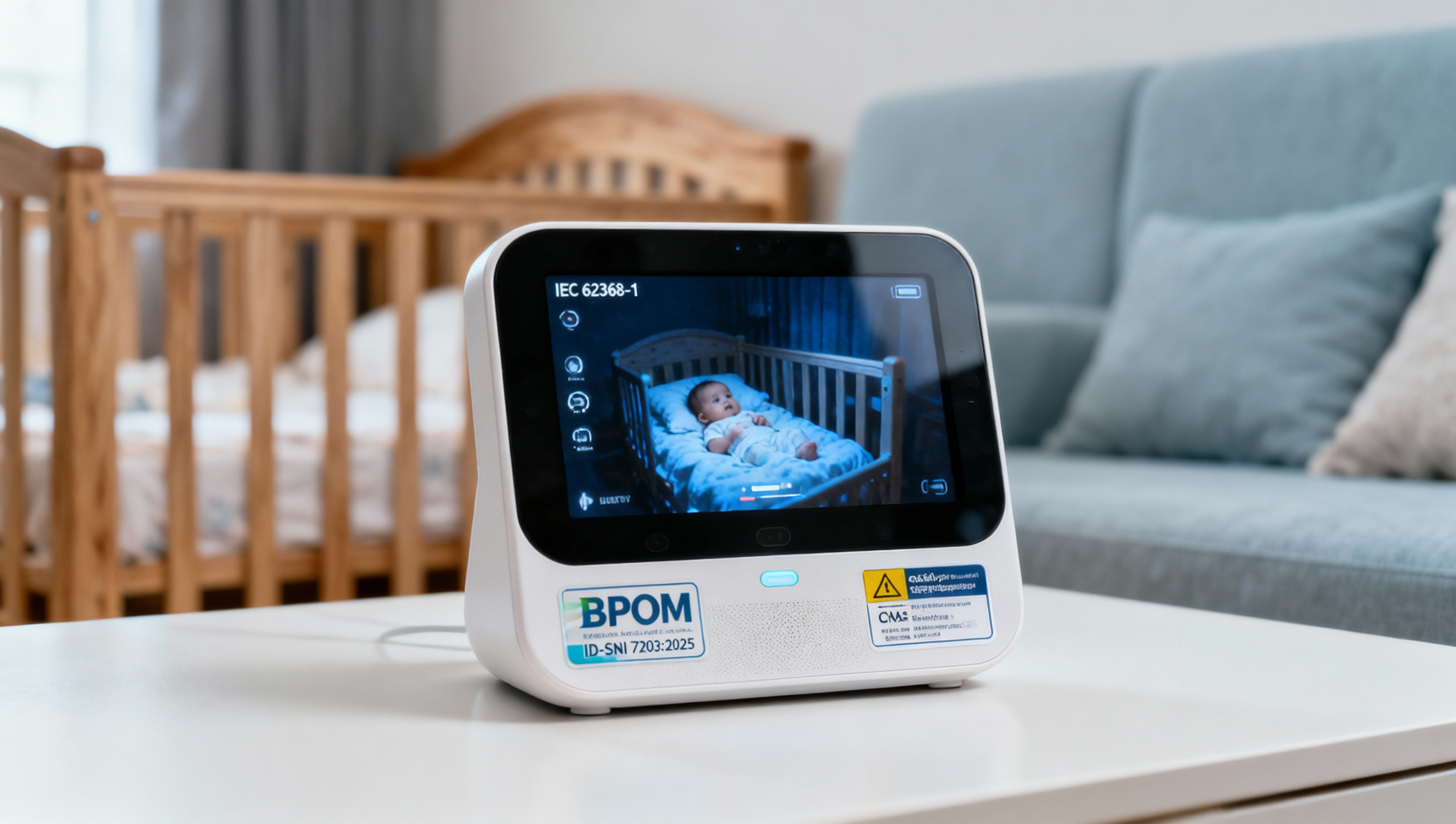
On April 26, 2026, Indonesia’s National Agency of Drug and Food Control (BPOM) launched a Fast Track Registration pathway for nursery monitors—including video baby monitors and respiration sensing pads—certified to IEC 62368-1 and ID-SNI 7203:2025. This development significantly shortens the local registration timeline from 90 to 14 working days for complete submissions, with initial acceptance of CNAS-accredited test reports from China. Medical device exporters, pediatric electronics manufacturers, and regulatory service providers serving the Southeast Asian market should closely monitor implications for product launch timing, certification strategy, and regional compliance planning.
Event Overview
On April 26, 2026, the Indonesian Food and Drug Authority (BPOM) announced the opening of a ‘Fast Track Registration’ channel for Nursery Furniture & Monitors products—including video baby monitors and breathing monitoring pads—that comply with IEC 62368-1 and ID-SNI 7203:2025. Under this pathway, registration processing time is reduced to 14 working days, provided all required documentation is submitted. The initiative initially accepts test reports issued by laboratories accredited by China’s National Accreditation Service for Conformity Assessment (CNAS).
Industries Affected by This Policy Change
Medical Device Exporters (especially from China)
Why affected: These companies rely on timely BPOM registration to enter or expand in Indonesia—a high-growth ASEAN market. The 14-day window represents a material reduction in time-to-market risk.
Impact areas: Reduced pre-market lead time; increased predictability for commercial launch scheduling; potential shift in priority markets for near-term product rollouts.
Pediatric Consumer Electronics Manufacturers
Why affected: Products such as video baby monitors and contactless respiration pads fall directly under the newly fast-tracked category. Compliance with ID-SNI 7203:2025—and not just IEC 62368-1—is now operationally decisive.
Impact areas: Accelerated need for SNI-aligned testing; possible redesign or labeling adjustments for Indonesia-specific versions; tighter coordination between R&D and regulatory affairs teams.
Regulatory Affairs & Certification Service Providers
Why affected: The pilot acceptance of CNAS reports introduces a new validation route for BPOM submissions—distinct from traditional BPOM-recognized labs or ISO/IEC 17025 bodies designated by BPOM.
Impact areas: Demand for dual-capability support (IEC + ID-SNI); need to verify CNAS lab scope against BPOM’s current list of accepted reports; updated client advisories on evidence hierarchy and fallback options.
What Relevant Companies or Practitioners Should Focus On Now
Monitor official updates on BPOM’s list of accepted CNAS-accredited labs
The announcement states “first batch pilot acceptance” of CNAS reports—but does not publish a definitive, publicly accessible list of qualifying labs. Companies must confirm whether their existing test lab is included before submitting.
Verify alignment of product testing scope with ID-SNI 7203:2025 requirements—not just IEC 62368-1
ID-SNI 7203:2025 includes Indonesia-specific safety, labeling, and performance provisions for nursery monitors. Analysis来看, conformance to IEC 62368-1 alone does not guarantee eligibility for the fast track. Testing reports must explicitly cover ID-SNI 7203:2025 clauses.
Distinguish between policy signal and operational readiness
From industry perspective, this is a procedural acceleration—not a relaxation of technical or documentation standards. All existing BPOM dossier requirements (e.g., local authorized representative, Indonesian-language labeling, post-market surveillance commitments) remain fully applicable. The 14-day timeline applies only when zero deficiencies are identified upon initial review.
Prepare for concurrent submission workflows
Given the compressed cycle, companies should align internal processes: finalizing Indonesian labeling files, appointing an in-country representative, and completing BPOM’s electronic registration portal training *before* initiating testing—rather than sequentially.
Editorial Perspective / Industry Observation
This update is better understood as a targeted administrative optimization—not a broad regulatory liberalization. Observation来看, BPOM appears to be prioritizing speed for low-risk, high-volume consumer health devices where international standards (IEC) already provide strong baseline assurance. Current more appropriate interpretation is that it reflects BPOM’s capacity-building efforts and growing recognition of aligned conformity assessment infrastructure across ASEAN and key trading partners like China. However, it does not signal imminent expansion of the fast track to other medical device classes or broader SNI harmonization. Continued attention is warranted for any extension to Class II devices or inclusion of additional accreditation bodies beyond CNAS.
Indonesia’s BPOM Fast-Track Registration for baby monitors marks a concrete step toward predictable, standards-based market access—but its scope remains narrow and conditional. For stakeholders, the immediate value lies not in regulatory simplification, but in improved planning certainty for one well-defined product segment. The policy underscores that alignment with both international (IEC) and national (ID-SNI) standards—plus rigorous documentation discipline—is now the prerequisite for accessing accelerated timelines.
Source: Official announcement by Badan Pengawas Obat dan Makanan (BPOM) of Indonesia, dated April 26, 2026. Note: BPOM’s public list of accepted CNAS-accredited laboratories and formal guidance documents on ID-SNI 7203:2025 implementation remain pending publication and are subject to ongoing observation.
Related Intelligence
 Baby Gear & StrollersApr 27, 2026Global Shipping Alliances Cut Shanghai–Rotterdam Capacity by 15%Global shipping alliances cut Shanghai–Rotterdam capacity by 15%—impacting baby strollers & gear exporters, EU retailers, and forwarders. Act now to secure space, assess rail/air alternatives, and build resilient supply chains.
 Camping & WaterApr 27, 2026SASO IEC 62368-3:2026 Released for GCC: IP6X Dust Testing Required for Camping & Water PumpsSASO IEC 62368-3:2026 now mandates IP6X dust testing for camping & water pumps in GCC — act now to avoid customs delays and ensure compliance by Oct 1, 2026.
 Nursery Furniture & MonitorsApr 27, 2026Indonesia BPOM Fast-Tracks Baby Monitor Registration to 14 Working DaysIndonesia BPOM Fast-Tracks Baby Monitor Registration to 14 working days—leverage CNAS reports & ID-SNI 7203:2025 for rapid market entry.
 Corporate & Seasonal GiftsApr 27, 2026TÜV Rheinland Releases Sustainable Gift Packaging White Paper 2026Sustainable gift packaging white paper 2026 by TÜV Rheinland: New LCA rules for VOCs, container loading & last-mile transport — act now to meet IKEA, Douglas Q3 2026 requirements.
 Smart Pet DevicesApr 27, 2026JETRO Summer Inspection: Smart Pet Collars Must Pass JIS T 1002:2026 Bluetooth TestSmart Pet Collars must pass JIS T 1002:2026 Bluetooth 5.4 coexistence testing for JETRO’s 2026 summer inspection — avoid delays, recalls & lost sales in Japan.
 Fitness EquipmentApr 27, 2026CPSC Mandates Emergency Stop & Thermal Cutoff for US Fitness MirrorsCPSC mandates emergency stop & thermal cutoff for US fitness mirrors—urgent compliance required by July 2026. Learn implications for OEMs, importers & suppliers.
 STEM & Educational ToysApr 27, 2026SASO Updates Toy Certification: EN71-3:2026 for STEM Toys in Saudi ArabiaSASO EN71-3:2026 toy certification now mandatory for STEM toys in Saudi Arabia—nickel, cobalt & antimony limits tightened. Act before Aug 1, 2026!
 Infant Feeding & CareApr 27, 2026RCEP Update: Vietnam Cuts Tariffs on Silicone Nipples, Smart Bottles from ChinaRCEP Update: Vietnam cuts tariffs on silicone nipples & smart bottles from China—save 9–13% import costs starting May 1, 2026. Act now!
 Beauty DevicesApr 27, 2026EU EPR Carbon Fee for Smart Beauty Devices Starts June 2026EU EPR Carbon Fee for Smart Beauty Devices starts June 2026 — learn how the new Green Packaging Regulation Fee impacts OEMs, suppliers & EU importers.
 Skincare OEMApr 27, 2026FDA CPIS Mandate Effective July 2026 for US Cosmetic ImportsFDA CPIS mandate takes effect July 2026—learn how skincare OEMs, cosmetic exporters & U.S. importers must comply to avoid shipment delays and entry denials.
 Beauty DevicesApr 26, 2026Global Li-ion Recycling Rate Hits 62%: Beauty Device Battery BOM Cost Down 9%Li-ion recycling hits 62% globally—cutting beauty device battery BOM costs by 9% and lead times to 6 weeks. Act now to boost export agility & margins.
") Smart Pet DevicesApr 26, 2026Vietnam Enforces New Smart Pet Collar Standard (QCVN 135:2026)Vietnam Enforces New Smart Pet Collar Standard (QCVN 135:2026): Bluetooth 5.4 resilience & native Vietnamese voice prompts required by July 1, 2026 — act now to avoid customs delays!
Smart Pet DevicesApr 26, 2026Vietnam Enforces New Smart Pet Collar Standard (QCVN 135:2026)Vietnam Enforces New Smart Pet Collar Standard (QCVN 135:2026): Bluetooth 5.4 resilience & native Vietnamese voice prompts required by July 1, 2026 — act now to avoid customs delays! Nursery Furniture & MonitorsApr 26, 2026Shanghai International Logistics Procurement Expo 2026 ClosesShanghai International Logistics Procurement Expo 2026 closed—AI-powered smart infant & pet health devices led procurement demand. Discover key trends, buyer priorities & 2027 outlook.