UBA to Pilot Carbon Labels for Corporate Gifts in Germany from Q3 2026
Germany’s Federal Environment Agency (UBA) has launched a public consultation on its Draft Initiative on Sustainable Corporate Gifting, announcing plans to pilot carbon labeling for corporate and seasonal gifts—covering custom packaging, printing inks, and promotional items—starting in Q3 2026 across six major cities. This development directly impacts OEM gift manufacturers, packaging suppliers, print service providers, and EU importers, particularly those sourcing from China. It signals an early regulatory shift toward transparency in the B2B gifting supply chain, where environmental data is becoming a prerequisite for market access.
Event Overview
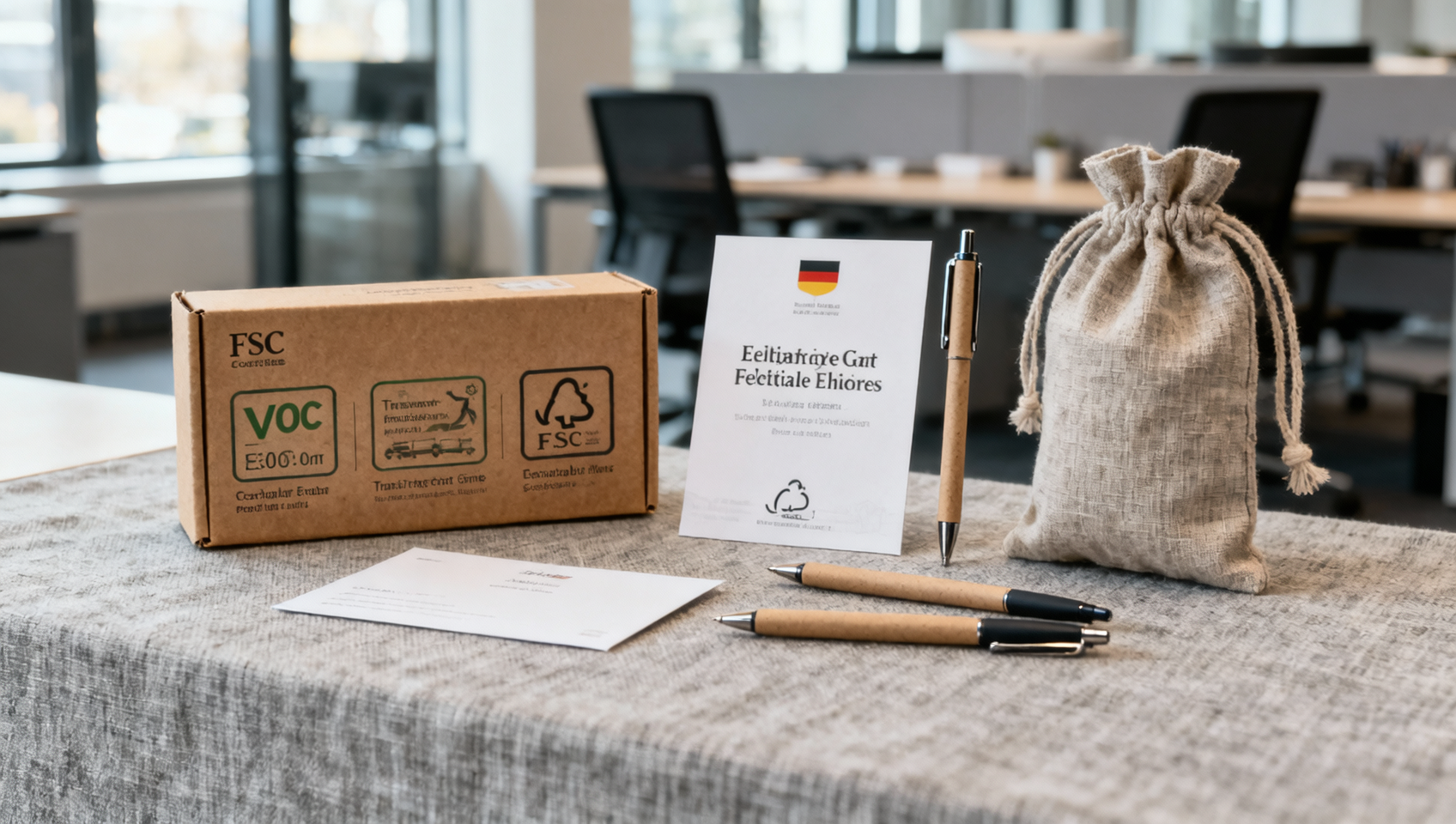
On 27 April 2026, the German Federal Environment Agency (UBA) published the Draft Initiative on Sustainable Corporate Gifting for public comment. The initiative proposes a voluntary carbon labeling pilot program for ‘Corporate & Seasonal Gifts’, set to launch in Q3 2026 in Berlin, Munich, Hamburg, Cologne, Frankfurt, and Stuttgart. Under the pilot, product packaging for custom gift boxes, promotional giveaways, and holiday sets must display three mandatory metrics: VOC emissions from printing inks, transport-related carbon footprint, and FSC certification status. The consultation remains open; no final regulation or binding timeline has been adopted.
Industries Affected
Custom Gift OEM Manufacturers (especially China-based)
These manufacturers produce finished gift sets—including printed boxes, branded stationery, and bundled seasonal kits—for EU clients. They are directly affected because label compliance requires upstream life cycle assessment (LCA) data—not just for finished goods, but specifically for ink formulations and transport logistics. Without verified LCA baselines, they cannot support downstream labeling claims—even under a voluntary framework.
Packaging & Print Suppliers
Suppliers of corrugated gift boxes, laminated sleeves, and offset/digital printing services must now provide VOC emission profiles per ink batch and document transport routes (e.g., sea freight leg + inland haulage). Ink vendors, in particular, face new data disclosure expectations—not only for REACH compliance but also for carbon-intensity benchmarking tied to specific print applications.
EU-Based Importers & Brand Owners
Companies placing corporate gifts on the German market—whether as end users (e.g., banks, insurers) or B2B distributors—will be responsible for label accuracy and consistency across SKUs. Though the initiative is labeled ‘voluntary’, participation in the pilot implies alignment with UBA’s emerging expectations for traceability, making pre-emptive verification of supplier data essential.
What Stakeholders Should Monitor and Do Now
Track official updates on UBA’s consultation timeline and scope definition
The current draft is open for feedback until mid-June 2026. Stakeholders should monitor UBA’s official portal for revisions—particularly whether ‘voluntary’ remains unchanged, or if thresholds (e.g., minimum order volume, company size) are introduced that could de facto broaden applicability.
Identify and prioritize high-volume pilot-market SKUs
Not all corporate gift lines will be equally exposed. Focus first on products shipped to the six pilot cities—especially those with complex packaging (multi-layer boxes, foil stamping, mixed-material inserts) and long-haul logistics (e.g., China → Hamburg port → Berlin warehouse), as these carry higher data collection burdens and greater visibility risk.
Distinguish between policy signal and operational requirement
This is not yet a legal mandate. However, early adopters—including German retailers and sustainability-conscious corporates—are likely to incorporate labeling readiness into supplier evaluations ahead of formal rollout. Treat the pilot less as a compliance deadline and more as a data-readiness benchmark.
Begin internal LCA scoping for ink and transport modules
Chinese OEMs and their EU partners should initiate basic LCA mapping for two key modules: (1) ink VOC profiles (by chemistry type—e.g., soy-based vs. solvent-based); and (2) transport carbon factors (by mode, distance, container load efficiency). Third-party verification is not required at this stage—but internally consistent, auditable records are.
Editorial Perspective / Industry Observation
Observably, this initiative functions primarily as a policy signal—not an immediate regulatory obligation. Its voluntary framing, limited geographic scope, and absence of enforcement mechanisms indicate UBA is testing stakeholder capacity and data infrastructure before considering broader application. From an industry perspective, it reflects growing convergence between ESG reporting expectations and tangible product-level disclosures in non-regulated B2B segments. Analysis shows that similar labeling approaches have previously served as precursors to mandatory schemes in other EU sectors (e.g., textiles, electronics), suggesting this pilot may lay groundwork for future harmonization under the EU Green Claims Directive or extended producer responsibility frameworks.
Conclusion
UBA’s corporate gift carbon labeling pilot marks an early, targeted step toward embedding environmental accountability deeper into promotional product supply chains. For now, it does not impose legal obligations—but it does raise the baseline for data transparency expected by leading EU buyers. Stakeholders are advised to treat it as a low-risk, high-learning opportunity: one that reveals where data gaps exist, which partners can support verification, and how quickly supply chain actors can align on shared sustainability metrics.
Information Sources
Main source: German Federal Environment Agency (UBA) – Draft Initiative on Sustainable Corporate Gifting, published 27 April 2026. Public consultation status and pilot city list confirmed via UBA press release and regulatory docket #UBA-GIFT-2026-01. Note: Final requirements, implementation rules, and potential expansion beyond the pilot phase remain subject to ongoing review and are not yet determined.
Related Intelligence
 Electronic & RC ToysApr 28, 2026ICTA 2026 Q2 RC Toy Sourcing Report: Shift to Guangdong ClusterICTA 2026 Q2 RC Toy Sourcing Report reveals 68% of global electronic RC toy orders shifting to Guangdong’s Shenzhen–Dongguan–Zhongshan cluster — driven by dual-band modules, UL9990 batteries & rapid prototyping. Act now.
 Skincare OEMApr 28, 2026FDA Adds Plant Stem Cell Extract Code to CPIS SystemFDA adds COS-PLS-2026 code for plant stem cell extract in CPIS — vital for skincare OEMs, suppliers & U.S. importers. Act now to ensure compliance by July 1, 2026.
 Nursery Furniture & MonitorsApr 28, 2026Vietnam Exempts Infant Monitors from Local Type TestingVietnam exempts infant monitors from local type testing—leverage your NMPA Class II filing to fast-track Vietnam market entry starting June 1, 2026.
 Corporate & Seasonal GiftsApr 28, 2026UBA to Pilot Carbon Labels for Corporate Gifts in Germany from Q3 2026UBA carbon labels for corporate gifts launch Q3 2026 in Germany—key for OEMs, packaging & print suppliers. Act now to prep LCA data & stay ahead.
 Camping & WaterApr 28, 2026SASO TA-2026-03: Camping Power & Inflatable Pumps Require IP6X + Salt Spray Testing for Saudi MarketSASO TA-2026-03 mandates IP6X + salt spray testing for camping power & inflatable pumps in Saudi Arabia — act now to avoid shipment delays post-Sept 1, 2026.
 Fitness EquipmentApr 28, 2026THE Alliance Cuts Shanghai–LA Capacity by 22% Amid Port CongestionTHE Alliance cuts Shanghai–LA capacity by 22% amid port congestion—impacting fitness equipment exporters, importers & logistics providers with longer lead times and higher deposits.
 Smart Pet DevicesApr 28, 2026Japan METI Launches Smart Pet Device Green Procurement ListSmart Pet Device Green Procurement List launched by Japan METI—key for Chinese exporters of smart pet collars, feeders & water dispensers. Act now to meet JIS T 1002:2026 and NB-IoT requirements.
 Infant Feeding & CareApr 28, 2026RCEP Members Adopt ASEAN-FFL 2026 for Infant Feeding ProductsRCEP Members Adopt ASEAN-FFL 2026 for Infant Feeding Products: New multilingual labelling rules for pacifiers, baby bottles & grinders take effect 1 Dec 2026 in Vietnam, Thailand, Indonesia — act now to avoid customs delays.
 2026/789: Beauty Device Packaging Must Declare Recycled Plastic & LCA") Beauty DevicesApr 28, 2026EU Regulation (EU) 2026/789: Beauty Device Packaging Must Declare Recycled Plastic & LCAEU Regulation (EU) 2026/789 mandates recycled plastic labeling & EN 15804+A2 LCA for beauty devices—act now to ensure EU market access and avoid delays.
Beauty DevicesApr 28, 2026EU Regulation (EU) 2026/789: Beauty Device Packaging Must Declare Recycled Plastic & LCAEU Regulation (EU) 2026/789 mandates recycled plastic labeling & EN 15804+A2 LCA for beauty devices—act now to ensure EU market access and avoid delays. STEM & Educational ToysApr 28, 2026CPSC Requires Nano-Material Migration Testing for STEM Toys from Q2 2026CPSC requires nano-material migration testing for STEM toys starting Q2 2026—key for exporters, OEMs & labs. Act now to ensure compliance with ZnO/TiO₂ saliva/sweat testing.
 Baby Gear & StrollersApr 27, 2026Global Shipping Alliances Cut Shanghai–Rotterdam Capacity by 15%Global shipping alliances cut Shanghai–Rotterdam capacity by 15%—impacting baby strollers & gear exporters, EU retailers, and forwarders. Act now to secure space, assess rail/air alternatives, and build resilient supply chains.
 Camping & WaterApr 27, 2026SASO IEC 62368-3:2026 Released for GCC: IP6X Dust Testing Required for Camping & Water PumpsSASO IEC 62368-3:2026 now mandates IP6X dust testing for camping & water pumps in GCC — act now to avoid customs delays and ensure compliance by Oct 1, 2026.
 Nursery Furniture & MonitorsApr 27, 2026Indonesia BPOM Fast-Tracks Baby Monitor Registration to 14 Working DaysIndonesia BPOM Fast-Tracks Baby Monitor Registration to 14 working days—leverage CNAS reports & ID-SNI 7203:2025 for rapid market entry.