Gaode Unveils First Quadruped Robot, Accelerating China's Embodied AI Hardware Export
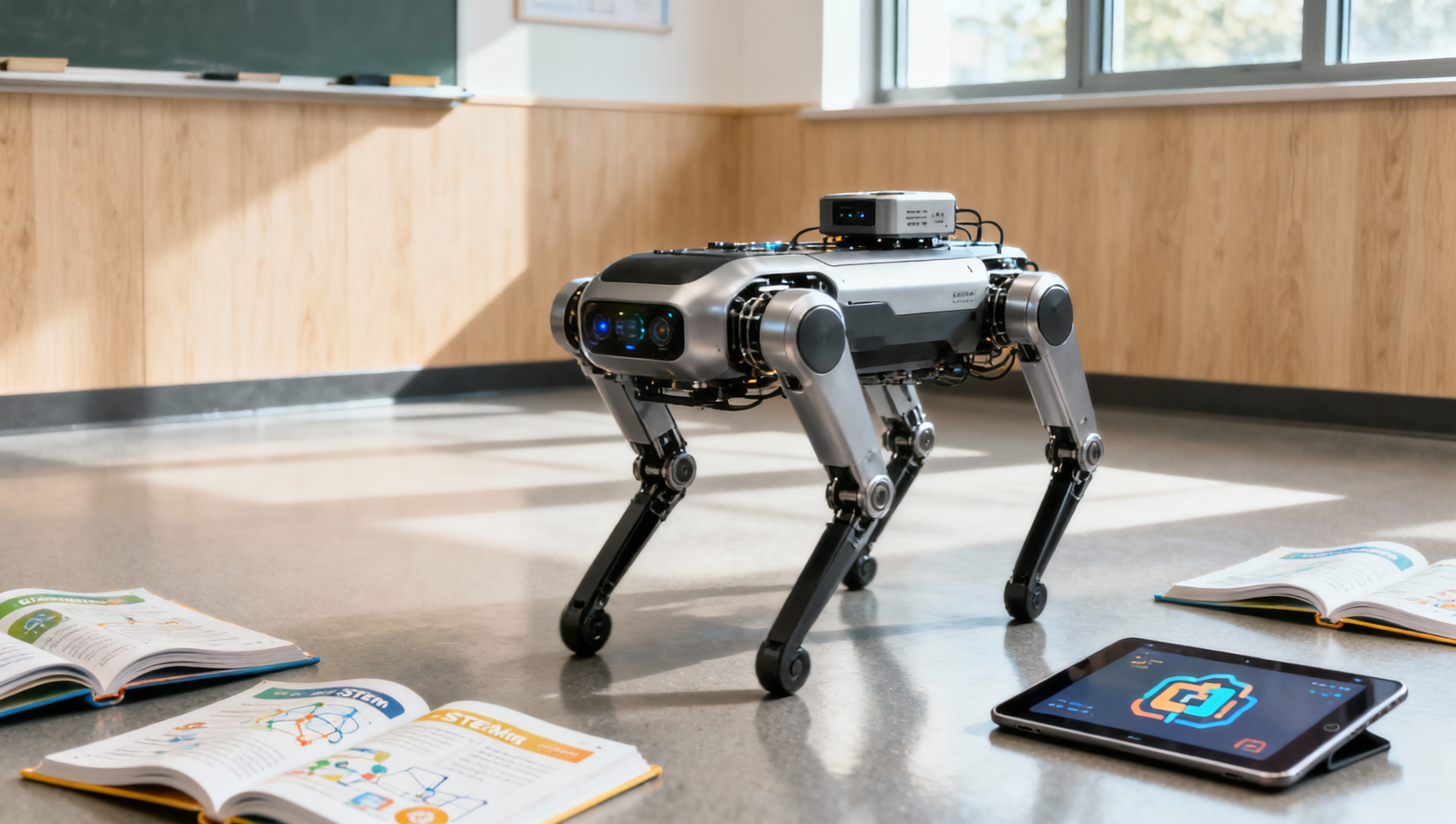
On April 14, 2026, Gaode Map’s Embodied Intelligence Division (under Alibaba Group) announced the imminent mass production of its first quadruped robot — powered by the ABot-M0 embodied manipulation base model, the world’s first unified-architecture robot base. With an 80.5% success rate on the Libero-Plus benchmark, this advancement is set to rapidly permeate STEM education and educational toy sectors. Key Chinese ODM manufacturers for educational robots have already begun adaptation work, targeting Q3 2026 launch of new programming robots supporting natural-language commands and autonomous environmental navigation — aligned with emerging procurement expectations for ‘AI-native interaction’ in K–12 classrooms across North America and Europe.
Event Overview
On April 14, 2026, Gaode Map’s Embodied Intelligence Division officially announced that its first quadruped robot is entering mass production. The robot integrates the ABot-M0 embodied operation base model — described as the world’s first unified-architecture robot base model. Publicly reported performance shows an 80.5% task success rate on the Libero-Plus benchmark. Concurrently, leading Chinese ODM manufacturers serving the STEM and educational toys sector have initiated compatibility development. A new generation of programming robots — featuring natural language instruction support and environment-aware autonomous navigation — is expected to launch in Q3 2026, targeting K–12 classroom procurement demand in North America and Europe.
Impact on Specific Industry Segments
STEM & Educational Toy ODM/OEM Manufacturers
These firms are directly affected because they are already engaged in adaptation development for the ABot-M0 platform. Impact manifests in revised hardware integration requirements (e.g., onboard multimodal perception modules, low-latency navigation stacks), updated firmware architecture for natural-language command parsing, and tighter alignment with AI-native interaction standards expected by Western school buyers.
Export-Focused Distributors & Channel Partners (North America/EU)
Channel partners serving K–12 institutional buyers face shifting product qualification criteria. The emergence of ‘AI-native interaction’ as a stated procurement expectation means existing robotics kits may require repositioning or supplementary AI middleware licensing to remain competitive — especially in districts adopting next-generation digital literacy curricula.
Curriculum Integration Providers & EdTech Platform Developers
Providers embedding robotics into lesson plans or LMS platforms must now account for new interaction paradigms: voice-first command flows, real-time environmental mapping outputs, and open-ended task execution (beyond pre-programmed sequences). This increases demand for API-accessible robot control layers and teacher-facing debugging dashboards.
What Relevant Enterprises or Practitioners Should Focus On
Monitor official technical documentation releases from Gaode’s Embodied Intelligence Division
Current public information is limited to benchmark performance and timeline announcements. Actual SDK availability, ROS2/ROS1 compatibility status, safety certification pathways (e.g., CE, FCC), and export classification (e.g., EAR99 vs. controlled tech) remain unconfirmed — all critical for procurement and compliance planning.
Track Q3 2026 product launches from top-tier Chinese ODMs serving Western education markets
Initial commercial units will serve as de facto reference designs. Their hardware configurations (e.g., sensor suite, compute module, battery life under continuous NLP + SLAM load), pricing tiers, and bundled curriculum assets will signal market readiness thresholds — not just for competitors, but for school district evaluation panels.
Distinguish between procurement signals and actual deployment timelines
‘AI-native interaction’ is currently framed as an emerging procurement preference — not a mandated standard. School districts rarely adopt new hardware platforms before full-year pilot validation. Therefore, near-term impact lies more in RFP language evolution and vendor qualification updates than in immediate volume shifts.
Assess internal firmware and cloud-service dependencies for compatibility gaps
Manufacturers and integrators should audit whether current voice-command pipelines, localization engines, or OTA update mechanisms can interface with ABot-M0’s published architecture. Early gap identification helps prioritize engineering resource allocation ahead of SDK release.
Editorial Perspective / Industry Observation
From an industry perspective, this announcement is best understood not as a product launch milestone, but as a signal of infrastructure maturation: the convergence of embodied foundation models, standardized robotic base architectures, and downstream commercialization pathways in regulated verticals like education. Analysis来看, ABot-M0’s 80.5% Libero-Plus score reflects progress toward functional robustness — yet remains below the >95% threshold typically required for unsupervised classroom use. Observation来看, the speed of ODM adaptation suggests strong prior alignment between Gaode’s hardware roadmap and existing export-oriented manufacturing capabilities. Current more relevant interpretation is that this marks the beginning of a platform-driven consolidation phase in educational robotics — where interoperability with unified base models becomes a differentiator alongside pedagogical design.
This development does not immediately replace existing robotics platforms, nor does it signify broad regulatory approval for autonomous mobile agents in schools. Rather, it introduces a new architectural reference point — one that shifts competitive emphasis from isolated hardware features toward system-level AI integration, developer tooling maturity, and curriculum-aligned interaction design.
Conclusion
The April 14, 2026 announcement by Gaode represents an early-stage inflection in the global educational robotics value chain — driven less by novelty and more by the emergence of standardized, AI-native robot base architectures. Its significance lies not in immediate market displacement, but in redefining technical prerequisites for next-generation classroom hardware. For stakeholders, the most rational stance is cautious monitoring: treat ABot-M0 as a platform signal requiring verification through SDK access, third-party validation, and real-world pilot data — rather than as an operational trigger for urgent retooling or inventory shifts.
Source Attribution
Main source: Official announcement by Gaode Map’s Embodied Intelligence Division, April 14, 2026.
Areas requiring ongoing observation: ABot-M0 SDK release timing and scope, formal safety/certification documentation, actual Q3 2026 product specifications from partnered ODMs, and verifiable evidence of ‘AI-native interaction’ inclusion in active North American/EU school RFPs.
Related Intelligence
 Baby Gear & StrollersApr 16, 2026Diaper changing pad wholesale: flame retardant claims vs. third-party test reportsDiaper changing pad wholesale: Verify flame retardant claims with third-party test reports—critical for custom knit baby blankets, baby safety gates wholesale, bamboo baby washcloths & more.
 Baby Gear & StrollersApr 16, 2026Are wholesale diaper changing pads really safer than retail versions?Discover safer diaper changing pad wholesale options—plus cabinet locks, corner protectors, baby safety gates, and bamboo washcloths—all GCS-verified for compliance & quality.
 Camping & WaterApr 16, 2026What Makes Aquarium LED Lighting OEM Reliable for Large Tank Projects?Aquarium LED lighting OEM reliability for large tank tourism projects starts with stable engineering, compliance, scalable production, and service support. Learn how to choose with confidence.
 Pet Grooming & TravelApr 16, 2026China Synthetic Rubber Price Surge Impacts TPR Footwear CostsChina synthetic rubber price surge hits TPR footwear costs—18% granule hike impacts pet travel gear & camping suppliers. Act now to secure Q2 inventory and assess TPU alternatives.
 Beauty DevicesApr 16, 2026Intel Launches World’s Thinnest GaN Chip for Beauty & Fitness DevicesIntel's world’s thinnest GaN chip—19μm, 78V, 300GHz—revolutionizes power efficiency for beauty & fitness devices. Boost EU ErP Lot 12 compliance, cut power use by 35–40%, and accelerate next-gen product launches.
 Infant Feeding & CareApr 16, 20262026 CHINASHOP Reveals Clean Label Push Driving Infant Nutrition Packaging ExportsClean label push at 2026 CHINASHOP drives infant nutrition packaging exports—FDA-compliant, BPA-free aluminum-plastic films in high demand for EU/US markets.
 Beauty DevicesApr 16, 2026Zanglong Island Semiconductor Park Land Acquisition BeginsZanglong Island Semiconductor Park land acquisition begins—key step toward domestic MCU & PMIC supply for beauty devices, smart pet tech, and IoT OEMs. Track 2027 production readiness.
 Activewear OEMApr 16, 2026Aksu Textile Capacity Ramps Up: 25-Day OEM Delivery for Cotton Babywear & ActivewearAksu textile capacity surge cuts OEM delivery to 25 days for cotton babywear & activewear—faster lead times, lower carbon shipping, ideal for NA/EU Q3 demand.
 Skincare OEMApr 16, 2026Yangsen Pharma’s Sensitive-Skin ODM Patent Approved in GuangzhouYangsen Pharma’s Sensitive-Skin ODM patent approved in Guangzhou—micro-liposomal barrier repair tech, alcohol-free & ECOCERT-compatible for EU organic skincare brands.
 STEM & Educational ToysApr 16, 2026Gaode Unveils First Quadruped Robot, Accelerating China's Embodied AI Hardware ExportGaode's first quadruped robot—powered by ABot-M0, the world’s first unified-architecture embodied AI base—accelerates China's AI hardware export to global STEM education markets.
 Beauty DevicesApr 16, 2026Lithium Carbonate Price Surge Impacts Beauty & Fitness Device BOMLithium carbonate price surge hits beauty & fitness device BOMs—12% cost rise, 14–18 week lead times. Act now to secure Q3 production capacity.
 Effective July 2026") Nursery Furniture & MonitorsApr 16, 2026CPSC Revises Infant Bed Rail Standard (16 CFR 1220) Effective July 2026CPSC revises Infant Bed Rail Standard (16 CFR 1220) effective July 2026—new dynamic testing, 5mm finger-trap limits & 120N detachment force. Act now to avoid port detention or recall.
Nursery Furniture & MonitorsApr 16, 2026CPSC Revises Infant Bed Rail Standard (16 CFR 1220) Effective July 2026CPSC revises Infant Bed Rail Standard (16 CFR 1220) effective July 2026—new dynamic testing, 5mm finger-trap limits & 120N detachment force. Act now to avoid port detention or recall. Cosmetics & PkgApr 16, 2026EU CBAM Carbon Tariff Takes Effect April 1, 2026EU CBAM carbon tariff takes effect April 1, 2026 — what it means for cosmetics packaging, baby gear & electronic toy exporters. Act now to avoid delays.