2026 CHINASHOP Reveals Clean Label Push Driving Infant Nutrition Packaging Exports
At the 2026 China Retail Expo (CHINASHOP), held April 9, the debut of a dedicated ‘Clean Label & Healthy Food Zone’—backed by the newly adopted Chinese group standard T/CAS 586–2025—signals a tightening alignment between global retail health mandates and export-oriented packaging supply chains, particularly for infant nutrition products serving EU and US markets.
Event Overview
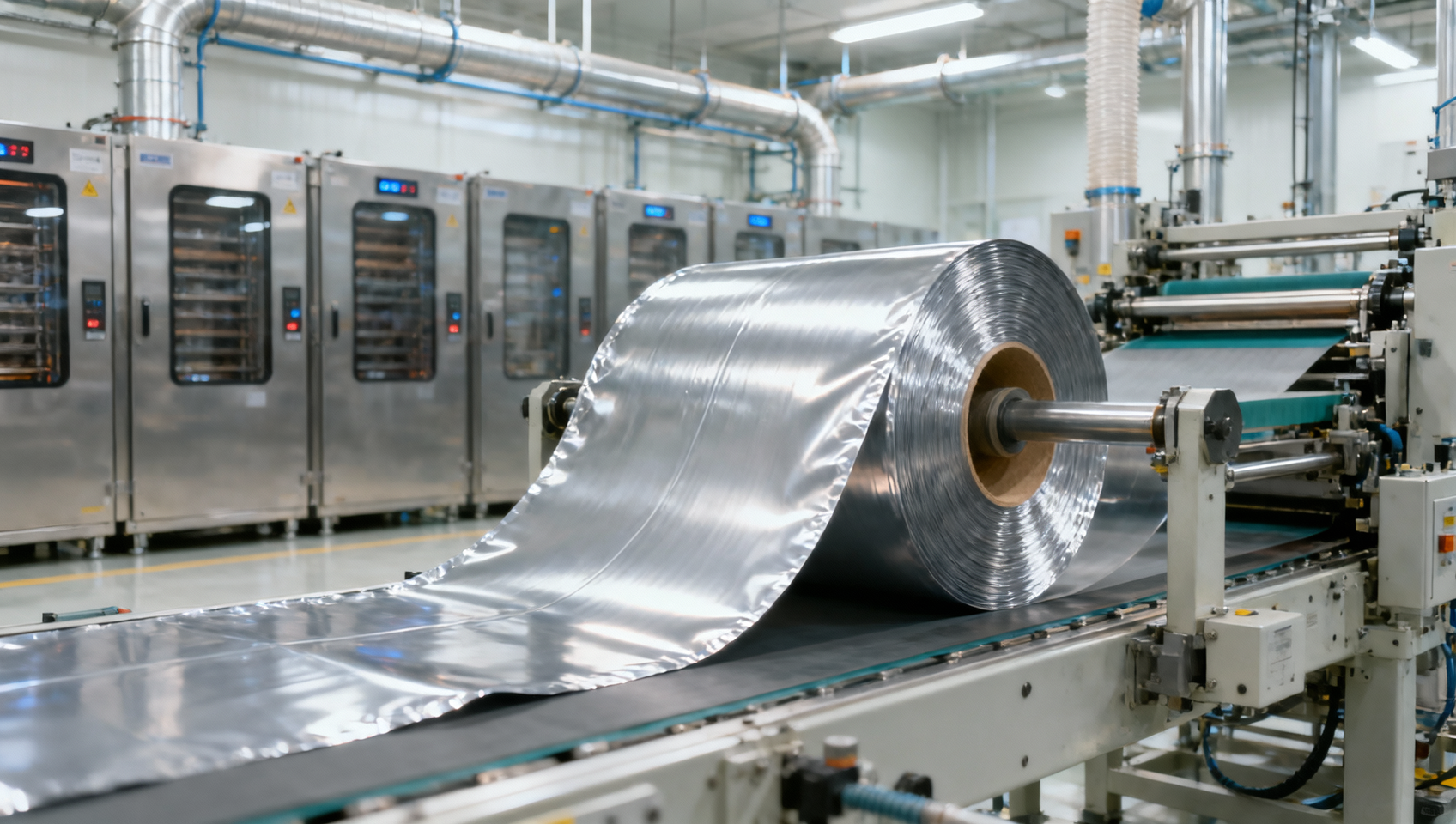
The 2026 CHINASHOP exhibition opened on April 9, 2026. For the first time, it featured a ‘Clean Label & Healthy Food Zone’. The zone explicitly references the Chinese group standard T/CAS 586–2025 as its procurement benchmark. Separately, U.S. and UK pharmacy chains—including CVS and Boots—have issued procurement requests to Chinese OEM packaging suppliers for new aluminum-plastic composite films intended for infant feeding and care supplements. These materials must comply with FDA 21 CFR 177.1520 and exclude BPA derivatives. Order windows are concentrated in May–June 2026.
Which Sub-Sectors Are Affected
Direct Export Trading Firms
These firms act as intermediaries between Chinese packaging manufacturers and overseas retailers or brand owners. They are affected because the new demand originates from end-market specifications (e.g., FDA compliance, BPA-free declaration) rather than generic commercial terms. Impact manifests in tighter documentation requirements, shorter quotation-to-confirmation cycles, and heightened need for third-party test reports aligned with U.S./UK regulatory frameworks.
Flexible Packaging Manufacturers (OEM/ODM)
Manufacturers producing aluminum-plastic laminates for nutritional supplement pouches or stick packs face direct technical and compliance pressure. The requirement to meet FDA 21 CFR 177.1520—and specifically avoid BPA derivatives—means reformulation or supplier qualification adjustments may be needed, especially for adhesives, primers, or inner sealant layers. Lead-time compression (May–June order window) also pressures production scheduling and raw material inventory planning.
Raw Material Suppliers (Film, Adhesive, Ink)
Suppliers providing base films (e.g., CPP, PE), adhesive systems, or food-contact inks must verify compatibility with the updated regulatory constraints. Since the final laminate must be BPA-derivative-free, upstream components—even those not directly containing BPA—may require revalidation if their synthesis pathways or stabilizers involve BPA-related precursors. This triggers new technical data exchange and traceability demands from downstream converters.
Regulatory & Compliance Service Providers
Firms offering FDA pre-submission reviews, migration testing, or T/CAS 586–2025 conformance assessments are seeing increased inbound inquiries. However, impact is currently limited to early-stage engagement: no public certification scheme for T/CAS 586–2025 has been launched, and FDA 21 CFR 177.1520 verification remains product-specific—not blanket-certifiable.
What Relevant Companies or Practitioners Should Focus On Now
Monitor official implementation guidance for T/CAS 586–2025
While cited at CHINASHOP as a procurement reference, T/CAS 586–2025 is a voluntary group standard. Its practical weight depends on whether major retailers formally adopt it into tender documents or audit checklists. Track updates from the China Association for Standardization (CAS) and participating retailers over Q2 2026.
Prioritize FDA-compliant material declarations for infant nutrition applications
CVS and Boots’ requests specify FDA 21 CFR 177.1520 and absence of BPA derivatives—not general food-grade status. Suppliers should prepare full substance declarations (including reaction intermediates and stabilizers) for all laminate layers, not just final composite performance data.
Distinguish between policy signal and near-term procurement reality
The CHINASHOP zone reflects retailer intent, not binding regulation. Actual orders remain project-based and buyer-specific. Avoid broad capacity expansion; instead, allocate internal resources toward rapid sample turnaround, test report generation, and cross-functional review (R&D + QA + export sales) for infant nutrition accounts.
Prepare documentation packages ahead of the May–June order window
Given the narrow procurement timeline, pre-assemble core compliance assets: FDA-mandated resin identification, extractable/leachable test summaries, BPA-derivative screening affidavits, and laminate structure schematics with layer-by-layer compliance mapping. This reduces response lag when RFQs arrive.
Editorial Observation / Industry Perspective
From an industry perspective, this development is best understood as a coordinated signal—not yet a structural shift. The linkage between CHINASHOP’s ‘Clean Label Zone’ and specific OEM requests from CVS and Boots suggests growing vertical alignment across retail standards, trade shows, and sourcing execution. However, analysis来看, T/CAS 586–2025 remains a reference tool without enforcement mechanism, and FDA 21 CFR 177.1520 applicability to multi-layer composites still requires case-by-case evaluation. Current more relevant is the timing: the May–June 2026 order window represents a near-term operational checkpoint, not a long-term regulatory inflection point. Sustained attention is warranted—not because rules have changed, but because buyer expectations are consolidating around verifiable, application-specific compliance.
This is not yet a market-wide pivot, but rather a targeted tightening for a high-trust, high-regulation subsegment: infant nutrition packaging destined for regulated pharmacy channels. Its significance lies less in novelty and more in execution discipline—testing how quickly supply chain actors can translate standardized language into auditable, shippable outcomes.
Conclusion
The 2026 CHINASHOP ‘Clean Label & Healthy Food Zone’ serves as a visible conduit through which evolving retailer health mandates—particularly for infant nutrition—are translating into concrete, time-bound procurement requirements for Chinese packaging suppliers. It does not introduce new law, but sharpens existing compliance expectations and compresses response timelines. Currently, it is more accurately interpreted as a demand signal with defined near-term execution parameters, rather than evidence of systemic regulatory change. Stakeholders are advised to treat it as a focused operational trigger—not a strategic overhaul.
Source Attribution
Main source: Official announcements and exhibitor briefings from the 2026 China Retail Expo (CHINASHOP), April 9, 2026.
Elements requiring ongoing observation: Formal adoption status of T/CAS 586–2025 by major international retailers; availability of accredited third-party verification for this standard; emergence of additional FDA-mandated testing protocols beyond 21 CFR 177.1520 for multi-layer infant nutrition packaging.
Related Intelligence
 Pet Grooming & TravelApr 16, 2026China Synthetic Rubber Price Surge Impacts TPR Footwear CostsChina synthetic rubber price surge hits TPR footwear costs—18% granule hike impacts pet travel gear & camping suppliers. Act now to secure Q2 inventory and assess TPU alternatives.
 Beauty DevicesApr 16, 2026Intel Launches World’s Thinnest GaN Chip for Beauty & Fitness DevicesIntel's world’s thinnest GaN chip—19μm, 78V, 300GHz—revolutionizes power efficiency for beauty & fitness devices. Boost EU ErP Lot 12 compliance, cut power use by 35–40%, and accelerate next-gen product launches.
 Infant Feeding & CareApr 16, 20262026 CHINASHOP Reveals Clean Label Push Driving Infant Nutrition Packaging ExportsClean label push at 2026 CHINASHOP drives infant nutrition packaging exports—FDA-compliant, BPA-free aluminum-plastic films in high demand for EU/US markets.
 Beauty DevicesApr 16, 2026Zanglong Island Semiconductor Park Land Acquisition BeginsZanglong Island Semiconductor Park land acquisition begins—key step toward domestic MCU & PMIC supply for beauty devices, smart pet tech, and IoT OEMs. Track 2027 production readiness.
 Activewear OEMApr 16, 2026Aksu Textile Capacity Ramps Up: 25-Day OEM Delivery for Cotton Babywear & ActivewearAksu textile capacity surge cuts OEM delivery to 25 days for cotton babywear & activewear—faster lead times, lower carbon shipping, ideal for NA/EU Q3 demand.
 Skincare OEMApr 16, 2026Yangsen Pharma’s Sensitive-Skin ODM Patent Approved in GuangzhouYangsen Pharma’s Sensitive-Skin ODM patent approved in Guangzhou—micro-liposomal barrier repair tech, alcohol-free & ECOCERT-compatible for EU organic skincare brands.
 STEM & Educational ToysApr 16, 2026Gaode Unveils First Quadruped Robot, Accelerating China's Embodied AI Hardware ExportGaode's first quadruped robot—powered by ABot-M0, the world’s first unified-architecture embodied AI base—accelerates China's AI hardware export to global STEM education markets.
 Beauty DevicesApr 16, 2026Lithium Carbonate Price Surge Impacts Beauty & Fitness Device BOMLithium carbonate price surge hits beauty & fitness device BOMs—12% cost rise, 14–18 week lead times. Act now to secure Q3 production capacity.
 Effective July 2026") Nursery Furniture & MonitorsApr 16, 2026CPSC Revises Infant Bed Rail Standard (16 CFR 1220) Effective July 2026CPSC revises Infant Bed Rail Standard (16 CFR 1220) effective July 2026—new dynamic testing, 5mm finger-trap limits & 120N detachment force. Act now to avoid port detention or recall.
Nursery Furniture & MonitorsApr 16, 2026CPSC Revises Infant Bed Rail Standard (16 CFR 1220) Effective July 2026CPSC revises Infant Bed Rail Standard (16 CFR 1220) effective July 2026—new dynamic testing, 5mm finger-trap limits & 120N detachment force. Act now to avoid port detention or recall. Cosmetics & PkgApr 16, 2026EU CBAM Carbon Tariff Takes Effect April 1, 2026EU CBAM carbon tariff takes effect April 1, 2026 — what it means for cosmetics packaging, baby gear & electronic toy exporters. Act now to avoid delays.
 Beauty DevicesApr 15, 2026Commercial microdermabrasion machine: what affects treatment consistency?Microdermabrasion machine commercial buying guide for tourism spas: learn what affects treatment consistency, supplier reliability, maintenance, and rollout value for high-turnover service environments.
 Beauty DevicesApr 15, 2026IPL hair removal device OEM quotes vary so much for one reasonIPL hair removal device OEM quotes vary for one key reason: manufacturing depth. Compare suppliers smarter across microdermabrasion machine commercial and beauty OEM projects.
 Cosmetics & PkgApr 15, 2026False eyelashes vendor selection often fails at sample qualityFalse eyelashes vendor selection often fails at sample quality. Learn how travel retail buyers compare suppliers, packaging, and adjacent sourcing like custom lip gloss vendor, organic face serum OEM, anti aging cream wholesale, IPL hair removal device OEM, and microdermabrasion machine commercial solutions.