SASO Accelerates AI-Enabled STEM Toy Certification to 24 Hours
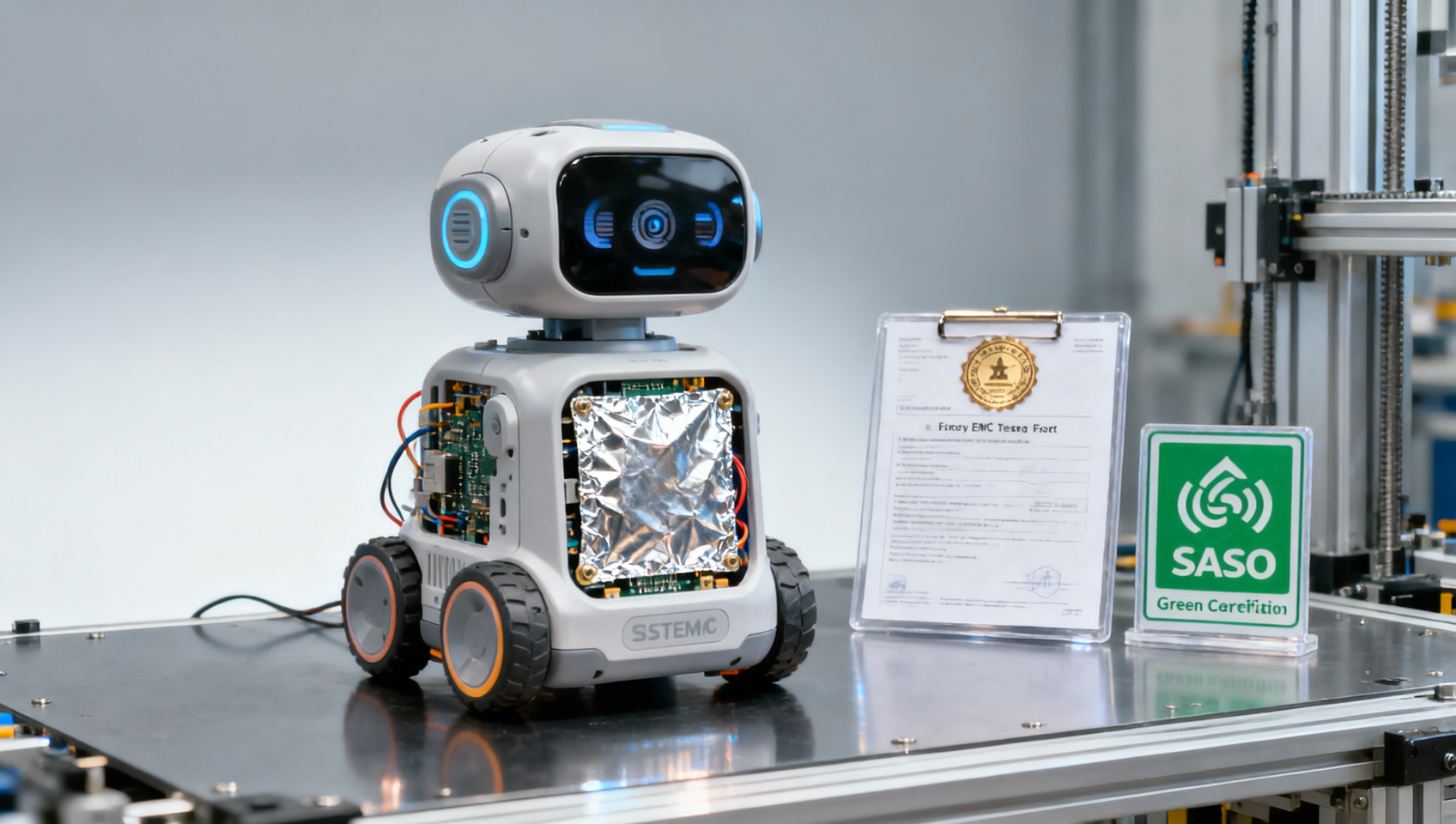
Saudi Arabia’s Standards, Metrology and Quality Organization (SASO) announced on April 19, 2026, a streamlined Conformity Assessment Certificate (CoC) process for STEM educational toys incorporating AI voice interaction and image recognition capabilities. The new fast-track pathway reduces technical review and certification issuance to 24 hours — a significant acceleration from standard timelines. Exporters and manufacturers targeting the Saudi market, particularly those in AI-integrated children’s edtech, electronics manufacturing, and international trade compliance, should monitor this development closely, as it introduces both opportunity and new technical prerequisites.
Event Overview
On April 19, 2026, SASO launched a dedicated绿色通道 (green channel) for SASO CoC certification of STEM toys with AI voice interaction and image recognition functions. Under this arrangement, the full certification cycle — including technical document review and certificate issuance — is compressed to 24 hours. However, SASO explicitly requires that Chinese manufacturing facilities pre-embed EMC shielding structural design in the product and provide validated factory-level EMC test reports; applications failing to meet this condition will not be accepted.
Industries Affected by This Change
Direct Exporters & Trading Companies: These entities face immediate implications for time-to-market planning. While faster certification enables quicker customs clearance and shelf placement in Saudi retail channels, the new EMC pre-validation requirement shifts responsibility upstream — meaning exporters can no longer rely solely on third-party lab reports post-production. Delayed or non-compliant submissions risk missing promotional windows or seasonal demand cycles.
Electronics Contract Manufacturers & OEMs (especially China-based): Factories supplying AI-enabled STEM toys must now integrate EMC shielding into mechanical and PCB layout design phases — not as a late-stage add-on. The requirement for factory-level EMC test reports implies internal testing capability or formalized partnerships with accredited labs prior to shipment. Absence of such infrastructure may trigger redesign delays or sourcing reevaluation.
Supply Chain & Compliance Service Providers: Certification consultants, testing laboratories, and logistics coordinators serving the GCC toy sector will see increased demand for integrated EMC design advisory services and pre-submission verification support. However, service offerings must now explicitly cover pre-factory EMC structural validation — a scope expansion beyond traditional post-manufacturing conformity testing.
Key Points for Enterprises and Practitioners to Monitor and Act On
Track official SASO guidance on EMC shielding specifications
While SASO has mandated pre-embedded EMC shielding and factory test reports, the exact structural requirements (e.g., material thickness, grounding topology, aperture control) have not been publicly detailed. Current more suitable action is to request clarification directly from SASO-accredited certification bodies before initiating new product submissions.
Verify whether existing AI-STEM product lines meet the structural EMC prerequisite
Manufacturers should audit current production documentation — especially mechanical drawings, BOM notes, and internal test records — to determine if shielding was designed-in and verified at factory level. Products certified under prior SASO procedures but lacking documented EMC structural integration may require revalidation or design updates ahead of future renewals.
Distinguish between policy signal and operational readiness
The 24-hour certification timeline reflects SASO’s administrative capacity upgrade, not a relaxation of technical standards. Analysis来看, this change prioritizes enforcement efficiency over standard simplification: speed is conditional on upfront compliance. Enterprises should avoid interpreting the green channel as a shortcut — rather, it rewards preparation.
Prepare updated technical files and coordinate early with accredited labs
To align with the 24-hour window, exporters must submit complete, error-free documentation on first submission. This includes schematic diagrams highlighting shielding implementation, factory EMC test reports bearing authorized signatures and lab accreditation numbers, and AI functionality descriptions aligned with SASO’s defined scope (voice interaction + image recognition only). Early engagement with SASO-recognized labs ensures report format and measurement methodology match expectations.
Editorial Perspective / Industry Observation
From industry angle, this update signals SASO’s strategic pivot toward managing AI-integrated consumer products through design-phase governance — not just end-product testing. It reflects growing regional emphasis on electromagnetic compatibility as a foundational safety element in intelligent children’s devices. Observation来看, the 24-hour certification is less about lowering barriers and more about shifting compliance burden earlier in the value chain: from post-production verification to pre-manufacturing engineering accountability. Current more suitable understanding is that this is an enforcement signal — one that tests readiness across global supply chains, especially among suppliers historically reliant on reactive certification models.
Conclusion
This development marks a procedural tightening disguised as acceleration: SASO is accelerating certification only for those who already embed compliance into product architecture. For stakeholders, its significance lies not in speed alone, but in the explicit linkage between physical design integrity and market access. It underscores a broader trend — regulatory agencies increasingly treating hardware-level electromagnetic resilience as non-negotiable for AI-enabled consumer goods, particularly in education and child-facing categories. Current more appropriate interpretation is that this is a targeted calibration of oversight, not a broad easing of requirements.
Information Sources
Main source: Official SASO announcement dated April 19, 2026.
Note: Specific EMC shielding design criteria and list of accepted factory test report formats remain pending official publication and are subject to ongoing observation.
Related Intelligence
 Cosmetics & PkgApr 20, 2026SAMR Penalizes 7 Platforms for Unlicensed Food PackagingSAMR penalizes 7 platforms for unlicensed food packaging—key implications for manufacturers, platforms & suppliers. Learn compliance must-dos now.
 Beauty DevicesApr 20, 2026Global Li-ion Recycling Rate Hits 62%: Impact on Beauty Device Battery SupplyLi-ion recycling rate hits 62% — unlocking cost savings, faster lead times & MOQ flexibility for beauty device battery supply. Act now.
 Nursery Furniture & MonitorsApr 20, 2026Canton Fair Phase III: Infant Monitor Inquiries Surge, EN60601-1-12 Focus in Middle EastEN60601-1-12 compliance surges at Canton Fair Phase III as Middle East buyers prioritize certified infant monitors — act now to meet GCC market demands.
 Camping & WaterApr 20, 2026RCEP Cuts Tariff on Camping Water Bags for IndonesiaRCEP cuts tariff on camping water bags for Indonesia to 4.2%—boosting export opportunities. Dunia Luar’s new TPU + food-grade aluminum specs demand urgent compliance.
 Corporate & Seasonal GiftsApr 20, 2026TÜV Rheinland Enforces LCA Heatmap for Green Gift PackagingTÜV Rheinland now requires an LCA heat map for Green Gift Packaging certification—key for exporters, manufacturers & brand licensees targeting EU markets. Act now!
 Smart Pet DevicesApr 20, 2026Vietnam Enforces ISO 13485 + Vietnamese Manual for Smart Pet CollarsVietnam enforces ISO 13485 + Vietnamese manual for smart pet collars — essential compliance for exporters, manufacturers & distributors targeting the growing pet tech market.
 Infant Feeding & CareApr 20, 2026JETRO Spring 2026 Inspection: Silicone Infant Feeding Products Require Blockchain Batch CodesSilicone infant feeding products for Japan must now carry blockchain batch codes per JETRO Spring 2026 inspection—ensure compliance for pacifiers, teething rings & spoons.
 STEM & Educational ToysApr 20, 2026SASO Accelerates AI-Enabled STEM Toy Certification to 24 HoursSASO AI-STEM toy certification now in 24 hours — but only with pre-embedded EMC shielding. Act fast: meet new Saudi AI toy compliance rules.
 Cosmetics & PkgApr 20, 2026EU EPR Dual-Country Registration Effective for Beauty PackagingEU EPR dual-country registration is now mandatory for beauty packaging in France & Germany—act now to avoid customs delays, fines up to €100k, and lost market access.
 Cosmetics & PkgApr 20, 2026FDA Requires Separate VCRP Registration for Cosmetic Packaging as of April 19, 2026FDA requires separate VCRP registration for cosmetic packaging by April 19, 2026—critical for Chinese OEMs, U.S. importers & suppliers. Act now to avoid port detentions.
 Beauty DevicesApr 19, 2026Global Li-ion Recycling Rate Hits 62.3%: Beauty Device BOM Cost Down 9%Li-ion recycling rate hits 62.3% — driving 9% BOM cost reduction for beauty devices. Discover how cascade utilization is reshaping global supply chains & boosting margins.
 Cosmetics & PkgApr 19, 2026FDA Mandates Independent VCRP Registration for Cosmetic Packaging as of Apr 19, 2026FDA mandates independent VCRP registration for cosmetic packaging by Apr 19, 2026—avoid Import Alert 66-12. Act now to secure U.S. market access.
 Nursery Furniture & MonitorsApr 19, 2026Canton Fair Phase III: Smart Infant Monitors Surge Amid EN60601-1-12 DemandSmart infant monitors surge at Canton Fair Phase III amid rising EN60601-1-12 compliance demand — discover why Middle East buyers now prioritize medical-grade safety.