Maternity backpack OEM: which closures work best one handed?
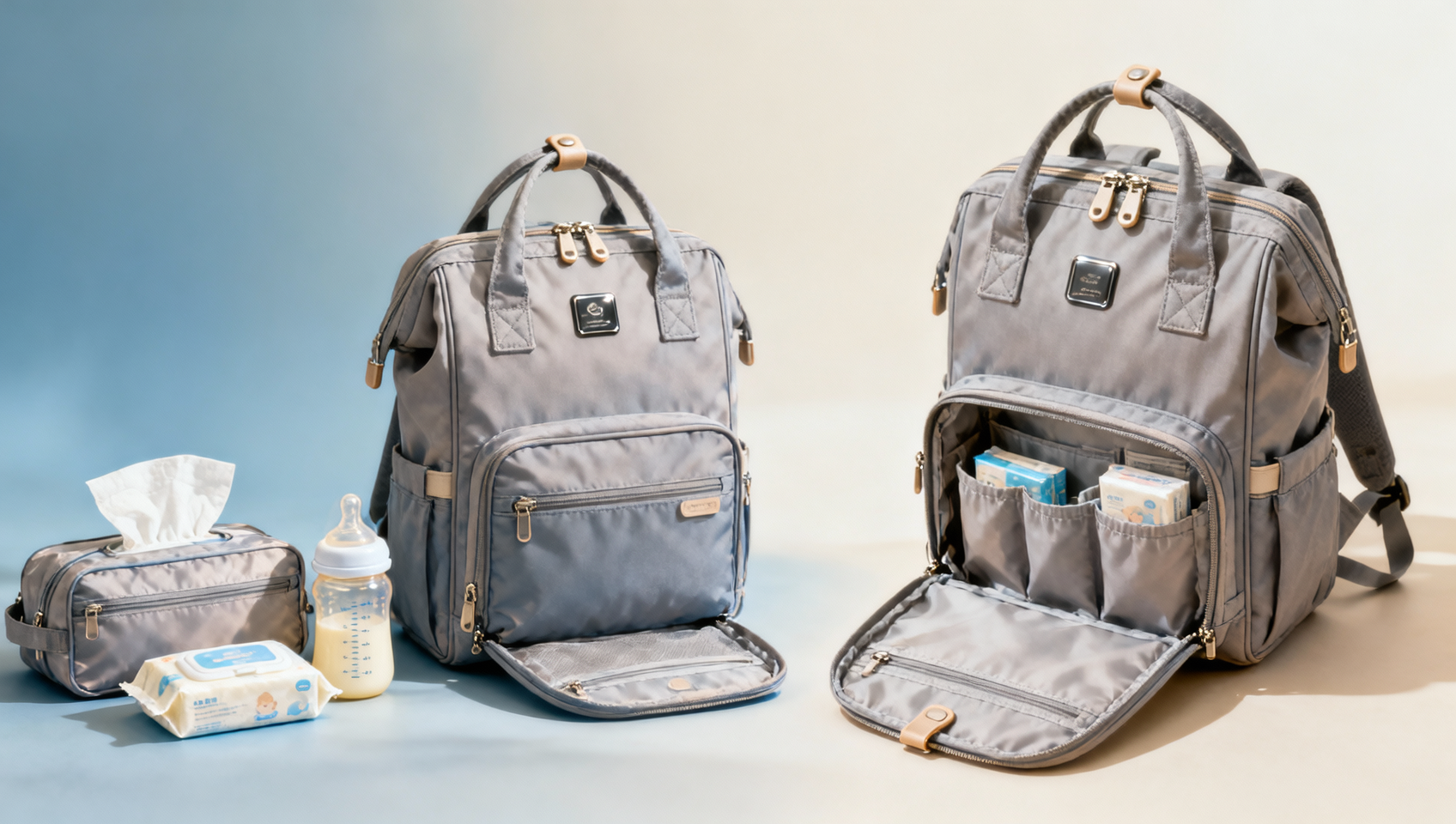
For buyers evaluating maternity backpack OEM options, the short answer is this: the best one-handed closure is usually a well-engineered zipper system with oversized pullers and guided opening paths, while magnetic flaps work best for quick-access pockets rather than primary compartments. Buckles can add security, but they often slow real-world use, and flap-only designs rarely deliver the balance of speed, containment, and reliability parents expect. For OEM sourcing teams, the right closure choice affects not only user convenience, but also product safety, SKU positioning, complaint rates, manufacturing complexity, and margin control.
In baby and maternity categories, closure performance is not a cosmetic detail. Parents often open bags while holding a baby, pushing a stroller, or managing wipes, bottles, and clothing at the same time. That means one-handed usability becomes a product-definition issue. For sourcing teams comparing maternity backpack OEM suppliers, the key is to match closure type to use case, safety requirements, material stack-up, and target price band.
What buyers really need to know first: which closure performs best in actual parenting use?
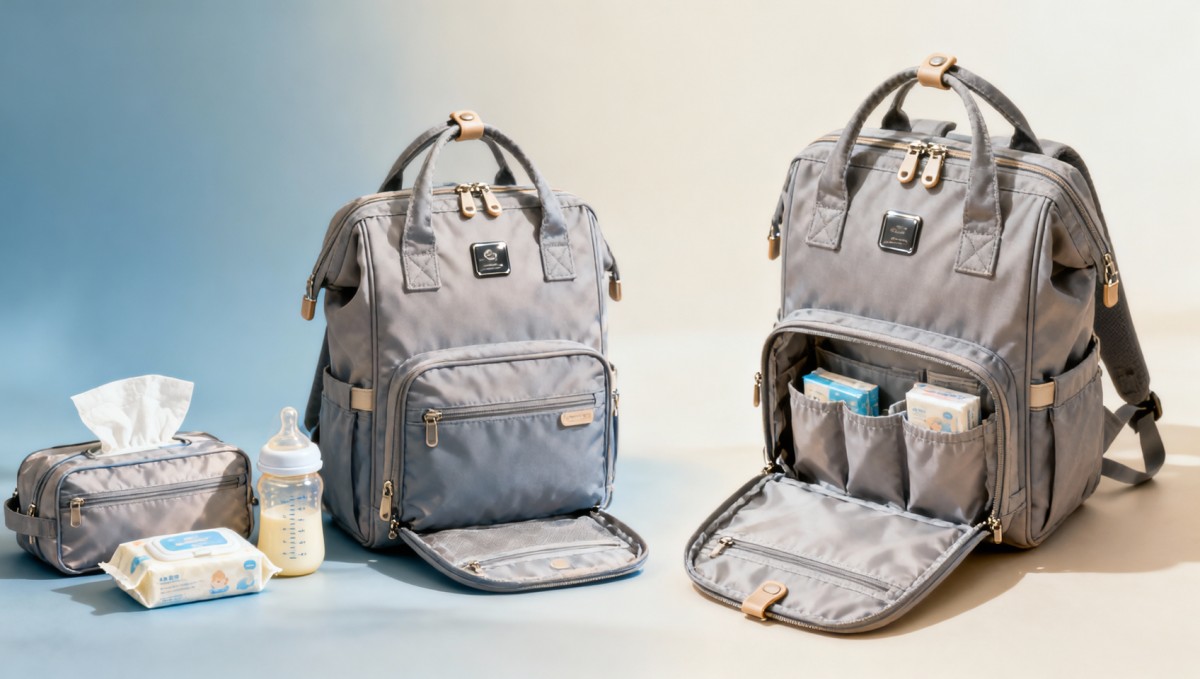
If the goal is the best all-round one-handed experience for a maternity backpack, a premium zipper is usually the safest and most commercially reliable choice for the main compartment. A magnetic closure is often the best choice for secondary quick-access pockets. Side-release buckles, tuck locks, and flap-only closures can work in specific styling directions, but they are usually weaker in speed and convenience when used with one hand.
Here is the practical ranking most buyers can use during product evaluation:
- Best overall for main compartment: two-way zipper with large pull tabs, structured opening, and anti-snag tape design
- Best for quick-access exterior pocket: magnetic flap or hidden magnet snap
- Best for security or fashion-led design: buckle combined with zipper underneath
- Least effective for true one-handed access: flap-only or stiff buckle-first constructions
This matters because buyers, product developers, and quality teams are not simply choosing hardware. They are deciding how the bag will behave under stress, how often consumers will use each compartment, and where friction may lead to negative reviews. In maternity and baby care products, real-life usability is often what separates a repeat-order item from a high-return SKU.
Why one-handed closure performance matters more than many OEM briefs assume
Many OEM briefs still focus heavily on silhouette, capacity, and fabric finish, while treating closures as a secondary trim issue. In reality, closures influence the product in five important ways.
- Safety and control: Parents may be holding a child while opening the bag. A closure that needs two hands creates more awkward handling and more risk of dropped items.
- Speed of access: Wipes, bottles, pacifiers, and spare clothing are time-sensitive items. Delayed access damages perceived product quality.
- Containment and organization: A closure that opens too easily can cause spillage or disorganization during transport.
- Durability and complaint rate: Weak magnets, snagging zippers, or broken buckles quickly become warranty and review problems.
- Market positioning: Closure selection signals whether the bag is practical, fashion-forward, premium, travel-ready, or urban minimalist.
For enterprise buyers and financial approvers, this translates into a simple commercial reality: a slightly better closure system can justify better pricing, stronger conversion, lower returns, and higher customer satisfaction.
How each closure type compares for maternity backpack OEM projects
Below is the decision framework most useful for technical evaluators, project managers, and sourcing teams.
Zippers: the best default for primary access
Zippers remain the strongest option for most main compartments because they provide controlled opening, strong containment, and broad user familiarity. However, not all zippers are equally one-hand friendly.
Best zipper characteristics for one-handed use:
- Oversized pullers that can be gripped without precision
- Two-way zipper design for access from either side
- Semi-rigid opening frame that helps the bag hold shape
- Smooth tape alignment to reduce snagging on lining or insulation layers
- Long zipper path with ergonomic arc rather than tight corner turns
Advantages:
- Strong closure security
- Good for travel and daily commuting
- Easy to standardize in OEM production
- Works across value, mid-range, and premium price tiers
Limitations:
- Can become difficult if fabric panels are too soft or overstuffed
- Low-grade zippers often fail in mass-market programs
- One-handed closing can still be harder than one-handed opening
For most maternity backpack OEM briefs, the right question is not “zipper or not,” but “what zipper construction delivers one-handed access without compromising durability?”
Magnetic closures: excellent for speed, but not always enough alone
Magnetic systems are highly attractive for parents because they allow quick drop-in access with minimal hand movement. They are most effective on front pockets, wipe compartments, bottle-access flaps, and caregiver essentials zones.
Advantages:
- Fast one-handed opening and closing
- Premium feel when well integrated
- Good for frequent-access compartments
- Supports minimalist and fashion-oriented designs
Limitations:
- Usually weaker than zippers for full containment
- Can misalign if fabric shifts or padding thickness varies
- May open unintentionally under pressure in overloaded pockets
- Requires careful material and placement engineering
For OEM buyers, magnets should usually be treated as a targeted convenience feature, not a universal solution. In many successful designs, the best formula is zippered main storage plus magnet-assisted quick-access sections.
Buckles: secure, visual, but slower in real use
Buckles can create a durable and outdoor-inspired look, which may suit crossover diaper bags aimed at travel, mobility, or sports-lifestyle channels. They are useful when the brand wants strong visual hardware or extra compression.
Advantages:
- Strong visual identity
- Good mechanical security
- Suitable for larger flap systems and expandable sections
Limitations:
- Generally weaker for true one-handed operation
- Can frustrate users in urgent access moments
- Adds hardware cost, assembly steps, and possible breakage points
As a result, buckles are often best used as a design accent or secondary securing layer, not as the primary closure parents rely on repeatedly throughout the day.
Flap closures: good for style, weak for performance-only buying briefs
Flap-only constructions may look elegant, but they are rarely the best answer if usability is the priority. They work better in lifestyle or gift-oriented product lines than in performance-driven diaper and maternity backpacks.
If a flap is required for design reasons, combining it with hidden magnets or a zipper underneath often produces better results.
What closure details separate a good OEM sample from a production-ready design?
Experienced sourcing teams know that closure category alone is not enough. The execution details decide whether one-handed use feels smooth or frustrating.
When reviewing supplier samples, assess the following:
- Puller size and texture: Can it be gripped quickly without looking?
- Opening angle: Does the bag open wide enough to retrieve items with one hand?
- Shape retention: Does the opening collapse when partially open?
- Resistance level: Is the zipper too stiff, or the magnet too weak?
- Closure path: Are corners smooth, or do they drag?
- Load tolerance: Does the closure still work when the bag is full?
- Lining interference: Does internal fabric catch in the zip path?
- Quiet operation: Is the closure noisy in sleeping-baby scenarios?
These details are especially important for quality control teams and project managers because many closure issues do not appear in static inspection. They appear only during repeated use with realistic packing loads.
How to test one-handed closures during OEM sourcing and sample approval
A reliable sourcing process should include simple use-case testing, not just visual approval. This is where technical evaluators and operational users can add significant value.
Recommended practical test protocol:
- Load the backpack to realistic daily-use weight.
- Test opening while the other hand is occupied.
- Retrieve small and medium items from main and front compartments.
- Close the compartment using one hand only.
- Repeat the cycle at least 50 to 100 times.
- Test while wearing the bag and while it is hung on a stroller.
- Check whether closure performance changes after light tension or fabric shifting.
What to record:
- Opening speed
- Closing success rate
- Snag frequency
- Accidental opening risk
- User comfort and grip confidence
- Noise level
This type of testing helps decision-makers avoid an expensive but common mistake: approving a beautiful sample that performs poorly once consumers use it in dynamic daily parenting conditions.
How closure choice affects cost, positioning, and retail strategy
From a business perspective, closure selection should align with channel, price architecture, and target customer expectations.
Value segment: Standard zippers with improved pullers often provide the best balance of cost and function.
Mid-range segment: Better zipper brands, dual-access designs, and selective magnetic pockets can strengthen product appeal.
Premium segment: Hidden magnets, smoother zip architecture, upgraded trim materials, and quieter hardware can elevate perceived quality.
For financial approvers and brand leaders, the key is to avoid overengineering features customers will not pay for. The best closure is not always the most complex one; it is the one that improves use experience in ways shoppers immediately notice and appreciate.
This is particularly relevant when extending sourcing strategy beyond a single SKU. Teams planning wider baby-category lines often evaluate maternity backpacks together with baby diaper bags wholesale programs, wholesale baby carriers, and ergonomic soft-gear accessories. In these adjacent products, the same principle applies: convenience features that directly improve caregiver handling usually create stronger market traction than decorative complexity alone.
What safety and compliance teams should check before finalizing closure specifications
In baby and maternity products, convenience must never override safety and compliance. Quality and safety teams should review closure systems for:
- Secure attachment strength of magnets, pullers, and buckle parts
- Absence of sharp edges or pinch points
- Material durability under repeated opening cycles
- Chemical compliance of trims, coatings, and hardware finishes
- Consistency across batch production
- Child-safety implications of detachable components
For OEM and ODM projects serving international retail channels, closure hardware should be evaluated as part of the full compliance pathway, not as a late-stage trim selection. This reduces rework risk and protects launch timelines.
Best closure recommendations by product scenario
To simplify sourcing decisions, buyers can use the following scenario-based guidance:
- Daily urban diaper backpack: two-way zipper main opening + magnetic front essentials pocket
- Travel maternity backpack: heavy-duty zipper closure + limited buckle compression features
- Fashion-forward parent bag: flap with hidden magnet + zip-secured interior
- Budget-friendly wholesale line: smooth standard zipper with oversized branded pullers
- Premium private-label line: structured wide-mouth zipper opening + discreet quick-access magnetic compartment
If one-handed usability is a core selling point, avoid making buckles or decorative flaps the only access system for high-frequency compartments.
Final sourcing conclusion: what closure should most buyers choose?
For most maternity backpack OEM projects, the strongest recommendation is a zippered main compartment engineered for smooth one-handed access, supported by magnetic quick-access pockets where speed matters most. This combination offers the best balance of usability, security, manufacturability, and commercial appeal.
Buyers should be cautious about relying on flap-only or buckle-first systems unless the product is intentionally style-led and the trade-off in convenience is acceptable. The best-performing maternity backpacks are rarely defined by a single closure type alone. They succeed because each compartment uses the right closure for the right task.
For sourcing teams building broader baby-category assortments, this decision framework can also support adjacent planning in baby diaper bags wholesale, wholesale baby carriers, and ergonomic baby wrap development. In all cases, the same rule holds: if a caregiver can use the product quickly, safely, and confidently with one hand, the product is much more likely to perform well in the market.
Related Intelligence
 Cosmetics & PkgApr 24, 2026SAMR Fines 7 Platforms $230M for 'Ghost Kitchen' Packaging ViolationsSAMR fines 7 platforms $230M for ghost kitchen packaging violations—critical alert for infant feeding, supplement, and export packaging manufacturers.
 Nursery Furniture & MonitorsApr 24, 2026Canton Fair Phase III: Infant Monitors Draw Middle East Demand Amid EN60601-1-12 FocusInfant monitors at Canton Fair Phase III spark Middle East demand — IEC 60601-1-12:2022 compliance is now critical for GCC hospital tenders.
 Smart Pet DevicesApr 24, 2026Vietnam Enforces ISO 13485 + Vietnamese Manual for Smart Pet CollarsISO 13485 + Vietnamese manual now mandatory for smart pet collars entering Vietnam — avoid customs rejection. Act now to comply with MOH/MOIT’s April 2026 regulation.
 Camping & WaterApr 24, 2026RCEP Camping Water Bags: Indonesia Cuts Tariff, Sets New TPU+Alu SpecRCEP Camping Water Bags: Indonesia cuts tariffs to 5.7% — but only for TPU+Alu spec (0.25mm, 120kPa) with SNI & MUI compliance. Act now!
 Cosmetics & PkgApr 24, 2026EU EPR Dual Registration Effective for Cosmetics Packaging ExportersEU EPR dual registration is now mandatory for cosmetics packaging exporters—register with Eco-Emballages & Dual System Germany by deadline to avoid fines and delisting.
 Beauty DevicesApr 24, 2026Global Lithium Battery Recycling Rate Hits 62%: Impact on Beauty Device Supply ChainLithium battery recycling rate hits 62% — cutting beauty device BOM costs by 9% and lead times to 6 weeks. Discover supply chain impacts & compliance actions.
 Infant Feeding & CareApr 24, 2026JETRO Spring 2026 Sourcing Alert: Blockchain Batch Codes for Infant Silicone Feeding ProductsBlockchain batch codes now mandatory for infant silicone feeding products entering Japan—learn how JETRO’s Spring 2026 Sourcing Alert impacts your compliance, labeling, and market access.
 STEM & Educational ToysApr 24, 2026SASO Launches 24-Hour AI-STEM Toy Certification in Saudi ArabiaSASO's new 24-hour AI-STEM toy certification accelerates Saudi market access for Chinese exporters—fast, standards-aligned, and Q3 2026 ready.
![]() Corporate & Seasonal GiftsApr 24, 2026TÜV Rheinland Enforces LCA Heatmaps for Green Gift Packaging in German MarketLCA heatmaps now mandatory for green gift packaging in Germany—TÜV Rheinland enforces Protocol v2.0 from July 2026. Act now to secure market access.
Corporate & Seasonal GiftsApr 24, 2026TÜV Rheinland Enforces LCA Heatmaps for Green Gift Packaging in German MarketLCA heatmaps now mandatory for green gift packaging in Germany—TÜV Rheinland enforces Protocol v2.0 from July 2026. Act now to secure market access. Cosmetics & PkgApr 24, 2026FDA New Rule: Cosmetic Packaging Must Have Independent VCRP RegistrationFDA's new VCRP registration rule for cosmetic packaging takes effect April 2026—tubes, pumps, laminates & more must be independently registered. Act now to avoid CBP delays, rejections, or penalties.
 Cosmetics & PkgApr 23, 2026SAMR Penalizes 7 Platforms for 'Ghost Food Delivery' PackagingSAMR penalizes 7 platforms for 'ghost food delivery' packaging—critical for infant pouch & supplement container suppliers. Verify your Food-Related Product Production License now to secure global orders.
 Cosmetics & PkgApr 23, 2026EU EPR Dual-Country Registration Effective for Cosmetics PackagingEU EPR Dual-Country Registration is now mandatory for cosmetics packaging in France & Germany—register with ADEME and EAR by April 2026 to avoid delisting.
 Cosmetics & PkgApr 23, 2026US FDA Enforces VCRP Registration for Cosmetic Packaging as of Apr 22, 2026US FDA mandates VCRP registration for cosmetic packaging as of Apr 22, 2026 — learn how bottles, tubes & aerosol cans must comply to clear U.S. customs.