
Sustainable Toys: What Makes Claims Credible
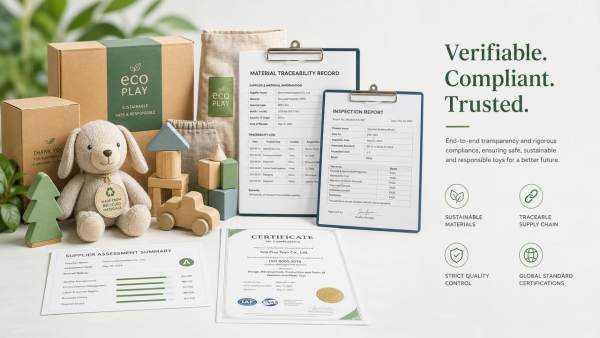
As sustainability becomes a core buying criterion, claims around sustainable toys face growing scrutiny from retail evaluators and sourcing teams. For business assessment professionals, credibility depends on more than eco-friendly language—it requires traceable materials, valid certifications, factory transparency, and compliance evidence. This article examines what makes sustainability claims believable and how buyers can reduce risk while identifying commercially viable suppliers.
For most sourcing and evaluation teams, the core search intent behind this topic is practical: how to tell whether a supplier’s sustainability claims are real, provable, and suitable for commercial retail use. The question is not whether sustainability matters. It is how to verify it without increasing regulatory exposure, margin pressure, or reputational risk.
That is why the most useful lens is not marketing language, but evidence quality. A credible sustainable toy claim usually rests on four pillars: material traceability, product safety and legal compliance, manufacturing transparency, and consistency between environmental claims and actual business operations. If one pillar is missing, the claim may still sound appealing, but it becomes harder to defend in a buyer review, internal audit, or retail compliance check.
What business assessment teams are really evaluating when suppliers claim “sustainable toys”
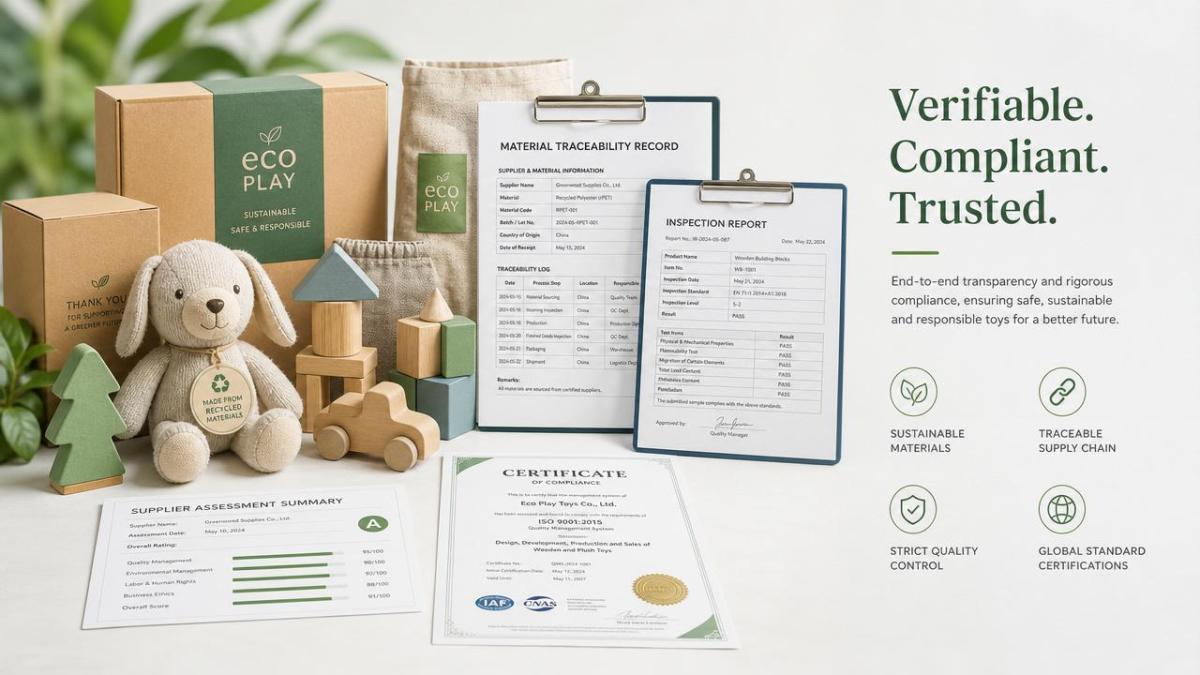
When a supplier presents a toy line as sustainable, assessment professionals are typically not asking a philosophical question. They are asking whether the claim is specific, auditable, scalable, and safe to take to market. In practice, this means examining whether the product can survive retailer due diligence, customs review, product safety testing, and public scrutiny from consumers or watchdog groups.
The biggest concern is greenwashing risk. Broad claims such as “eco-friendly,” “green,” or “planet-safe” have little value unless they are supported by documents that explain what exactly is sustainable about the product. Is the claim about recycled plastic content, FSC-certified wood, lower-emission production, reduced packaging, or end-of-life recyclability? If the supplier cannot define the claim precisely, it should not be treated as credible.
Commercial teams also care about repeatability. A one-off sample made with better materials is not enough if the factory cannot maintain the same specification across production runs. A credible supplier should be able to show how sustainable inputs are sourced consistently, how substitution is controlled, and how lot-level records are maintained.
Finally, assessment teams want to understand whether sustainability creates operational strength or simply added complexity. The best suppliers use sustainability as part of a disciplined manufacturing system that also improves quality control, documentation, and retailer readiness. Those are the partners more likely to support long-term account growth.
Which sustainability claims in toys are most credible—and which deserve caution
Not all sustainability claims carry the same level of credibility. Some are easier to verify and more meaningful in a sourcing context. Others are vague, selective, or designed mainly for packaging appeal. Buyers should separate high-evidence claims from low-evidence narratives.
Among the more credible claims are those linked to recognized material standards. Examples include FSC-certified wood or paper components, Global Recycled Standard content in textiles or plastics, or verified organic cotton where relevant. These claims point to a certifiable chain of custody or documented input standard, which gives evaluators something tangible to review.
Claims around reduced packaging can also be credible if they are measurable. A supplier that demonstrates a 20% reduction in packaging weight, eliminates mixed-material packaging, or shifts to recyclable mono-material structures is making a claim that can usually be confirmed through packaging specifications and physical review.
By contrast, generic claims such as “natural,” “non-toxic,” or “environmentally friendly” require caution. “Natural” does not guarantee responsible sourcing. “Non-toxic” can be misleading if it is used without reference to actual toy safety requirements. “Environmentally friendly” is too broad unless broken down into verifiable attributes. Buyers should be especially careful when a supplier uses emotional language but offers no third-party validation, no bill of materials transparency, and no compliance file.
Another area requiring close review is biodegradability or compostability. These claims may sound attractive but are often poorly understood. A toy may include one component marketed as biodegradable while the assembled product itself is not suitable for normal composting systems. If disposal claims are made, buyers need clear test basis, conditions, and market relevance.
Why traceable materials matter more than attractive sustainability messaging
For business evaluators, traceability is often the dividing line between a marketable claim and a risky one. A supplier may say that a toy is made from recycled ABS, recycled polyester filling, or responsibly sourced wood. The real question is whether that material can be tracked from source to finished product in a way that stands up to review.
Traceability starts with documentation at the raw material level. Suppliers should be able to identify material grades, origin, percentage of claimed recycled or certified content, and the processors involved. In stronger systems, these details connect to purchase records, incoming inspection reports, and production batch data.
This matters because toy manufacturing often involves multiple materials and subcontracted processes. A plush toy may combine fabric, thread, stuffing, printing ink, polybags, and hangtags from different vendors. A wooden toy may include paint, coatings, packaging inserts, and hardware. A sustainability claim that applies to only one visible element can be technically true but commercially misleading if the rest of the product lacks the same rigor.
Assessment teams should therefore ask suppliers to define exactly what percentage of the finished product is covered by the claim. For example, does “recycled material” refer to the outer shell only, or the whole item by weight? Is the FSC claim limited to the packaging, or does it include the toy itself? Precision helps prevent downstream disputes with retail customers and marketing teams.
How certifications, test reports, and compliance records support credibility
In toys, sustainability cannot be evaluated separately from safety and legal compliance. A supplier may offer appealing environmental claims, but if the item lacks the required testing or certification pathway for the target market, the commercial value drops quickly. Credible sustainable toys must satisfy both environmental expectations and the baseline rules for children’s products.
Depending on market destination, buyers may need to review CPC documentation for the United States, CE-related conformity documentation for the European market, EN71 test results, ASTM F963 testing, phthalate restrictions, heavy metal limits, labeling compliance, and packaging requirements. Sustainability does not override any of these. In fact, alternative materials often require even closer testing because formulation changes can affect safety performance.
Third-party certifications can strengthen a sustainability claim, but only when they are relevant and valid. Buyers should confirm the issuing body, certificate scope, facility name, expiration date, and whether the certified entity matches the production site. It is not uncommon for suppliers to present outdated certificates or documents that apply to a related factory rather than the actual manufacturing location.
Test reports also need context. A report on one sample from two years ago does not prove that the current production item meets the same standard. Business assessment teams should check whether the report matches the exact SKU, material configuration, and applicable regulation. The more frequent the material changes, the more important it is to maintain current verification.
What factory transparency reveals about whether claims are operationally real
One of the strongest indicators of credibility is how a supplier behaves when asked operational questions. Reliable factories can usually explain their sourcing structure, approved material list, audit history, quality controls, and corrective action process without becoming evasive. Weak suppliers often remain at the level of slogans.
Transparency includes visibility into subcontracting. If key processes such as molding, painting, sewing, printing, or packaging are outsourced, buyers need to know whether sustainability controls extend to those partners. A factory cannot make strong environmental claims if major production steps happen through unaudited vendors with undocumented material substitutions.
It is also useful to examine whether sustainability is embedded into routine management systems. Does the factory track waste reduction, energy usage, packaging optimization, or restricted substance controls? Are there standard operating procedures for segregating certified materials? Are procurement and quality teams aligned on approved alternatives? These are practical signs that sustainability is being managed rather than merely advertised.
For larger sourcing programs, on-site or virtual factory assessments remain valuable. Even when buyers rely on third-party audits, direct questioning helps clarify whether the supplier understands the commercial consequences of unsupported claims. In many cases, confidence comes less from a single certificate and more from the overall coherence of the supplier’s systems and documentation.
How to spot red flags before a sustainability claim becomes a sourcing risk
Several warning signs appear repeatedly in toy sourcing. The first is inconsistency between marketing claims and technical files. If the sales deck promotes recycled content but the bill of materials or test reports do not reference the same material specification, the claim needs closer review.
The second red flag is overreliance on packaging language. Some products are promoted as sustainable because the outer carton is recyclable, while the toy itself remains unchanged in materials, chemistry, and design. Packaging improvements can be meaningful, but they should not be confused with whole-product sustainability.
A third warning sign is unclear chain of custody. If a supplier can show a material certificate but cannot connect it to the specific production lot, the evidence may not support the final product claim. Likewise, if multiple factories are involved and only one holds the certification, buyers should not assume all output qualifies.
Another issue is selective disclosure. A supplier may emphasize renewable or recycled inputs but avoid discussing durability, product lifespan, repairability, or failure rates. In toys, durability has sustainability value because products that break quickly create waste and customer dissatisfaction. A credible evaluation should look beyond one environmental attribute and consider actual product performance.
Finally, be cautious when pricing seems disconnected from the claim. Sustainable inputs, traceability systems, and third-party certifications usually involve some cost. Extremely low pricing does not automatically mean the claim is false, but it should prompt questions about whether the documented standard can be sustained at scale.
A practical evaluation framework for buyers assessing sustainable toy suppliers
For business assessment professionals, an effective evaluation framework should be simple enough to apply consistently and detailed enough to withstand internal review. A useful starting point is a five-part screen: claim definition, evidence quality, compliance readiness, operational transparency, and commercial scalability.
First, define the claim in exact terms. Ask what makes the toy sustainable, which components are covered, and how the supplier would describe the claim in retailer-facing language. If the supplier cannot state this clearly, the process should not move forward.
Second, evaluate evidence quality. Request certifications, material declarations, chain-of-custody records, specification sheets, and recent test reports. Check whether the documents relate to the finished product and the actual production facility. Evidence should be current, product-specific where possible, and traceable to a credible issuer.
Third, assess compliance readiness. Sustainable positioning has little value if the product is not prepared for the legal demands of the destination market. Confirm required toy safety testing, labeling, age grading, chemical compliance, and market-specific documentation. New materials should trigger additional scrutiny rather than assumptions.
Fourth, review operational transparency. Understand the factory structure, subcontractor controls, material approval process, and change management discipline. This helps determine whether the supplier can maintain claim integrity after the sample stage.
Fifth, test commercial scalability. Ask about minimum order quantities, lead times, raw material availability, cost stability, and the ability to support private-label modifications. Buyers need sustainable toys that can move from concept to dependable retail supply, not just perform well in a presentation.
Why credible sustainability claims create business value beyond compliance
For retail buyers and brand owners, credible sustainability claims are not only about risk reduction. They can also strengthen assortment strategy, improve retailer negotiations, and support premium positioning when backed by real evidence. In categories such as gifts and toys, where purchase decisions are emotional but compliance expectations are strict, credibility becomes a commercial differentiator.
Verified sustainable attributes can help brands meet internal ESG commitments, retailer scorecard requirements, and consumer communication standards with greater confidence. They also reduce the chance of late-stage rejection from compliance teams or marketplace reviewers, which protects launch timing and sourcing efficiency.
From a supplier-selection perspective, factories that can support credible claims often demonstrate broader operational maturity. They tend to have stronger documentation habits, clearer process control, and better readiness for international retail programs. Those capabilities matter even beyond sustainability because they contribute to fewer disruptions and more resilient supply relationships.
In other words, the real value of sustainable toys is not created by a label alone. It comes from the combination of compliant design, traceable materials, transparent manufacturing, and commercially viable execution. That combination is what turns sustainability from a branding idea into a sourcing advantage.
Conclusion: credible sustainable toys are built on proof, not promises
For business assessment teams, the most reliable way to evaluate sustainable toys is to treat every claim as a commercial and compliance question, not a marketing statement. Credibility depends on whether the supplier can define the claim clearly, support it with traceable evidence, align it with toy safety requirements, and deliver it consistently at production scale.
The strongest suppliers do not rely on vague eco-language. They show documented material sourcing, valid certifications, current test reports, transparent factory systems, and realistic production capabilities. That is what reduces greenwashing risk and gives buyers confidence in both regulatory defensibility and retail readiness.
As sustainability standards continue to tighten across global markets, procurement and evaluation professionals will be judged not just on finding attractive products, but on selecting claims they can stand behind. In that environment, proof is the real product. The more disciplined the verification process, the more likely buyers are to build assortments that are credible, compliant, and commercially durable.
Related Intelligence
 Skincare OEMAug 16, 2026Amazon Enforces AI Human Metadata Rule for Beauty and Personal Care SellersAmazon now enforces AI human metadata rules for beauty sellers. Learn how to protect listings, traffic, and compliance in skincare, cosmetics, and beauty devices.
 Beauty DevicesAug 15, 2026China to Roll Out Nationwide Cross-Border Cash Pooling for MultinationalsChina to roll out nationwide cross-border cash pooling for multinationals from Sept. 14. Discover how this policy could improve treasury efficiency, liquidity management, and China-linked supply chains.
 Beauty DevicesAug 14, 2026China Imposes Temporary Export Ban on Helium, Affecting Cooling Supply ChainsChina's temporary helium export ban may disrupt cooling supply chains for beauty RF devices and laser systems. Learn what ODMs, buyers, and procurement teams should check now.
![]() Cosmetics & PkgAug 13, 2026PPWR becomes mandatory: Beauty and personal care packaging materials usher in new EPR and PFAS compliance requirementsPPWR takes effect for cosmetics packaging in the EU, bringing EPR registration and PFAS limits. Learn what brands, importers, and suppliers must do now.
Cosmetics & PkgAug 13, 2026PPWR becomes mandatory: Beauty and personal care packaging materials usher in new EPR and PFAS compliance requirementsPPWR takes effect for cosmetics packaging in the EU, bringing EPR registration and PFAS limits. Learn what brands, importers, and suppliers must do now. Cosmetics & PkgAug 12, 2026EU PPWR Now Enforced for Beauty Packaging ComplianceEU PPWR now enforced for beauty packaging compliance: learn how EPR, ERN, heavy metals and PFAS rules affect EU exports, customs clearance and platform sales.
 Cosmetics & PkgAug 11, 2026EU PPWR Rules Take Effect on Aug. 12 for Beauty PackagingEU PPWR rules for beauty packaging take effect on Aug. 12, 2026. Learn key compliance steps, EPR, labeling, PFAS limits, and how to avoid customs delays and fines.
 Smart Pet DevicesAug 10, 2026EU EPR Rules to Cover Smart Pet Devices on Aug. 15EU EPR Rules will cover smart pet devices from Aug. 15, 2026. Learn how smart collars, feeders, and monitoring devices can avoid delisting, customs delays, and compliance risks in the EU.
 Infant Feeding & CareAug 09, 2026CPSC Recalls Baby Sleep Sacks Over Undeclared TDCPPCPSC Recalls Baby Sleep Sacks Over Undeclared TDCPP: learn how this 2026 recall impacts CPC documents, third-party testing, and U.S. baby product compliance for exporters.
 Infant Feeding & CareAug 08, 2026ECHA Adds 5 SVHCs, Importer Notices Due From Oct 2026ECHA adds 5 SVHCs to the Candidate List, with importer notices due from October 2026. Learn how REACH affects exporters, supply chains, and documentation readiness.
 Baby Gear & StrollersAug 07, 2026CPSC Revises Crib Rail Standard for November 2026CPSC revises crib rail standard for November 2026, adding dynamic impact tests and mandatory third-party lab testing. Learn how the new rule affects U.S. market access, compliance, and shipments.
 Electronic & RC ToysAug 06, 2026EU to Require EN IEC 62115:2025 for Electronic ToysEU to Require EN IEC 62115:2025 for Electronic Toys from Oct 1, 2026. Learn scope, battery and AI safety updates, CE compliance risks, and how exporters can avoid customs delays.
 Baby Gear & StrollersAug 05, 2026US Stroller Stability Rule Takes Effect Aug. 15US Stroller Stability Rule Takes Effect Aug. 15: learn how new U.S. stroller compliance, ASTM F833-26a, and CPSC testing rules may affect imports, certification, and shipment readiness.
 Infant Feeding & CareAug 04, 2026ECHA Adds 5 SVHCs, Triggering Baby Care Export ReviewECHA adds 5 SVHCs, prompting an urgent baby care export review for EU-bound products. Learn the 0.1% threshold risks, compliance steps, and how to avoid customs delays and fines.












