How Can Retailers Prevent Mold Complaints About Bath Toys?
Mold complaints about bath toys are usually traceable to retained water, not to a single visible defect. A toy can look clean on the outside while water remains in a hollow chamber, seam cavity, whistle insert, or narrow squeeze nozzle. Warm, damp storage then allows residue and microorganisms to accumulate. Preventing complaints therefore starts with choosing designs that dry reliably, confirming that the finished product does not trap rinse water, and giving clear care guidance that matches the toy’s actual construction.
Surface discoloration, black particles expelled from a squeeze toy, an odor after use, and a sticky interior film are often reported as the same problem. They do not always have the same cause. Pigment transfer, incomplete washing after molding, adhesive residue, and true internal growth require different corrective actions. A complaint-review process should preserve the returned item, inspect its construction, and distinguish a moisture-retention issue from a manufacturing cleanliness issue before changing materials or making broad claims about the product.
Start With a Design That Can Drain and Dry
The highest-risk format is a sealed-looking hollow toy with a tiny opening intended only to make a sound or allow squeezing. Water enters through the opening during play, but the opening is too small, poorly positioned, or obstructed by an internal component to release the water completely. Once water is inside, shaking the toy rarely proves that the cavity is dry. Droplets can remain around internal ribs, under a bonded cap, or behind a molded valve.
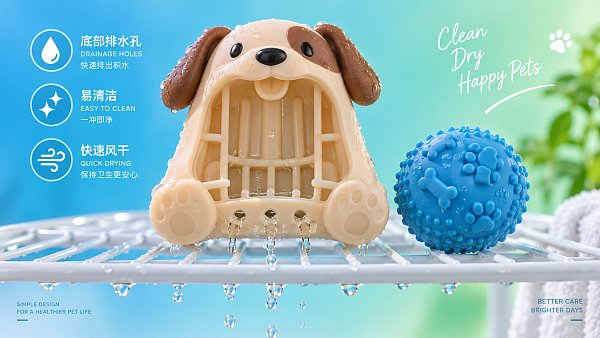
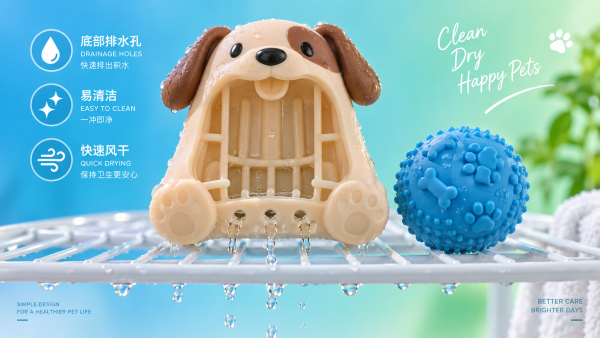
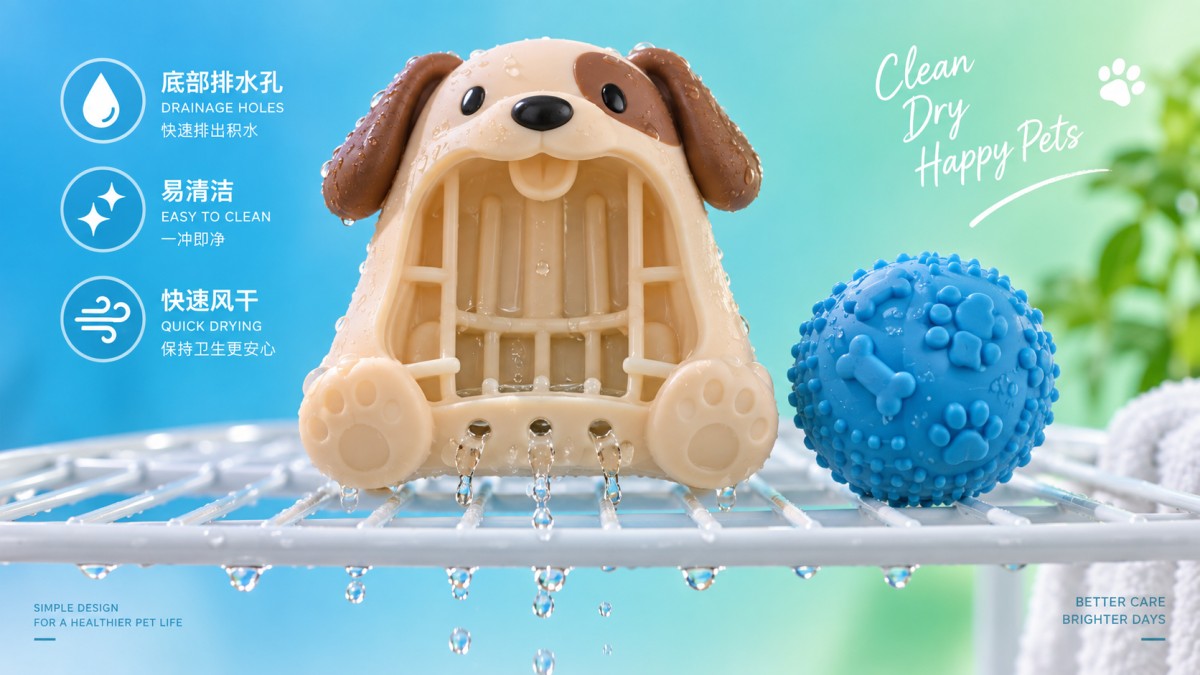
A fully open construction is usually easier to inspect, rinse, and air-dry than a closed hollow body. Openings should be large enough to permit visual examination and practical cleaning, rather than merely allowing a trickle of water to escape. Their location matters as much as their diameter. When the toy rests in its normal storage orientation, the drainage route needs to sit at a low point. A hole positioned on the side of a rounded body can leave a reservoir at the base even when water seems to drain quickly.
For soft squeeze toys, a two-part construction with a removable and secure component can make interior drying more realistic, provided that the connection remains safe, durable, and appropriate for the intended use. A non-squeezing, solid molded form avoids the internal-cavity problem altogether, although textured exterior features can still hold soap residue. Products intended for pet bathing need the same scrutiny: flexible chew-like forms, treat-dispensing cavities, and float toys can hold dirty bath water if their openings do not permit thorough flushing and drying.
Drainage testing should use the exact production configuration, including squeakers, plugs, printed decorations, weighted elements, and bonded accessories. A prototype that drains well before an internal insert is fitted does not demonstrate that the finished item drains well. The test should also consider how a child or pet owner naturally handles the toy: filling it, squeezing it, leaving it upright in a tub, or placing it in a basket while still wet. Design decisions based only on an inverted laboratory position often fail in ordinary use.
Material Choice Should Support Cleaning, Not Replace It
Material selection influences odor, surface feel, staining, seam quality, and resistance to repeated washing, but it does not make a water-filled cavity maintenance-free. Claims that a material is inherently resistant to microbial growth can be misunderstood when the design still traps bath water containing soap, skin oils, saliva, or environmental debris. The relevant question is whether the complete part can be cleaned and dried after realistic use.
Nonporous, well-finished surfaces are generally easier to rinse than rough, under-cured, or heavily textured ones. Material compatibility with cleaners matters too. A product that becomes tacky, cracks, loses print, or develops stress whitening after a reasonable care method creates a difficult situation: the instructions may ask for cleaning that shortens the toy’s useful life. Review the anticipated care routine against the actual resin, elastomer, colorant, coating, adhesive, and decoration system.
Soft materials require particular attention at mold lines and bonded interfaces. A fine seam is not automatically a hygiene problem, but an open seam or poorly fused joint can create a capillary path that draws in water and residue. Conversely, aggressively trimming a seam can leave a thin wall or a weak point that later splits. The relevant production standard is not simply “no visible seam”; it is a stable joint with no accessible crevice and no unintended route into a hidden void.
Translate the Design Into Measurable Supplier Controls
A purchase specification should describe the water-management features as functional requirements. “Drainage hole included” is too vague. The specification can define the opening location relative to the lowest internal point, require that no component obstruct the route, state whether the internal cavity must be visible through the opening, and identify the storage orientation used during evaluation. Drawings, approved samples, and written acceptance criteria should describe the same arrangement.
Sampling should not focus only on color, dimensions, and appearance. Finished pieces from different cavities, production shifts, and assembly batches need functional review. Water ingress can reveal variation that visual inspection misses. A blocked hole may result from flash, excess adhesive, a shifted squeaker, an improperly seated plug, or a distortion caused by cooling. Cutting open a limited number of evaluated units can be useful when internal geometry cannot otherwise be confirmed, especially after tooling changes or process adjustments.
Assembly steps deserve separate attention. An otherwise drainable shell can become a moisture trap when a cap is ultrasonically welded over an opening, when adhesive migrates into a channel, or when a sound insert covers the outlet under compression. Work instructions should identify the orientation of each internal part and the acceptable adhesive footprint where adhesive is used. Operators need a clear reject condition for blocked ports, incomplete welds, exposed sharp edges, and parts that do not expel water as intended.
Packaging also affects complaint patterns. Bath toys packed immediately after water-based testing, washing, or cooling can carry residual moisture into a closed carton. That moisture does not necessarily create internal growth on its own, but it can leave odor, spotting, or staining that customers interpret as contamination. Drying time, handling conditions, and packaging cleanliness should be controlled after any wet process. If a toy is sold in a sealed package, the pre-packaging inspection must be strong because the customer cannot assess the interior before opening.
Use Testing That Reflects the Failure Mode
Routine material tests and general product safety assessments do not automatically answer whether a bath toy will retain dirty water. A focused evaluation is simple in principle: expose the toy to water in the way it will be used, drain it using ordinary handling, leave it in a plausible storage position, then inspect for retained moisture. Repeating the cycle is more informative than a single fill-and-pour exercise because residue becomes more apparent after several wetting and drying events.
Evaluation should observe both the exterior and the inaccessible interior. Squeezing a toy over a clean surface after a drainage period can show whether water remains. Weighing before and after controlled draining can identify retained water where a visual check is difficult, although the method needs consistent timing and surface drying. Transparent or cutaway development samples can expose dead zones in a complex shape. These approaches are diagnostic tools, not interchangeable proof: a weight change shows retained liquid, while a cutaway shows where geometry prevents release.
Do not treat a fast initial stream as a pass result. Small droplets can persist in a neck, foot, ear, tail, valve recess, or internal decorative chamber. Designs with several connected cavities are especially prone to this problem because air locking can stop the final pocket from draining. Tilting the toy through several realistic orientations during testing helps reveal whether water shifts between chambers rather than leaving the product.
Cleaning validation should be equally practical. If care instructions say to rinse and air-dry, test whether that action actually clears the product. If they call for a dishwasher, confirm heat exposure, water pressure, detergent contact, and drying conditions against the finished assembly rather than an unprinted material plaque. If the product cannot be safely opened, flushed, or dried using the stated method, the construction and instructions are out of alignment.
Care Instructions Need Specific Actions and Realistic Limits
Vague wording such as “keep clean” gives little direction after a wet bath-time session. Useful instructions tell the owner to empty any water immediately, squeeze and shake the toy where applicable, rinse away visible residue, leave it in a ventilated area, and avoid storing it in a closed damp container. The wording should match the shape. A toy designed to stand on its base should not require an awkward upside-down drying position unless a drying stand or other practical method is provided.
Instructions should also state when the item should be removed from use: persistent odor, expelled dark material, a split seam, damaged coating, or an interior that cannot be adequately cleaned. This is not an admission that the product is expected to fail. It defines a sensible response to visible deterioration and reduces the chance that a damaged water-trapping toy remains in service.
Care claims need restraint. Avoid presenting ordinary rinsing as a guarantee against mold under every storage condition. Bathrooms vary widely in ventilation, temperature, drying time, and residue load. Clear maintenance directions reduce avoidable retention; they cannot compensate for a cavity that cannot empty or a product left wet in an enclosed bin for extended periods.
Handle Complaints as Evidence, Not Just Returns
Complaint records become more useful when they capture the product version, purchase period, lot or production identifier where available, reported storage conditions, and the exact symptom. A photo of exterior spotting does not establish the same root cause as a report of particles expelled from an opening. Asking whether water entered the toy, whether it was squeezed after use, whether the item has a crack, and whether it was stored in a sealed container can narrow the investigation without assuming customer misuse.
Returned samples should be compared with retained production samples and current specifications. Look for blocked drainage paths, seam openings, incomplete bonding, foreign matter, odor, or differences in component placement. If several returns involve the same construction feature, changing the customer-care text alone is unlikely to resolve the underlying issue. If the product drains as designed but complaints cluster around an unclear storage behavior, packaging and post-purchase guidance may need revision.
The strongest prevention program links a drainable design to verified production execution and care instructions that people can follow after an ordinary bath. When those three elements agree, moisture is less likely to remain hidden inside the toy, and a complaint can be investigated against concrete product evidence rather than guesswork.
Related Intelligence
 Infant Feeding & CareSep 20, 2026How Can Retailers Prevent Mold Complaints About Bath Toys?How can retailers prevent mold complaints about bath toys? Explore drainable designs, supplier controls, testing, and care guidance to reduce moisture risks.
 Camping & WaterSep 20, 2026Which Folding Chair Fabrics Last Longest Outdoors?Which folding chair fabrics last longest outdoors? Compare acrylic, PVC-coated polyester, UV-stabilized polyester, and mesh for durable, pet-friendly outdoor seating.
 Camping & WaterSep 20, 2026Are Folding Camping Chairs Tested for Weight Capacity?Are folding camping chairs tested for weight capacity? Learn what credible load testing, safety margins, and supplier documentation mean for confident outdoor product sourcing.
 Corporate & Seasonal GiftsSep 20, 2026How Can Corporate Gift Buyers Avoid Missing Event Deadlines?How do corporate gift buyers avoid missed event deadlines? Discover proven sourcing, customization, compliance, and shipping strategies for pet-themed corporate gifts.
 Corporate & Seasonal GiftsSep 20, 2026What Should Be Approved Before Placing a Custom Gift Order?What should be approved before placing a custom gift order? Explore the essential checks for safe, compliant, retail-ready custom pet gifts.
 Corporate & Seasonal GiftsSep 20, 2026Which Custom Gift Materials Have the Lowest Defect Rates?Which custom gift materials have the lowest defect rate? Explore why silicone, stainless steel, polypropylene, and polyester help pet gift brands reduce rejects and improve quality.
 Skincare OEMAug 16, 2026Amazon Enforces AI Human Metadata Rule for Beauty and Personal Care SellersAmazon now enforces AI human metadata rules for beauty sellers. Learn how to protect listings, traffic, and compliance in skincare, cosmetics, and beauty devices.
 Beauty DevicesAug 15, 2026China to Roll Out Nationwide Cross-Border Cash Pooling for MultinationalsChina to roll out nationwide cross-border cash pooling for multinationals from Sept. 14. Discover how this policy could improve treasury efficiency, liquidity management, and China-linked supply chains.
 Beauty DevicesAug 14, 2026China Imposes Temporary Export Ban on Helium, Affecting Cooling Supply ChainsChina's temporary helium export ban may disrupt cooling supply chains for beauty RF devices and laser systems. Learn what ODMs, buyers, and procurement teams should check now.
![]() Cosmetics & PkgAug 13, 2026PPWR becomes mandatory: Beauty and personal care packaging materials usher in new EPR and PFAS compliance requirementsPPWR takes effect for cosmetics packaging in the EU, bringing EPR registration and PFAS limits. Learn what brands, importers, and suppliers must do now.
Cosmetics & PkgAug 13, 2026PPWR becomes mandatory: Beauty and personal care packaging materials usher in new EPR and PFAS compliance requirementsPPWR takes effect for cosmetics packaging in the EU, bringing EPR registration and PFAS limits. Learn what brands, importers, and suppliers must do now. Cosmetics & PkgAug 12, 2026EU PPWR Now Enforced for Beauty Packaging ComplianceEU PPWR now enforced for beauty packaging compliance: learn how EPR, ERN, heavy metals and PFAS rules affect EU exports, customs clearance and platform sales.
 Cosmetics & PkgAug 11, 2026EU PPWR Rules Take Effect on Aug. 12 for Beauty PackagingEU PPWR rules for beauty packaging take effect on Aug. 12, 2026. Learn key compliance steps, EPR, labeling, PFAS limits, and how to avoid customs delays and fines.
 Smart Pet DevicesAug 10, 2026EU EPR Rules to Cover Smart Pet Devices on Aug. 15EU EPR Rules will cover smart pet devices from Aug. 15, 2026. Learn how smart collars, feeders, and monitoring devices can avoid delisting, customs delays, and compliance risks in the EU.