
SASO Mandates EN 13537:2026 Class B Fire Rating for Smart Pet Travel Bags
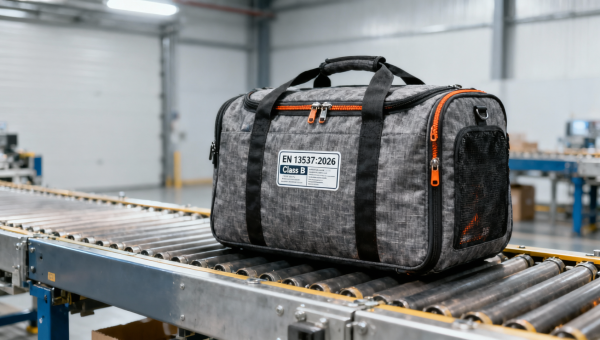
On May 16, 2026, the Saudi Standards, Metrology and Quality Organization (SASO) updated its SABER platform to require fire-resistance certification for smart pet travel products entering the Kingdom — a move directly impacting exporters, material suppliers, manufacturers, and compliance service providers serving the GCC pet-tech market.
Event Overview
Effective immediately as of May 16, 2026, SASO amended the SABER product registration requirements for items classified under ‘Smart Pet Devices’. This includes smart pet travel bags, vehicle-mounted pet carriers, and similar portable containment solutions. In addition to existing GCC RoHS compliance, applicants must now upload a valid EN 13537:2026 Class B fire resistance test report — issued exclusively by an ISO/IEC 17025-accredited laboratory — simulating combustion behavior in confined vehicular environments. Products lacking this documentation will face suspension of customs clearance.
Industries Affected
Direct Trading Enterprises: Exporters and distributors targeting the Saudi market must now verify fire-test compliance prior to shipment. Non-compliant consignments risk port hold, rework delays, or rejection at entry — increasing landed cost and eroding margin on time-sensitive seasonal launches (e.g., summer pet travel season).
Raw Material Suppliers: Fabric, foam, and polymer suppliers providing components for certified travel bags must align specifications with EN 13537:2026 Class B thresholds (e.g., limiting flame spread, smoke density, and heat release rate). This triggers demand for traceable, pre-tested materials — shifting procurement from generic to performance-verified grades.
Manufacturing Enterprises: OEM/ODM facilities producing smart pet gear face revised design validation workflows. Integration of fire-rated linings, non-melting zippers, and thermally stable electronics housings becomes mandatory — requiring cross-functional review between R&D, QA, and regulatory teams before pilot production.
Supply Chain Service Providers: SABER agents, conformity assessment bodies, and lab coordination platforms must update their checklists and client advisories. Capacity constraints are emerging at accredited labs offering EN 13537:2026 testing — leading to longer turnaround times and premium pricing for Class B reports.
Key Focus Areas & Recommended Actions
Verify Product Classification First
Not all pet carriers fall under ‘Smart Pet Devices’ in SABER. Only units incorporating sensors, Bluetooth/Wi-Fi connectivity, battery-powered climate control, or GPS tracking are subject. Manual or passive travel bags remain exempt — but classification ambiguity requires official SASO confirmation prior to registration.
Secure Lab Accreditation Early
EN 13537:2026 Class B testing is not widely available outside EU-based ISO/IEC 17025 labs. Applicants should confirm lab scope validity (not just accreditation status) and request sample test protocols upfront — especially regarding simulated cabin ventilation conditions.
Update Technical Documentation Packages
Technical files submitted via SABER must now include: (1) full test report with lab seal and signature, (2) annotated product photos highlighting fire-resistant layers, and (3) declaration of conformity referencing EN 13537:2026 Class B — not earlier editions or equivalent standards.
Editorial Perspective / Industry Observation
Observably, this update reflects SASO’s broader shift toward functional safety — moving beyond electrical and chemical hazards to address real-world usage risks, such as fire propagation in enclosed transport spaces. While EN 13537 was historically applied to sleeping bags, its extension to pet travel gear signals a precedent that may influence other Gulf Cooperation Council (GCC) members. Analysis shows this is less about harmonizing with EU norms and more about domestic incident response — reportedly following two documented cases of thermal runaway in lithium-powered pet carriers during vehicle exposure in 2025.
Current regulatory trajectory suggests further segmentation of ‘smart’ vs. ‘non-smart’ product pathways in SABER — potentially leading to divergent conformity routes and fee structures. From an industry perspective, this development is better understood not as a one-off compliance hurdle, but as an early indicator of performance-based regulation scaling into adjacent consumer IoT categories.
Conclusion
This requirement marks a meaningful escalation in technical due diligence for pet-tech exporters to Saudi Arabia. It underscores how regional standardization bodies are increasingly treating connected consumer accessories as integrated safety systems — rather than discrete hardware. For stakeholders, adaptability hinges less on document submission and more on embedded product safety literacy across sourcing, engineering, and regulatory functions.
Source Attribution
Official notice published on the SASO SABER portal (saber.sa), dated May 16, 2026 (Reference: SASO/NOT/SPD/2026/047). Confirmed via SASO’s Public Inquiry Unit (PIU) response ID #PIU-2026-1892. Ongoing monitoring recommended for: (1) potential extension to UAE ESMA or Kuwait KOWSME frameworks; (2) clarification on grandfathering for already-cleared stock; (3) publication of SASO’s internal interpretation guide for EN 13537:2026 Class B application criteria.
Related Intelligence
 Skincare OEMAug 16, 2026Amazon Enforces AI Human Metadata Rule for Beauty and Personal Care SellersAmazon now enforces AI human metadata rules for beauty sellers. Learn how to protect listings, traffic, and compliance in skincare, cosmetics, and beauty devices.
 Beauty DevicesAug 15, 2026China to Roll Out Nationwide Cross-Border Cash Pooling for MultinationalsChina to roll out nationwide cross-border cash pooling for multinationals from Sept. 14. Discover how this policy could improve treasury efficiency, liquidity management, and China-linked supply chains.
 Beauty DevicesAug 14, 2026China Imposes Temporary Export Ban on Helium, Affecting Cooling Supply ChainsChina's temporary helium export ban may disrupt cooling supply chains for beauty RF devices and laser systems. Learn what ODMs, buyers, and procurement teams should check now.
![]() Cosmetics & PkgAug 13, 2026PPWR becomes mandatory: Beauty and personal care packaging materials usher in new EPR and PFAS compliance requirementsPPWR takes effect for cosmetics packaging in the EU, bringing EPR registration and PFAS limits. Learn what brands, importers, and suppliers must do now.
Cosmetics & PkgAug 13, 2026PPWR becomes mandatory: Beauty and personal care packaging materials usher in new EPR and PFAS compliance requirementsPPWR takes effect for cosmetics packaging in the EU, bringing EPR registration and PFAS limits. Learn what brands, importers, and suppliers must do now. Cosmetics & PkgAug 12, 2026EU PPWR Now Enforced for Beauty Packaging ComplianceEU PPWR now enforced for beauty packaging compliance: learn how EPR, ERN, heavy metals and PFAS rules affect EU exports, customs clearance and platform sales.
 Cosmetics & PkgAug 11, 2026EU PPWR Rules Take Effect on Aug. 12 for Beauty PackagingEU PPWR rules for beauty packaging take effect on Aug. 12, 2026. Learn key compliance steps, EPR, labeling, PFAS limits, and how to avoid customs delays and fines.
 Smart Pet DevicesAug 10, 2026EU EPR Rules to Cover Smart Pet Devices on Aug. 15EU EPR Rules will cover smart pet devices from Aug. 15, 2026. Learn how smart collars, feeders, and monitoring devices can avoid delisting, customs delays, and compliance risks in the EU.
 Infant Feeding & CareAug 09, 2026CPSC Recalls Baby Sleep Sacks Over Undeclared TDCPPCPSC Recalls Baby Sleep Sacks Over Undeclared TDCPP: learn how this 2026 recall impacts CPC documents, third-party testing, and U.S. baby product compliance for exporters.
 Infant Feeding & CareAug 08, 2026ECHA Adds 5 SVHCs, Importer Notices Due From Oct 2026ECHA adds 5 SVHCs to the Candidate List, with importer notices due from October 2026. Learn how REACH affects exporters, supply chains, and documentation readiness.
 Baby Gear & StrollersAug 07, 2026CPSC Revises Crib Rail Standard for November 2026CPSC revises crib rail standard for November 2026, adding dynamic impact tests and mandatory third-party lab testing. Learn how the new rule affects U.S. market access, compliance, and shipments.
 Electronic & RC ToysAug 06, 2026EU to Require EN IEC 62115:2025 for Electronic ToysEU to Require EN IEC 62115:2025 for Electronic Toys from Oct 1, 2026. Learn scope, battery and AI safety updates, CE compliance risks, and how exporters can avoid customs delays.
 Baby Gear & StrollersAug 05, 2026US Stroller Stability Rule Takes Effect Aug. 15US Stroller Stability Rule Takes Effect Aug. 15: learn how new U.S. stroller compliance, ASTM F833-26a, and CPSC testing rules may affect imports, certification, and shipment readiness.
 Infant Feeding & CareAug 04, 2026ECHA Adds 5 SVHCs, Triggering Baby Care Export ReviewECHA adds 5 SVHCs, prompting an urgent baby care export review for EU-bound products. Learn the 0.1% threshold risks, compliance steps, and how to avoid customs delays and fines.












