
TÜV Rheinland Mandates New Wireless Charging Tests for E-Fitness Equipment
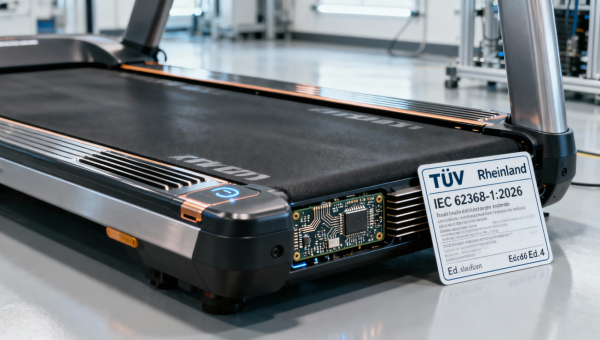
On 17 May 2026, TÜV Rheinland issued a global technical bulletin requiring wireless charging modules in electric fitness equipment to comply with newly added test requirements under IEC 62368-1:2026 Ed.4 — marking a significant regulatory shift for manufacturers exporting to the EU and other IEC-aligned markets. The change directly affects product safety certification pathways, supply chain timelines, and compliance cost structures across the fitness hardware value chain.
Event Overview
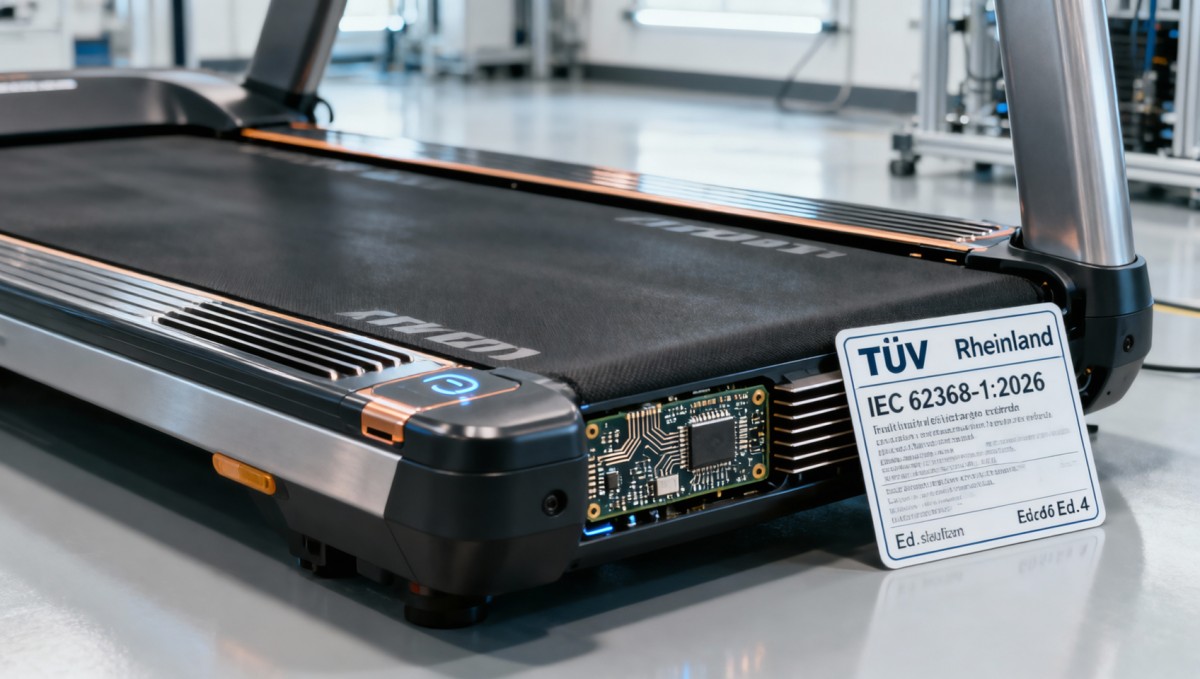
TÜV Rheinland announced on 17 May 2026 that all fitness equipment incorporating Qi or proprietary wireless charging functionality — including smart treadmills and fascia gun charging docks — must pass two newly introduced test items under IEC 62368-1:2026 Ed.4: ‘dynamic load harmonic interference’ and ‘abnormal temperature rise gradient’. Enforcement begins 1 August 2026. Chinese exporters must update their EN 62368-1 certificates accordingly; failure to do so will invalidate CE marking for affected products.
Industries Affected
Direct trading enterprises: Exporters relying on CE marking for EU market access face immediate certification revalidation pressure. Non-compliant stock may be blocked at customs post-August 2026, and contract renewals with EU distributors now hinge on demonstrable test readiness — not just documentation submission.
Raw material procurement enterprises: Suppliers of wireless power ICs, ferrite shielding sheets, and thermally conductive adhesives must now provide harmonized test data supporting dynamic load and thermal gradient performance — not merely static electrical specs. This shifts sourcing criteria from cost and lead time toward certified interoperability evidence.
Contract manufacturing enterprises: ODM/OEM factories producing fitness devices with integrated wireless charging must revise test protocols, calibrate new thermal profiling equipment, and allocate additional validation cycles per SKU. Batch-level testing (not just type approval) becomes more likely, increasing unit-level compliance overhead.
Supply chain service enterprises: Certification consultancies and lab coordination platforms must integrate the two new test items into pre-assessment checklists and timeline calculators. Their reporting dashboards now need fields tracking ‘harmonic interference margin’ and ‘ΔT/dt compliance status’, not only pass/fail outcomes.
Key Focus Areas and Recommended Actions
Verify current certification scope against IEC 62368-1:2026 Ed.4 Annexes
Many existing EN 62368-1 certificates reference earlier editions (e.g., Ed.3). Enterprises should request formal gap analyses from their Notified Body — especially checking whether ‘dynamic load harmonic interference’ and ‘abnormal temperature rise gradient’ were included in original test reports.
Conduct pre-validation using representative worst-case operating profiles
The ‘dynamic load harmonic interference’ test simulates real-world usage patterns — e.g., rapid power ramping during treadmill incline shifts or intermittent pulse charging in percussive therapy devices. Manufacturers should simulate these sequences in-house before third-party lab engagement to reduce retest risk.
Update technical documentation for EU Responsible Person and Declaration of Conformity
Revised DoC templates must explicitly cite IEC 62368-1:2026 Ed.4 (including the two new clauses), and technical files must include traceable test records — not just lab reports — linking each measurement to specific firmware versions and mechanical configurations.
Editorial Perspective / Industry Observation
Observably, this update signals a broader regulatory pivot: safety standards are evolving from static hazard containment toward dynamic system behavior verification. Analysis shows that harmonics and thermal gradients — both highly dependent on firmware control logic and PCB layout — are now treated as intrinsic safety parameters, not just electromagnetic compatibility (EMC) or thermal management concerns. From an industry perspective, this blurs traditional boundaries between hardware certification and software validation. Current more critical implication is not just test compliance, but cross-functional alignment between RF engineers, thermal designers, and embedded firmware teams — a structural challenge for many mid-tier OEMs.
Conclusion
This requirement reflects an accelerating trend: global conformity frameworks increasingly treat intelligent power delivery as a core safety subsystem — not an accessory feature. For the fitness equipment sector, the August 2026 deadline serves less as a one-time hurdle and more as a litmus test for adaptive compliance maturity. A rational conclusion is that firms investing in modular test infrastructure and cross-disciplinary design review processes will gain measurable advantage beyond mere certification renewal.
Source Attribution
Official notice: TÜV Rheinland Technical Bulletin No. TB-FIT-2026-05, published 17 May 2026 (publicly accessible via tuv.com/global/en).
Standard reference: IEC 62368-1:2026 Ed.4 (final draft published March 2026; official release pending IEC confirmation).
Note: Harmonic interference test methodology and acceptable gradient thresholds remain under clarification; stakeholders are advised to monitor TÜV Rheinland’s quarterly technical webinars for updates.
Related Intelligence
 Skincare OEMAug 16, 2026Amazon Enforces AI Human Metadata Rule for Beauty and Personal Care SellersAmazon now enforces AI human metadata rules for beauty sellers. Learn how to protect listings, traffic, and compliance in skincare, cosmetics, and beauty devices.
 Beauty DevicesAug 15, 2026China to Roll Out Nationwide Cross-Border Cash Pooling for MultinationalsChina to roll out nationwide cross-border cash pooling for multinationals from Sept. 14. Discover how this policy could improve treasury efficiency, liquidity management, and China-linked supply chains.
 Beauty DevicesAug 14, 2026China Imposes Temporary Export Ban on Helium, Affecting Cooling Supply ChainsChina's temporary helium export ban may disrupt cooling supply chains for beauty RF devices and laser systems. Learn what ODMs, buyers, and procurement teams should check now.
![]() Cosmetics & PkgAug 13, 2026PPWR becomes mandatory: Beauty and personal care packaging materials usher in new EPR and PFAS compliance requirementsPPWR takes effect for cosmetics packaging in the EU, bringing EPR registration and PFAS limits. Learn what brands, importers, and suppliers must do now.
Cosmetics & PkgAug 13, 2026PPWR becomes mandatory: Beauty and personal care packaging materials usher in new EPR and PFAS compliance requirementsPPWR takes effect for cosmetics packaging in the EU, bringing EPR registration and PFAS limits. Learn what brands, importers, and suppliers must do now. Cosmetics & PkgAug 12, 2026EU PPWR Now Enforced for Beauty Packaging ComplianceEU PPWR now enforced for beauty packaging compliance: learn how EPR, ERN, heavy metals and PFAS rules affect EU exports, customs clearance and platform sales.
 Cosmetics & PkgAug 11, 2026EU PPWR Rules Take Effect on Aug. 12 for Beauty PackagingEU PPWR rules for beauty packaging take effect on Aug. 12, 2026. Learn key compliance steps, EPR, labeling, PFAS limits, and how to avoid customs delays and fines.
 Smart Pet DevicesAug 10, 2026EU EPR Rules to Cover Smart Pet Devices on Aug. 15EU EPR Rules will cover smart pet devices from Aug. 15, 2026. Learn how smart collars, feeders, and monitoring devices can avoid delisting, customs delays, and compliance risks in the EU.
 Infant Feeding & CareAug 09, 2026CPSC Recalls Baby Sleep Sacks Over Undeclared TDCPPCPSC Recalls Baby Sleep Sacks Over Undeclared TDCPP: learn how this 2026 recall impacts CPC documents, third-party testing, and U.S. baby product compliance for exporters.
 Infant Feeding & CareAug 08, 2026ECHA Adds 5 SVHCs, Importer Notices Due From Oct 2026ECHA adds 5 SVHCs to the Candidate List, with importer notices due from October 2026. Learn how REACH affects exporters, supply chains, and documentation readiness.
 Baby Gear & StrollersAug 07, 2026CPSC Revises Crib Rail Standard for November 2026CPSC revises crib rail standard for November 2026, adding dynamic impact tests and mandatory third-party lab testing. Learn how the new rule affects U.S. market access, compliance, and shipments.
 Electronic & RC ToysAug 06, 2026EU to Require EN IEC 62115:2025 for Electronic ToysEU to Require EN IEC 62115:2025 for Electronic Toys from Oct 1, 2026. Learn scope, battery and AI safety updates, CE compliance risks, and how exporters can avoid customs delays.
 Baby Gear & StrollersAug 05, 2026US Stroller Stability Rule Takes Effect Aug. 15US Stroller Stability Rule Takes Effect Aug. 15: learn how new U.S. stroller compliance, ASTM F833-26a, and CPSC testing rules may affect imports, certification, and shipment readiness.
 Infant Feeding & CareAug 04, 2026ECHA Adds 5 SVHCs, Triggering Baby Care Export ReviewECHA adds 5 SVHCs, prompting an urgent baby care export review for EU-bound products. Learn the 0.1% threshold risks, compliance steps, and how to avoid customs delays and fines.












