
SASO Updates SABER: Smart Pet Feeders Require GCC RoHS + Local Cloud Declaration
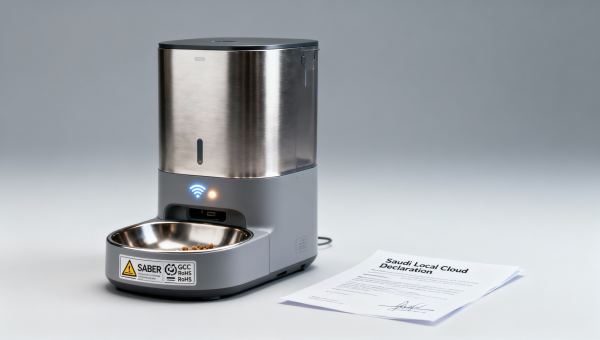
Saudi Arabia’s Standards, Metrology and Quality Organization (SASO) updated its SABER platform on May 15, 2026, introducing new mandatory documentation for smart, internet-connected pet feeders and water dispensers entering the Gulf Cooperation Council (GCC) market. The revision directly impacts exporters—especially manufacturers and trade intermediaries from China—and signals a tightening of digital sovereignty and environmental compliance requirements in the region.
Event Overview
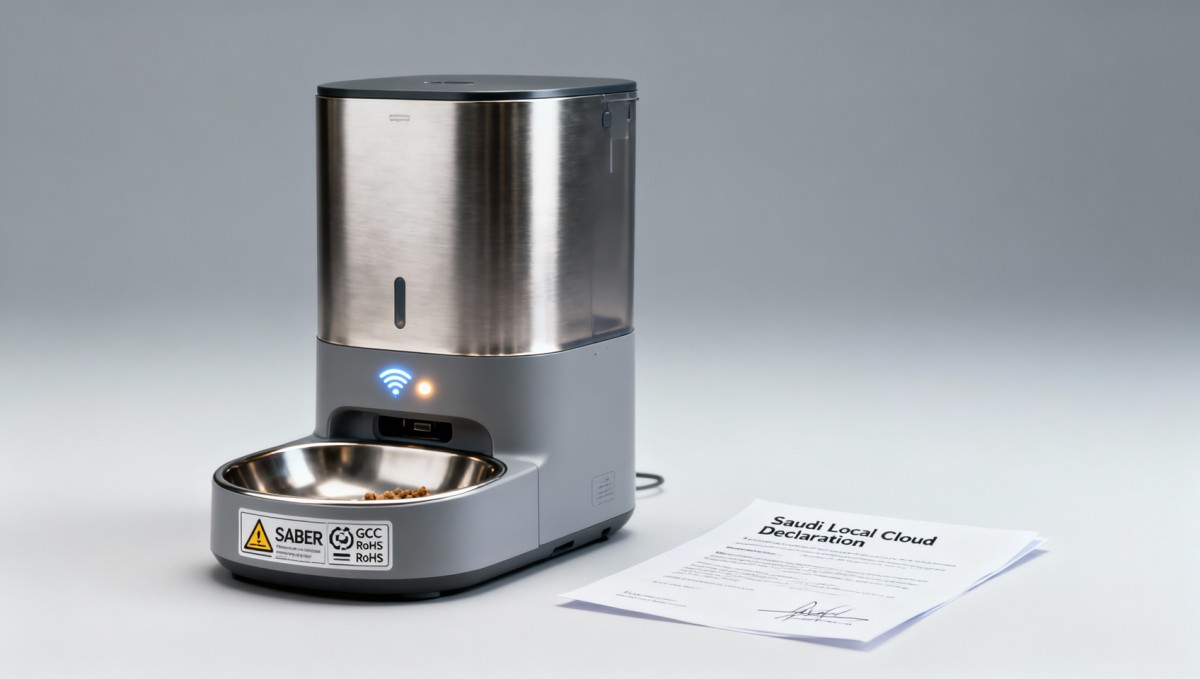
On May 15, 2026, SASO amended SABER system requirements to mandate that all network-enabled pet feeding and hydration devices must, at the time of product registration, submit both a GCC RoHS conformity report and a formal declaration confirming that cloud-based data storage and processing occur exclusively on servers physically located within Saudi Arabia. The requirement applies to all new registrations and renewals effective immediately. According to official SABER interface notifications, non-compliant submissions are rejected automatically. Average registration cycle has extended to 12 working days; some exporters without pre-arranged local cloud infrastructure have reported suspended orders.
Industries Affected
Direct Trading Enterprises
Exporters and trading companies handling smart pet device shipments to GCC countries face immediate operational friction. Because SABER registration is a prerequisite for customs clearance and market access, delays or rejections disrupt shipment scheduling, increase pre-shipment administrative overhead, and raise compliance risk exposure—particularly for firms relying on third-party conformity assessment bodies unfamiliar with GCC RoHS technical annexes or Saudi cloud localization standards.
Raw Material Procurement Enterprises
Suppliers of PCBs, power modules, wireless communication chips (e.g., Wi-Fi/Bluetooth SoCs), and plastic housings used in smart feeders may see downstream demand shifts. While not directly regulated, procurement entities must now anticipate tighter material traceability requests—especially for restricted substances covered under GCC RoHS (e.g., lead, cadmium, hexavalent chromium). Some buyers are beginning to require supplier declarations aligned with Annex II of GCC Technical Regulation TR GA 2020/04.
Contract Manufacturing & OEM Enterprises
Manufacturers—especially those based in Shenzhen and Dongguan, which collectively account for over 85% of GCC-bound smart pet feeder exports—are required to revise firmware architecture and cloud integration protocols. Devices previously using global cloud platforms (e.g., AWS US-East, Alibaba Cloud Singapore) must now route data through certified Saudi-based infrastructure partners. This necessitates firmware updates, API reconfiguration, and additional cybersecurity validation—raising unit-level compliance cost by an estimated 7–12% per model, according to preliminary vendor feedback.
Supply Chain Service Providers
Conformity assessment bodies, SABER authorized representatives, and logistics compliance consultants are adapting service offerings. Several newly accredited Saudi local representatives now bundle GCC RoHS testing coordination and cloud localization verification as integrated packages. Meanwhile, international labs face increased scrutiny from SASO-accredited certification bodies when issuing GCC RoHS reports—particularly regarding test methodology alignment with IEC 62321-7-2 and reporting of substance thresholds in homogenous materials.
Key Focus Areas and Recommended Actions
Verify GCC RoHS Test Scope Against Device Architecture
Manufacturers must ensure testing covers all electrically connected subassemblies—including motors, sensors, battery management ICs, and wireless modules—not just the main PCB. Reports omitting solder paste, connector plating, or coating materials have been rejected during SABER review since May 15.
Secure Pre-Certified Saudi Cloud Infrastructure Partnerships
Firms lacking existing agreements with SASO-recognized local cloud providers (e.g., STC Cloud, Mobily Cloud, or Saudi Aramco’s Amaala Cloud Platform) should prioritize engagement before initiating new SABER registrations. Self-hosted or hybrid deployments require documented evidence of physical server location, data residency logs, and annual third-party attestation.
Update Product Documentation and Firmware Metadata
The ‘local cloud declaration’ must be submitted as a signed PDF on company letterhead, explicitly naming the Saudi cloud provider, service contract ID, and scope of data handled (e.g., ‘user schedules, feeding logs, device status telemetry’). Firmware must also embed metadata indicating cloud endpoint configuration—visible via diagnostic mode—to support post-market surveillance.
Editorial Perspective / Industry Observation
Observably, this SABER update reflects a broader regional trend: GCC regulators are decoupling digital compliance from traditional safety/conformance frameworks and embedding data sovereignty as a standalone regulatory gate. Analysis shows that while GCC RoHS itself is not new, its linkage to cloud localization marks the first time SASO has enforced dual-track compliance for consumer IoT devices. From an industry perspective, this is better understood not as a technical barrier—but as a strategic signal that market access in Saudi Arabia increasingly hinges on localized digital infrastructure readiness, not just hardware conformity. Current more critical than RoHS testing capacity is the availability of vetted, audit-ready cloud partnerships inside KSA.
Conclusion
This policy shift underscores how regulatory convergence in the GCC is evolving beyond harmonized product standards toward integrated governance of hardware, software, and data flows. For global suppliers, it reinforces that ‘compliance’ now spans three domains: electrical safety, chemical restriction, and data jurisdiction. A rational interpretation is that early adopters who institutionalize local cloud integration and GCC RoHS design-for-compliance practices will gain measurable advantage in lead time, audit resilience, and channel trust—not only in Saudi Arabia but across future GCC-wide digital mandates.
Source Attribution
Primary source: SASO SABER System Notification No. SASO/SABER/NOT/2026/0515 (published May 15, 2026, on www.saber.gov.sa). Additional context drawn from GCC Standardization Organization (GSO) Technical Regulation TR GA 2020/04 (GCC RoHS) and Saudi National Cybersecurity Authority (NCA) Cloud Security Framework v3.1 (effective Jan 2026). Note: SASO has indicated pending guidance on transitional arrangements for legacy registered models; this remains under observation.
Related Intelligence
 Skincare OEMAug 16, 2026Amazon Enforces AI Human Metadata Rule for Beauty and Personal Care SellersAmazon now enforces AI human metadata rules for beauty sellers. Learn how to protect listings, traffic, and compliance in skincare, cosmetics, and beauty devices.
 Beauty DevicesAug 15, 2026China to Roll Out Nationwide Cross-Border Cash Pooling for MultinationalsChina to roll out nationwide cross-border cash pooling for multinationals from Sept. 14. Discover how this policy could improve treasury efficiency, liquidity management, and China-linked supply chains.
 Beauty DevicesAug 14, 2026China Imposes Temporary Export Ban on Helium, Affecting Cooling Supply ChainsChina's temporary helium export ban may disrupt cooling supply chains for beauty RF devices and laser systems. Learn what ODMs, buyers, and procurement teams should check now.
![]() Cosmetics & PkgAug 13, 2026PPWR becomes mandatory: Beauty and personal care packaging materials usher in new EPR and PFAS compliance requirementsPPWR takes effect for cosmetics packaging in the EU, bringing EPR registration and PFAS limits. Learn what brands, importers, and suppliers must do now.
Cosmetics & PkgAug 13, 2026PPWR becomes mandatory: Beauty and personal care packaging materials usher in new EPR and PFAS compliance requirementsPPWR takes effect for cosmetics packaging in the EU, bringing EPR registration and PFAS limits. Learn what brands, importers, and suppliers must do now. Cosmetics & PkgAug 12, 2026EU PPWR Now Enforced for Beauty Packaging ComplianceEU PPWR now enforced for beauty packaging compliance: learn how EPR, ERN, heavy metals and PFAS rules affect EU exports, customs clearance and platform sales.
 Cosmetics & PkgAug 11, 2026EU PPWR Rules Take Effect on Aug. 12 for Beauty PackagingEU PPWR rules for beauty packaging take effect on Aug. 12, 2026. Learn key compliance steps, EPR, labeling, PFAS limits, and how to avoid customs delays and fines.
 Smart Pet DevicesAug 10, 2026EU EPR Rules to Cover Smart Pet Devices on Aug. 15EU EPR Rules will cover smart pet devices from Aug. 15, 2026. Learn how smart collars, feeders, and monitoring devices can avoid delisting, customs delays, and compliance risks in the EU.
 Infant Feeding & CareAug 09, 2026CPSC Recalls Baby Sleep Sacks Over Undeclared TDCPPCPSC Recalls Baby Sleep Sacks Over Undeclared TDCPP: learn how this 2026 recall impacts CPC documents, third-party testing, and U.S. baby product compliance for exporters.
 Infant Feeding & CareAug 08, 2026ECHA Adds 5 SVHCs, Importer Notices Due From Oct 2026ECHA adds 5 SVHCs to the Candidate List, with importer notices due from October 2026. Learn how REACH affects exporters, supply chains, and documentation readiness.
 Baby Gear & StrollersAug 07, 2026CPSC Revises Crib Rail Standard for November 2026CPSC revises crib rail standard for November 2026, adding dynamic impact tests and mandatory third-party lab testing. Learn how the new rule affects U.S. market access, compliance, and shipments.
 Electronic & RC ToysAug 06, 2026EU to Require EN IEC 62115:2025 for Electronic ToysEU to Require EN IEC 62115:2025 for Electronic Toys from Oct 1, 2026. Learn scope, battery and AI safety updates, CE compliance risks, and how exporters can avoid customs delays.
 Baby Gear & StrollersAug 05, 2026US Stroller Stability Rule Takes Effect Aug. 15US Stroller Stability Rule Takes Effect Aug. 15: learn how new U.S. stroller compliance, ASTM F833-26a, and CPSC testing rules may affect imports, certification, and shipment readiness.
 Infant Feeding & CareAug 04, 2026ECHA Adds 5 SVHCs, Triggering Baby Care Export ReviewECHA adds 5 SVHCs, prompting an urgent baby care export review for EU-bound products. Learn the 0.1% threshold risks, compliance steps, and how to avoid customs delays and fines.












