Which Teething Toy Materials Are Easiest to Clean?
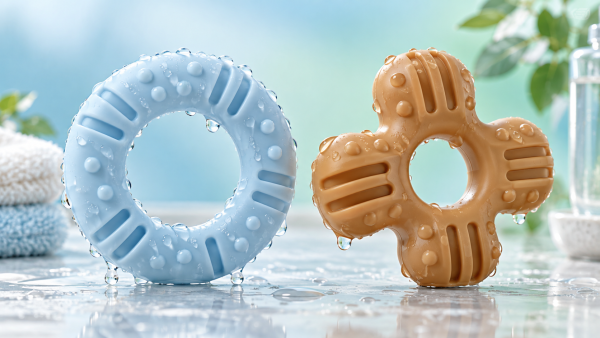
The easiest pet teething toy materials to clean are usually platinum-cured or food-grade silicone and smooth, non-porous natural rubber. Both can tolerate regular washing, resist absorbing moisture better than porous materials, and work well in products that are repeatedly covered in saliva, food residue, and outdoor dirt.
That answer needs one important qualification: material alone does not determine whether a teething toy stays hygienic. A smooth silicone toy with shallow grooves is far easier to maintain than a deeply textured rubber toy with narrow openings. Likewise, a durable TPE item may look simple to wash at first but become difficult to clean if its surface develops scratches, tackiness, or stress cracks after extended chewing.
When comparing materials for pet teething toys, the practical question is not simply whether a product can be rinsed. It is whether a pet owner can remove residue from the surface and internal areas without special tools, whether the toy dries fully between uses, and whether normal cleaning causes the material to degrade.
How the Main Teething Toy Materials Compare
Silicone Is Usually the Safest Starting Point for Easy-Care Designs
For an easy-clean pet teething toy, silicone is often the most straightforward material to work with. A well-made silicone surface does not have the fibrous structure of rope or fabric, so saliva and residue remain on the exterior instead of soaking into the toy. Pet owners can generally wash the surface with warm water and a mild pet-safe cleanser, rinse it thoroughly, and allow it to air-dry.
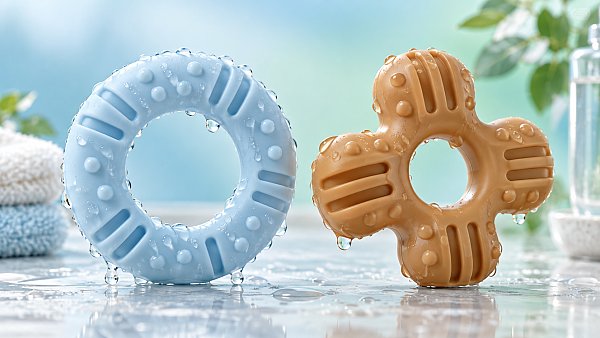
Silicone also supports designs that are forgiving in everyday use. It can be made into rounded rings, flexible nubs, solid bone shapes, and shallow textured pads without creating too many cleaning traps. That makes it especially suitable for puppy teething toys, where chewing is frequent but the product may also be dropped on floors, carried outdoors, or used with spreadable treats.
Not every silicone toy is equally easy to maintain. The material may be cleanable, while the product construction is not. Narrow ridges, blind holes, internal squeakers, and enclosed food cavities all increase cleaning time. A hollow silicone item should have enough access for water to flow through and for the interior to dry. If an owner cannot see, rinse, or dry an internal chamber, it is difficult to treat that design as genuinely easy-care.
Softness also needs to match the intended chewer. Very soft silicone can feel comfortable for young pets, but a toy that tears or develops deep bite marks becomes harder to clean and should not remain in use. A smooth surface is useful only while the surface remains intact.
Natural Rubber Cleans Well When the Design Is Controlled
Natural rubber is another strong option, particularly for products that need more resilience and grip than a soft silicone teether. A solid rubber toy with a smooth exterior can be rinsed quickly and dried without much difficulty. Its elastic structure also makes it useful for bouncing, carrying, and moderate chewing, so one product can cover more than a single teething use case.
The cleaning advantage becomes less clear when natural rubber is heavily textured. Texture is valuable for chewing interest and may help hold a paste or treat, but dense patterns can collect softened food, dust, and hair. Deep molded grooves are not automatically a problem; the issue is whether they can be reached by running water or a standard cleaning brush.
Rubber products also need consistent material selection and finishing. A strong rubber odor, powdery surface, sticky feel, or visible bloom can discourage regular use and make consumers question cleanliness even when the toy is technically washable. Cleanability is partly physical and partly perceptual. A toy that looks or smells difficult to clean is more likely to be discarded, returned, or replaced early.
For simple, solid, chew-resistant forms, natural rubber remains one of the most practical alternatives to silicone. It is less suitable when a product relies on a complex shape with inaccessible recesses.
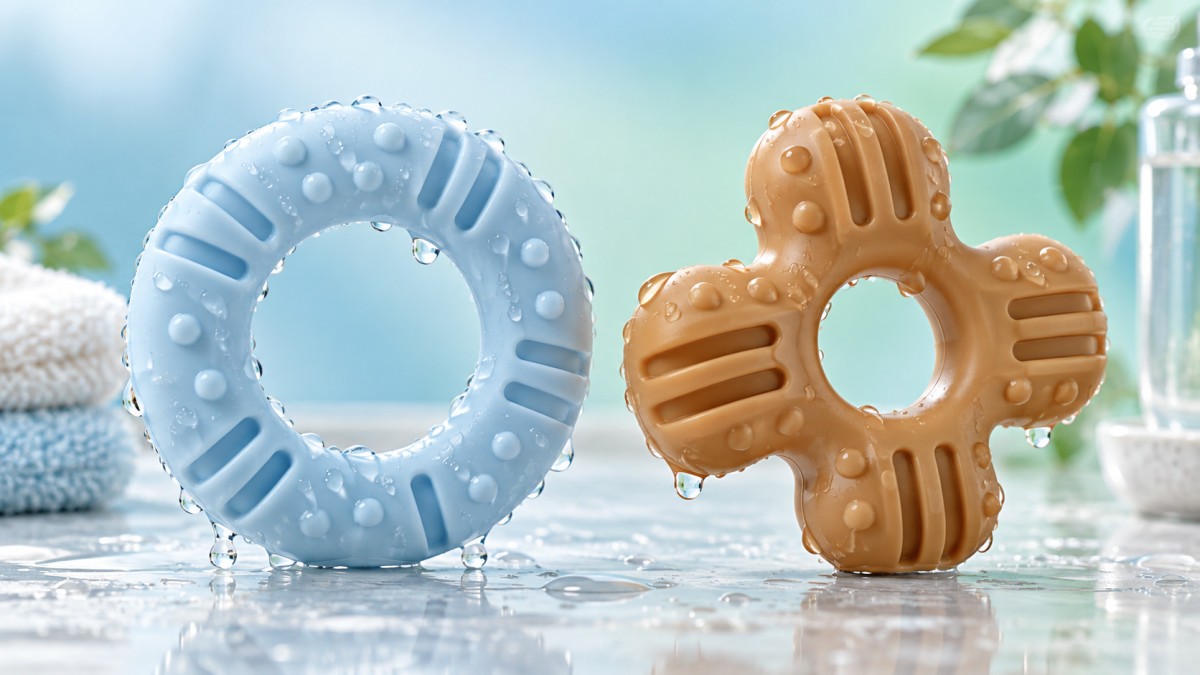
TPE and TPR Can Be Easy to Wash, but Formulation Matters More
Thermoplastic elastomers, commonly described as TPE or TPR in pet products, can offer a soft and flexible feel while allowing efficient molding of toys in different colors and shapes. A smooth, solid TPE teething ring can be simple to rinse, and its lower-density feel may appeal to pets that reject harder chew toys.
The limitation is consistency. TPE and TPR are broad material categories, not a single uniform substance. Their resistance to oils, staining, heat, and bite damage depends on the exact formulation, additives, hardness, and processing method. Two toys described with the same broad material label may behave very differently after weeks of use.
For this reason, cleanability claims should be evaluated with the finished product rather than the category name alone. Look for a dry, non-tacky surface; clean molding lines; stable color; and a shape that does not fold into a closed crevice during normal use. A toy that feels oily, becomes sticky after washing, or catches lint easily is unlikely to deliver the low-maintenance experience buyers expect.
TPE and TPR can be sensible choices for lighter-duty teething products and value-oriented ranges. They are less convincing for a toy positioned for sustained heavy chewing unless durability has been considered alongside softness and appearance.
Nylon Is Easy to Wipe, Not Always Easy to Restore
Nylon teethers and chew toys are often selected for firmness and longevity. When the design is solid and uncomplicated, the hard surface is easy to wipe down or rinse. It does not absorb moisture like fabric, and it usually dries quickly.
However, nylon’s cleaning profile changes as the toy is chewed. Surface scratches and tooth marks can create fine channels that retain residue. This does not mean nylon is inherently unsuitable, but it means the toy should be inspected more often than a smooth silicone ring. Once a hard chew toy has rough edges, splintering, or heavily damaged ridges, washing it cannot restore a hygienic, safe surface.
Nylon also tends to fit a different use case from a gentle puppy teether. Its firmer texture may be appropriate for pets that prefer harder chewing resistance, but material hardness should be matched to the pet’s age, size, chewing behavior, and dental condition. Easy cleaning does not compensate for a toy that is too hard or too aggressive for its intended user.
Why Fabric, Plush, and Rope Are the Hardest to Keep Clean
Fabric-covered teethers, braided rope toys, and plush chew products are usually the least convenient options for hygiene-focused ranges. Their fibers absorb saliva and moisture, while dirt can move below the visible surface. A quick rinse may remove surface debris without cleaning the interior of the material.
These products can still have a place in supervised play, comfort-oriented toys, or multi-material designs. They are simply not the best choice when the product promise is quick cleaning and repeated sanitation. Slow drying is the central issue. Moisture held inside rope knots, stuffing, or stitched seams creates an environment where odor and residue can persist.
A common design mistake is adding fabric elements to an otherwise washable rubber or silicone toy without considering the maintenance burden. The durable base may be easy to clean, but the attached textile component becomes the limiting factor. In practice, consumers judge the whole product by its hardest-to-clean part.
The Design Features That Decide Whether a Toy Is Truly Easy to Clean
Material selection should be followed by a design review. Several construction choices have more effect on day-to-day cleaning than a minor difference between two otherwise suitable polymers.
- Prefer solid forms for teething toys. A solid ring, nubbed stick, or compact chew shape is easier to rinse and dry than a hollow product with inaccessible internal space.
- Use open, shallow texture. Raised bumps and broad grooves can support chewing engagement without becoming hard-to-reach residue traps.
- Avoid decorative micro-detail. Fine embossed patterns may look premium at retail but can collect dried food and dust.
- Keep seams clean and minimal. Multi-part construction, loose inserts, and uneven joining lines create weak points for both hygiene and durability.
- Consider treat use honestly. If a toy is designed to hold paste, frozen food, or kibble, the cavity must be wide enough to clean fully. A food-loading feature changes the cleaning requirement.
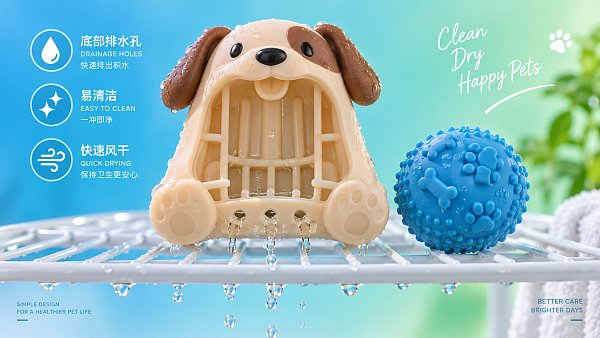
- Design for drying, not only washing. Water needs a clear path out of channels, cavities, and internal chambers. A toy that remains damp after cleaning is not low maintenance.
A Practical Choice by Product Positioning
For a puppy teething range centered on simple hygiene and everyday use, smooth silicone is usually the clearest first choice. It suits solid, shallow-textured designs and supports a familiar wash-rinse-dry routine. Natural rubber is a strong alternative where greater bounce, grip, or a more resilient chew response is desired.
For softer products at a broader range of price points, TPE or TPR may work well when the formulation produces a stable, non-tacky, durable surface. The finished item needs closer review because the label alone says little about long-term cleanability.
For harder chew products, nylon can be appropriate, provided the design avoids excessive grooves and the product is intended for pets that can use a firmer material safely. It should be positioned as an inspect-and-replace item rather than a permanently cleanable object.
Rope, plush, and fabric should be reserved for designs where sensory appeal outweighs easy maintenance. They are not the right foundation for a product line built around quick washing, minimal odor retention, and clean visual presentation after repeated use.
Do Not Treat “Dishwasher-Safe” as the Whole Answer
A dishwasher-safe claim can be useful, but it does not remove the need for sound material and product design. High heat, strong detergent, and repeated cycles can affect softness, color, adhesives, printed finishes, or multi-material assemblies. More importantly, a dishwasher cannot solve a cavity that does not drain or a surface already damaged by chewing.
The more helpful consumer instruction is usually simpler: remove visible debris promptly, wash according to the product’s care guidance, rinse thoroughly, dry completely, and inspect the toy before returning it to use. Care instructions should match the material, construction, and intended use rather than relying on a broad cleaning promise.
What to Confirm Before Finalizing a Material
The best material choice is the one that remains cleanable after the toy is shaped, chewed, washed, and dried in the way people will actually use it. Before moving ahead with a design, assess a physical sample with ordinary cleaning scenarios: saliva-coated use, food-filled use if relevant, dirt exposure, repeated washing, and visual inspection after chewing.
Ask whether residue can be removed without specialized tools, whether water escapes from every area, whether the surface stays dry rather than tacky, and whether bite damage creates difficult-to-clean edges. Those questions produce a more useful answer than a material label alone.
For easy-care pet teething toys, silicone leads when a smooth, simple, frequently washed product is the goal. Natural rubber follows closely for resilient solid designs. TPE, TPR, and nylon can be effective when the formulation and geometry are right, while fabric and rope should be chosen with a clear understanding that they require more maintenance.
Related Intelligence
 STEM & Educational ToysSep 20, 2026What Safety Checks Should Wooden Toy Suppliers Pass?What safety checks should wooden toy suppliers pass? Explore essential compliance, material traceability, chemical testing, and quality controls to source safer toys with confidence.
 Infant Feeding & CareSep 20, 2026Which Teething Toy Materials Are Easiest to Clean?Which teething toy materials are easiest to clean? Discover why silicone and natural rubber lead for hygienic, easy-care pet chew toys.
 Infant Feeding & CareSep 20, 2026How Can Retailers Prevent Mold Complaints About Bath Toys?How can retailers prevent mold complaints about bath toys? Explore drainable designs, supplier controls, testing, and care guidance to reduce moisture risks.
 Camping & WaterSep 20, 2026Which Folding Chair Fabrics Last Longest Outdoors?Which folding chair fabrics last longest outdoors? Compare acrylic, PVC-coated polyester, UV-stabilized polyester, and mesh for durable, pet-friendly outdoor seating.
 Camping & WaterSep 20, 2026Are Folding Camping Chairs Tested for Weight Capacity?Are folding camping chairs tested for weight capacity? Learn what credible load testing, safety margins, and supplier documentation mean for confident outdoor product sourcing.
 Corporate & Seasonal GiftsSep 20, 2026How Can Corporate Gift Buyers Avoid Missing Event Deadlines?How do corporate gift buyers avoid missed event deadlines? Discover proven sourcing, customization, compliance, and shipping strategies for pet-themed corporate gifts.
 Corporate & Seasonal GiftsSep 20, 2026What Should Be Approved Before Placing a Custom Gift Order?What should be approved before placing a custom gift order? Explore the essential checks for safe, compliant, retail-ready custom pet gifts.
 Corporate & Seasonal GiftsSep 20, 2026Which Custom Gift Materials Have the Lowest Defect Rates?Which custom gift materials have the lowest defect rate? Explore why silicone, stainless steel, polypropylene, and polyester help pet gift brands reduce rejects and improve quality.
 Skincare OEMAug 16, 2026Amazon Enforces AI Human Metadata Rule for Beauty and Personal Care SellersAmazon now enforces AI human metadata rules for beauty sellers. Learn how to protect listings, traffic, and compliance in skincare, cosmetics, and beauty devices.
 Beauty DevicesAug 15, 2026China to Roll Out Nationwide Cross-Border Cash Pooling for MultinationalsChina to roll out nationwide cross-border cash pooling for multinationals from Sept. 14. Discover how this policy could improve treasury efficiency, liquidity management, and China-linked supply chains.
 Beauty DevicesAug 14, 2026China Imposes Temporary Export Ban on Helium, Affecting Cooling Supply ChainsChina's temporary helium export ban may disrupt cooling supply chains for beauty RF devices and laser systems. Learn what ODMs, buyers, and procurement teams should check now.
![]() Cosmetics & PkgAug 13, 2026PPWR becomes mandatory: Beauty and personal care packaging materials usher in new EPR and PFAS compliance requirementsPPWR takes effect for cosmetics packaging in the EU, bringing EPR registration and PFAS limits. Learn what brands, importers, and suppliers must do now.
Cosmetics & PkgAug 13, 2026PPWR becomes mandatory: Beauty and personal care packaging materials usher in new EPR and PFAS compliance requirementsPPWR takes effect for cosmetics packaging in the EU, bringing EPR registration and PFAS limits. Learn what brands, importers, and suppliers must do now. Cosmetics & PkgAug 12, 2026EU PPWR Now Enforced for Beauty Packaging ComplianceEU PPWR now enforced for beauty packaging compliance: learn how EPR, ERN, heavy metals and PFAS rules affect EU exports, customs clearance and platform sales.