What Should a Pet Bed Factory Quality Inspection Include?
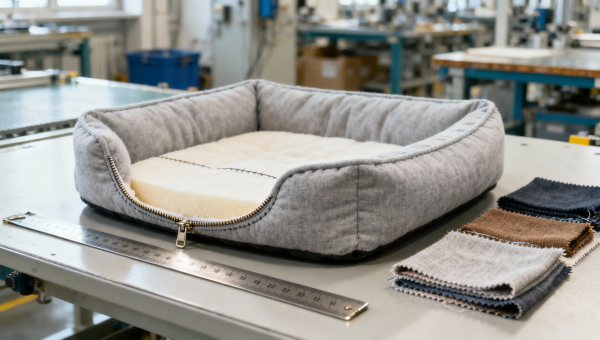
A pet bed can look well made and still fail after a few nights of use or its first wash. A complete pet bed factory quality inspection should cover material identity, construction, dimensions, support, washing performance, cleanliness, packaging, and the safety requirements that apply to the product and its destination market. It should also establish how samples are selected, which defects cause rejection, and what evidence is needed to release a shipment.
The most useful inspection follows the bed through normal use: unpacking, resting, scratching, moving, cleaning, and reassembling. Each stage exposes problems that a visual check alone can miss. Start with a written specification, then turn the likely failure points into measurable checks.
Define what a passing pet bed looks like before production
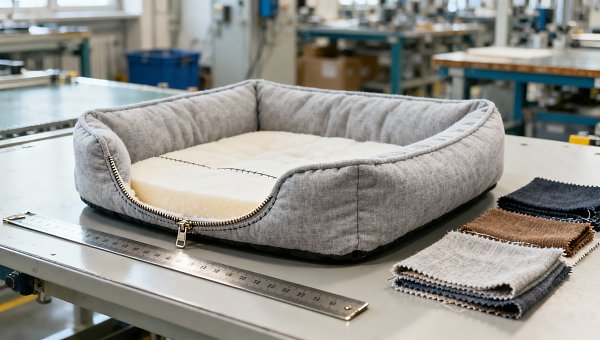
An approved sample provides a useful reference for appearance and feel, but it cannot replace a specification. Two beds may look identical while containing different foam, less filling, or a weaker backing fabric. The inspection sheet should identify the cover material, filling type, construction, finished dimensions, product weight, care instructions, and packaging requirements.
Specify tolerances and measurement methods. A soft bolster bed changes shape depending on how it is positioned, so measurements should be taken on a defined surface without stretching the fabric. Record both the overall dimensions and the usable sleeping area. A wide outer rim can make a bed appear spacious while leaving little room for the animal.
For compressed products, define the unpacking procedure and recovery period before measuring. Otherwise, an inspector may reject a bed before it has recovered or approve one that remains permanently flattened.
Acceptance criteria should distinguish appearance issues from functional failures. Slight variation in pile direction may be acceptable; a cover that cannot be refitted after washing is a different problem. Agree on these distinctions before production begins.
Inspect materials inside the bed, not just the finished cover
Material checks should connect the finished product to the approved bill of materials. Compare fabric texture, color, backing, and weight against the specification, and review supporting material records. Appearance and touch can reveal substitutions, but they cannot establish fiber composition or chemical compliance. Those questions require suitable documentation or laboratory testing.
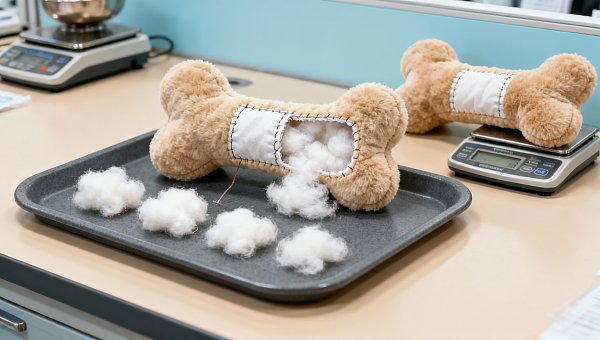
Open selected samples to examine the filling. Loose fiber should be distributed consistently, without hard clumps, unexplained debris, or large empty areas. Foam should match the specified construction and show no unintended cracks, crumbling, or poorly bonded layers. Shredded foam needs particular attention to consistency because large differences in piece size can create uneven support.
Measure finished weight where it helps detect variation. An unusually light bed may contain insufficient filling, but total weight alone does not prove correct construction. A heavier cover can disguise a lighter insert. Check component weights separately when they are part of the specification.
Match the checks to the design. Bolster beds need consistent wall filling and secure partitions. Flat foam beds need even thickness and a properly fitted cover. Outdoor beds need attention to drainage and drying. A waterproof liner needs its own checks; water resistance on the outer fabric does not establish that the complete bed prevents leakage.
Check seams, closures, and accessible components
Inspect the bed from the outside, then turn removable covers inside out. Look for skipped stitches, open seams, loose thread ends, exposed raw edges, uneven seam allowances, and fabric caught in stitching. Give extra attention to corners, bolster junctions, zipper ends, and handles because these areas concentrate stress.
A gentle manual pull can reveal obvious weakness, but repeatable seam-strength checks need an agreed method and acceptance limit. The force, direction, and duration should reflect the construction and intended use. An uncontrolled tug produces inconsistent results and may miss a weak seam that opens under repeated loading.
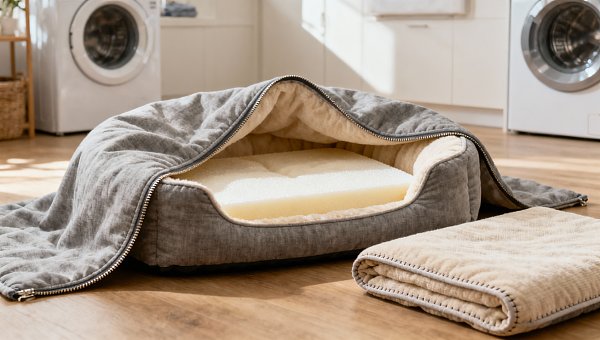
Operate each sampled zipper through its full travel several times. It should close without catching the lining or requiring excessive force. Remove and reinstall the insert to check whether the opening is practical and whether the cover fits without straining the zipper.
Inspect accessible zipper pulls, decorative trims, buttons, and other attachments for detachment risks or sharp edges. Dogs may mouth or pull exposed parts. Strong attachment reduces one risk, but design changes such as concealed closures may be more effective when a component invites chewing.
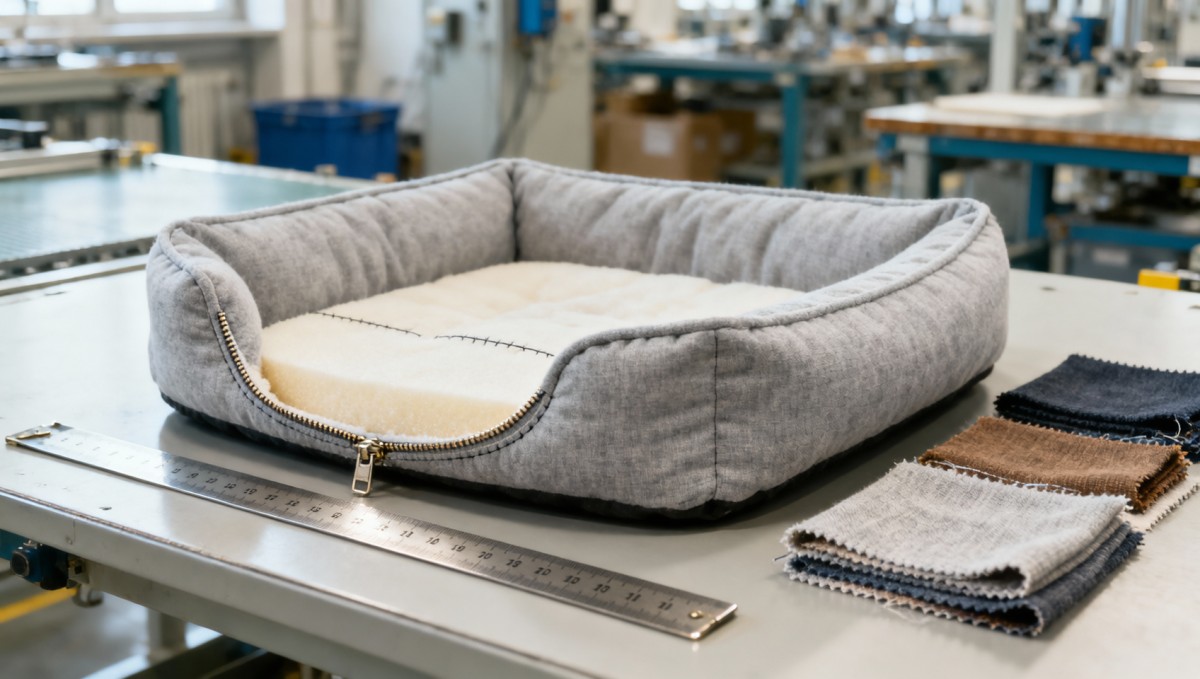
Include the underside in the inspection. Non-slip backing should be evenly applied and securely attached. Check for flaking, tackiness, or transfer to a representative floor surface under defined conditions. Sliding performance depends on the floor, loading, and contamination, so a hand swipe over the backing is insufficient evidence of a “non-slip” claim.
Test support, recovery, and cleaning as separate functions
Squeezing a cushion tells little about how it supports a resting animal. Evaluate the bed under a defined load distributed over a representative area. Examine whether the filling shifts, the base bottoms out, or the bolsters collapse. After removing the load, assess recovery using the agreed observation period.
Foam density and firmness describe different properties. Density concerns mass per unit volume; firmness concerns resistance to compression under a specified test. A dense foam can still feel soft. If either property is specified, assess it with the appropriate method rather than treating hand feel as proof.
For an “orthopedic” bed, document the construction and support characteristics behind the description. Factory inspection can assess those properties, but it does not demonstrate medical benefits. Any claim about relieving pain or treating a condition requires evidence beyond an ordinary quality inspection.
Wash the product exactly as the label instructs
If only the cover is washable, test the cover. If the whole bed is described as machine washable, test the assembled bed using the stated instructions and an appropriate machine capacity. Record measurements and appearance before washing, then examine the product after the specified drying process.
Look for shrinkage, color transfer, seam damage, filling migration, matting, backing deterioration, and zipper distortion. Refit the cover afterward. A cover may look acceptable on its own yet become too tight to fit the insert.
Pay attention to the parts that dry slowly, particularly thick bolsters and enclosed filling. A surface that feels dry can conceal moisture inside. Care instructions should support practical cleaning without leaving the product damp under the stated drying conditions.
Repeated washing tests are useful when ongoing washability is a central selling point. The number of cycles and acceptance limits should be agreed during product development. A quick wash during shipment inspection should not substitute for earlier durability validation.
Use targeted tests for specific claims
Include hygiene and product-specific safety checks
Check finished goods and storage areas for moisture, mold, pests, oil marks, and contamination. Inspect inside covers and filling compartments as well as exposed surfaces. A strong or unusual odor should trigger investigation of materials, adhesives, drying, and storage conditions. Smell alone cannot determine whether a material is chemically safe.
Review needle and sharp-tool controls for sewn products. The factory should have a documented response to broken needles and a suitable detection process where applicable. Detection equipment needs routine performance checks, and products containing intentional metal components may require an adapted method.
Chemical testing should reflect the actual materials and market requirements. Relevant substances can come from dyes, coatings, plasticized components, adhesives, or filling. A report for one fabric does not automatically cover a different color, backing, or supplier. Match reports to the components used in production and retain traceability when materials change.
Do not treat FDA, CE, or CPC documentation as a universal requirement for ordinary pet beds. Requirements depend on product classification, construction, claims, and destination. Electrically heated beds introduce electrical and thermal safety concerns; antimicrobial treatments introduce additional compliance questions. These features need a separate assessment beyond the checklist for a conventional textile bed.
Verify labels, packaging, and recovery after shipping
Labels should match the actual product and the requirements of its destination. Check applicable composition information, care instructions, origin marking, product identification, and relevant warnings. Compare the physical label with the carton and online product description. Conflicting cleaning instructions create avoidable misuse and returns.
Packaging checks should cover item identity, quantities, barcodes, carton markings, and protection from dirt and moisture. Inspect the packed product for sharp folds, trapped zipper pulls, and distortion caused by excessive compression.
For vacuum-packed beds, open representative units after the agreed packing duration and assess recovery. Confirm that the foam or filling regains acceptable shape and that the cover remains usable. Immediate unpacking after compression may miss problems that develop during storage and transport.
Choose transport tests according to the shipping route and packaging format. An individually shipped bed faces different handling from units secured on a pallet. Check the product after testing, since an intact carton can still contain a damaged zipper or permanently distorted insert.
Use sampling that represents the shipment
Select samples across sizes, colors, production batches, and cartons. Factory staff should provide access to the lot, while the inspector controls sample selection. Checking only neatly presented pieces creates a weak basis for shipment approval.
Agree on the sampling plan, defect categories, and acceptance rules in advance. Acceptance quality limit, or AQL, sampling can support routine workmanship decisions. It does not guarantee that every unit is defect-free, and safety-critical problems need their own acceptance rules and response procedures.
Classify defects by consequence. A sharp object inside a bed is a safety issue. An open seam exposing filling is generally a functional failure and may also create a safety concern. A small cosmetic irregularity may be minor if it falls within the agreed appearance standard. Classification should consider intended use rather than the defect’s visual size.
Place destructive and longer-duration tests earlier in the process where possible. Material validation and wash testing during development allow correction before a full order is complete. Checks during production can catch recurring construction problems while repair remains manageable. Final inspection then assesses shipment conformity.
Make the inspection report support a release decision
A useful report identifies the inspected lot, specification revision, sample selection, measurements, test conditions, defects, photographs, and supporting documents. It should distinguish checks performed during the inspection from results supplied by a laboratory or earlier production stage.
Release should depend on the agreed criteria and closure of unresolved issues. When a shipment fails, record the affected scope, corrective action, and reinspection method. Repairs to visible samples do not demonstrate that the rest of the lot has been corrected.
Before approving the shipment, confirm that the evidence answers three practical questions: Does the bed match the specified materials and construction? Does it remain usable after the expected cleaning and handling? Have the applicable safety and labeling requirements been addressed? Any unresolved answer should become a defined action with an owner and completion requirement before release.
Related Intelligence
 Corporate & Seasonal GiftsOct 26, 2026140th Canton Fair Phase Two in Full Swing as Green, Smart Home Products Secure OrdersExplore 140th Canton Fair Phase Two green and smart home products, reported buyer demand, and key procurement checks to turn orders into reliable export deliveries.
 STEM & Educational ToysOct 25, 2026Malaysia’s KPDN Seizes 5,801 Non-Compliant Squishy Toys in Nationwide ActionMalaysia’s KPDN reportedly seized 5,801 squishy toys lacking safety compliance marks. Discover key checks to help toy suppliers assess stock and verify compliance before distribution.
 Infant Feeding & CareOct 24, 2026FDA Issues Draft Guidance on Cadmium Action Levels in Baby FoodsFDA draft guidance on cadmium action levels in baby foods proposes category-specific targets. Explore potential impacts on sourcing, testing and compliance planning—and how to prepare.
 STEM & Educational ToysOct 23, 20262026 China Toy Expo Gives AI Toys a Dedicated Hall as Practical Features Take Priority2026 China Toy Expo spotlights AI toys with a dedicated hall. Explore how practical features and everyday play experiences are reshaping manufacturers’ product priorities.
 STEM & Educational ToysOct 22, 2026Blokees Showcases Over 900 Products at the 2026 China International Toy FairBlokees showcases over 900 products at the 2026 China International Toy Fair. Explore Model Kits, BLOKEES WHEELS and key sourcing checks to guide your next purchase.
 Cosmetics & PkgOct 21, 2026BASF Plans Beauty Innovation Showcase at in-cosmetics Asia 2026Explore BASF’s planned beauty innovations at in-cosmetics Asia 2026 in Bangkok, with a focus on skin protection, repair and sustainable solutions for personal care formulators.
 Cosmetics & PkgOct 20, 2026Beauty Tops Amazon’s 2026 Prime Big Deal Days Shopping CategoriesBeauty tops Amazon’s 2026 Prime Big Deal Days at 32% of shoppers, according to Market Defense. Explore what the findings could mean for product selection, inventory and promotional planning.
 Pet Furniture & EnrichmentOct 14, 2026Are Removable Covers Worth the Extra Cost for Pet Beds?Are removable covers worth the extra cost for pet beds? Compare cleaning ease, durability, and replacement costs to discover when the upgrade pays off—and when to save.
 Pet Furniture & EnrichmentOct 14, 2026What Should a Pet Bed Factory Quality Inspection Include?What should a pet bed factory quality inspection include? Discover essential checks for materials, durability, washability, and safety to reduce returns and approve shipments with confidence.
 Pet Grooming & TravelOct 14, 2026Which Pet Grooming Tools Have the Lowest Return Risk?Which pet grooming tools have the lowest return risk? Explore manual combs, rubber brushes, and sourcing tips to reduce avoidable returns and build a smarter, customer-friendly assortment.
 Pet Grooming & TravelOct 14, 2026How Should Buyers Assess a Pet Grooming Supplier Before Ordering?How do I assess a pet grooming supplier before ordering? Discover practical checks for quality, compliance, capacity, and contracts to reduce sourcing risks and buy with confidence.
 Corporate & Seasonal GiftsOct 14, 2026How Can Retailers Check Plush Toy Stuffing Quality?How do retailers check plush toy stuffing quality? Discover practical inspections, supplier checks, and testing tips to reduce defects and make smarter pet toy sourcing decisions.
 Corporate & Seasonal GiftsOct 14, 2026Are Embroidered Eyes Safer Than Plastic Eyes on Plush Toys?Are plush toys with embroidered eyes safer than plastic eyes? Discover key pet-toy risks, quality checks, and sourcing tips to make smarter buying decisions.