Are Embroidered Eyes Safer Than Plastic Eyes on Plush Toys?
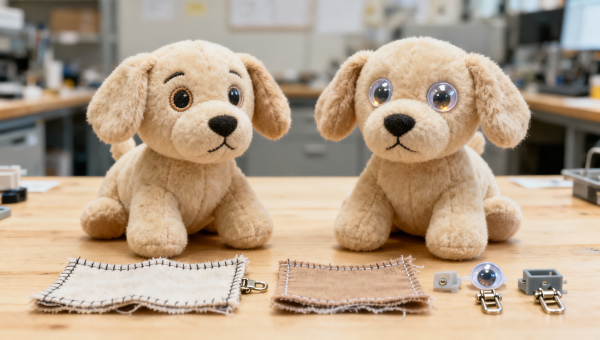
A plush dog toy can look reassuringly soft while hiding its most vulnerable component in plain sight: the eyes. For a retail buyer reviewing samples, glossy plastic eyes may give a character more personality. For a pet owner watching a dog pull at that same face, they can become a source of concern.
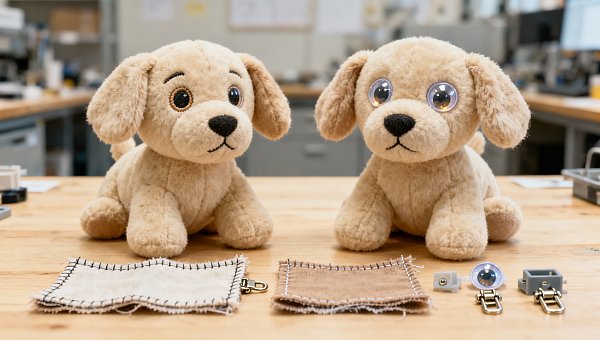
Are plush toys with embroidered eyes safer than plastic eyes? Generally, yes—embroidered eyes remove a separate hard component that could detach and be swallowed. But that advantage applies to one part of the toy, not its overall safety. Loose thread, torn fabric, accessible stuffing, and damaged squeakers still matter.
For pet brands and sourcing teams, the useful question is therefore not simply “Which eyes look better?” It is “Which construction reduces avoidable hazards for the intended pet, and how can we verify that the finished toy performs as expected?”
The key difference is how the eyes can fail
Plastic eyes usually consist of a visible eye attached through the fabric with a backing or retaining component inside the plush shell. Construction varies: some use locking washers, others use different fasteners, and decorative parts may be glued on. A well-secured eye can resist ordinary handling, but repeated biting introduces stresses that ordinary handling does not.
A dog may grip the eye itself, chew the surrounding fabric, or repeatedly bend the attachment point. The plastic can break, the fastener can fail, or the fabric can tear around an otherwise intact assembly. The resulting piece may pose a choking hazard, cause gastrointestinal obstruction if swallowed, or expose sharp edges if fractured.
Embroidered eyes create the facial feature with thread stitched into the fabric, rather than adding a separate molded eye. That eliminates the particular failure mode of a hard eye coming away as a discrete component. However, damaged embroidery can unravel, and densely stitched areas can weaken unsuitable fabric.
Embroidery reduces a specific hazard; it does not make a plush toy chew-proof, ingestion-proof, or safe for every pet.
Why “safety eyes” should not settle the purchasing decision
The term “safety eyes” commonly describes plastic eyes fitted with a locking backing. It identifies a type of attachment, not a universal assurance of safety. It does not, by itself, demonstrate suitability for a dog that chews or a cat that repeatedly bites the toy’s face.
This distinction becomes important when suppliers also manufacture children’s plush toys. An attachment intended to resist removal during ordinary play may face very different conditions in a pet’s mouth. Teeth concentrate force into small areas, while saliva, pulling, and repeated flexing can contribute to deterioration.
Even a secure fastener cannot compensate for weak fabric. If the plush shell tears around the eye, the eye assembly may separate with fabric still attached.
Ask suppliers to describe the actual construction rather than accepting the component name as evidence. “Locking plastic eye with reinforced attachment area” is useful technical information. “Safety eye, therefore safe for dogs” is not a defensible conclusion without relevant evaluation.
When embroidered eyes are the better choice—and when the toy is wrong
For many soft pet toys, embroidery is a sensible default because it avoids an unnecessary hard attachment. It is particularly attractive for toys intended for carrying, cuddling, gentle fetch, or light supervised play.
A puppy exploring objects with its mouth may benefit from having fewer raised components to grip. Small pets do not automatically present a lower risk: they can still pick at prominent features, and a detached component may be hazardous regardless of the animal’s size.
For a determined shredder, however, changing the eyes is not enough. A dog that opens plush seams within minutes can reach stuffing, squeakers, and internal backing whether the eyes are embroidered or plastic. Such a pet may need a different toy category rather than a better-decorated plush toy.
Cat toys deserve similar attention. Embroidered facial features avoid rigid eyes, but loose thread, ribbons, and other string-like elements can be dangerous if swallowed. Evaluate the entire design, especially any components the cat can catch and pull.
The practical hierarchy is straightforward: choose a suitable toy category, evaluate the whole construction, then compare the eye design. An embroidered face should not override obvious concerns elsewhere.
Look beyond the front of the sample
Two embroidered faces can look almost identical on a product listing yet differ substantially in construction. One may have secure stitch endings and suitable backing; another may hide long thread tails or loose material behind the surface.
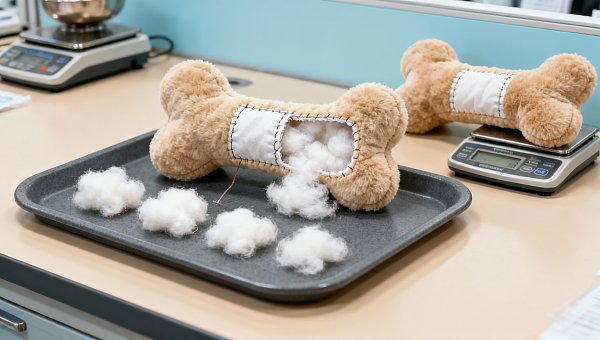
Where possible, request an opened or cutaway sample alongside the finished product. Inspect the reverse of the embroidery, the attachment area of any plastic eyes, and the route from a damaged face to the toy’s internal contents.
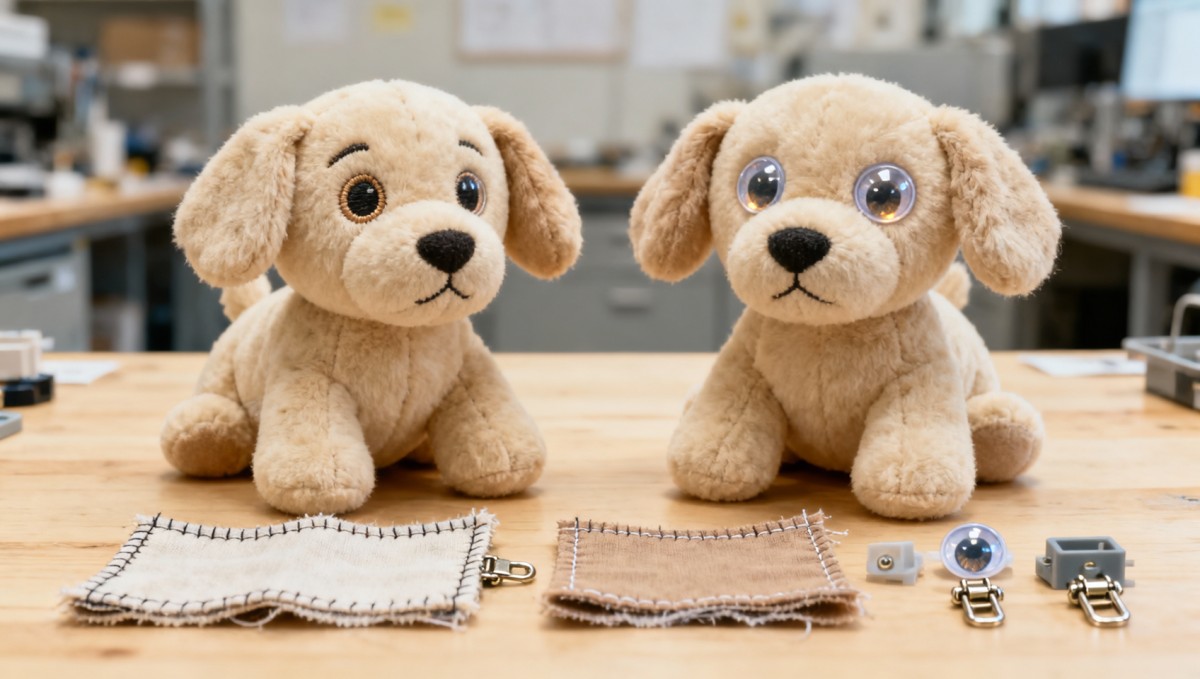
For embroidery, inspect the stitch-and-fabric combination
Look for loose loops, exposed thread ends, skipped stitches, puckering, and damage to the base fabric. Very dense embroidery on a thin shell can create a stiff area surrounded by weaker material. More stitches do not automatically mean a stronger product.
Backing also matters. Embroidery may use stabilizers to support manufacturing. Ask what remains inside the finished toy and whether tearing could make that material accessible. Supplier answers should address the completed product, not just the embroidery operation.
For plastic eyes, inspect the entire attachment assembly
Check the eye, stem, backing, surrounding fabric, and any reinforcement together. An impressive-looking washer tells little about how easily the fabric around it can tear. Examine plastic parts for cracks, sharp molding edges, and changes after relevant durability testing.
Glue-only decorative eyes warrant particular scrutiny because attachment durability can vary with adhesive selection, application, fabric, and exposure conditions. A quick hand tug is useful for identifying obvious defects, but it is not a substitute for a defined test program.
A sourcing specification that goes beyond “embroidered eyes required”
For buyers comparing OEM or ODM suppliers, a clear specification prevents safer design intent from being lost during production. “No plastic eyes” is a start, but it leaves important details unresolved.
- Define the intended use. State the target pet, size range, and play style. Distinguish supervised soft play from products marketed for intensive chewing.
- Specify the facial construction. Confirm that eyes are directly embroidered rather than glued-on patches or separate appliqués presented as embroidery.
- Control accessible loose material. Address unsecured thread ends, loops, decorative cords, and backing that could become exposed.
- Review the complete bill of materials. Include shell fabric, thread, stuffing, squeakers, backing, labels, and decorative components.
- Agree on finished-product evaluation. Select relevant seam, attachment, fabric-tear, and durability checks with a qualified laboratory or product-safety specialist.
- Require change notification. Changes to fabric, thread, plastic components, backing, or subcontractors can affect performance even when appearance stays the same.
- Set inspection and rejection criteria. Define unacceptable loose stitching, cracked parts, exposed contents, and inconsistent assembly before bulk production.
Testing should reflect foreseeable use without pretending that a laboratory can reproduce every animal’s behavior. Depending on the design, assessment may include repeated loading, moisture exposure, and laundering where the product is labeled washable. Methods and acceptance criteria should be selected for the product and market, not copied unquestioningly from another category.
Production consistency is equally important. An approved sample shows what a supplier can make; incoming and in-process checks help establish whether that construction is being maintained across orders.
Compliance documents: useful evidence, not a substitute for product judgment
Pet buyers sometimes receive test reports originally prepared for children’s toys. These can contain useful information about materials or mechanical performance, but they do not automatically establish that a product is suitable for pets or compliant with every applicable requirement.
In the United States, a Children’s Product Certificate relates to applicable requirements for children’s products; it is not a generic pet-toy certificate. Similarly, CE marking is not a blanket safety endorsement for ordinary pet toys. Whether particular legal obligations apply depends on classification, market, and product features.
Ask what was tested, which product and materials the report covers, which methods were used, and whether the report matches the current construction. A report for a similar-looking plush animal may not cover a changed eye attachment or different fabric.
For the retail and sourcing audience served by Global Consumer Sourcing, this is the essential distinction: documentation supports due diligence, while product-specific design review addresses the actual hazards. Neither should be replaced by a reassuring label or a supplier’s broad claim of certification.
What retailers should tell pet owners
Good product communication helps owners understand the design without promising more than it can deliver. A factual statement such as “embroidered facial features with no plastic eyes” explains the construction. Claims such as “completely safe” or “cannot be swallowed” are much harder to justify.
Owners should be advised to supervise play, inspect the toy regularly, and remove it when threads loosen, seams open, plastic cracks, or internal contents become accessible. Size and play-style guidance should be easy to find, rather than buried beneath decorative descriptions.
If a pet is suspected of swallowing an eye, thread, or another toy component, prompt veterinary advice is appropriate. Do not encourage owners to pull visible string from the animal’s mouth or rear, or induce vomiting without veterinary direction.
The purchasing verdict
Embroidered eyes are generally the safer choice for plush pet toys because they eliminate detachable rigid eye components. That is a meaningful design advantage, particularly when the plastic alternative adds a raised feature that pets can grip.
The stronger buying decision combines that preference with sound fabric selection, secure stitching, robust seams, controlled internal components, and relevant finished-product evaluation. Plastic eyes deserve closer attachment scrutiny; embroidered eyes still require inspection for unraveling and fabric damage.
For a brand building a plush range, embroidered features are a reasonable default—not the end of the safety review. The best product is the one whose entire construction suits the intended pet and whose limitations are communicated honestly.
Related Intelligence
 STEM & Educational ToysOct 23, 20262026 China Toy Expo Gives AI Toys a Dedicated Hall as Practical Features Take Priority2026 China Toy Expo spotlights AI toys with a dedicated hall. Explore how practical features and everyday play experiences are reshaping manufacturers’ product priorities.
 STEM & Educational ToysOct 22, 2026Blokees Showcases Over 900 Products at the 2026 China International Toy FairBlokees showcases over 900 products at the 2026 China International Toy Fair. Explore Model Kits, BLOKEES WHEELS and key sourcing checks to guide your next purchase.
 Cosmetics & PkgOct 21, 2026BASF Plans Beauty Innovation Showcase at in-cosmetics Asia 2026Explore BASF’s planned beauty innovations at in-cosmetics Asia 2026 in Bangkok, with a focus on skin protection, repair and sustainable solutions for personal care formulators.
 Cosmetics & PkgOct 20, 2026Beauty Tops Amazon’s 2026 Prime Big Deal Days Shopping CategoriesBeauty tops Amazon’s 2026 Prime Big Deal Days at 32% of shoppers, according to Market Defense. Explore what the findings could mean for product selection, inventory and promotional planning.
 Corporate & Seasonal GiftsOct 14, 2026How Can Retailers Check Plush Toy Stuffing Quality?How do retailers check plush toy stuffing quality? Discover practical inspections, supplier checks, and testing tips to reduce defects and make smarter pet toy sourcing decisions.
 Corporate & Seasonal GiftsOct 14, 2026Are Embroidered Eyes Safer Than Plastic Eyes on Plush Toys?Are plush toys with embroidered eyes safer than plastic eyes? Discover key pet-toy risks, quality checks, and sourcing tips to make smarter buying decisions.
 Infant Feeding & CareOct 14, 2026What Documents Are Required to Import Baby Formula?What import documents are needed for baby formula? Explore shipment paperwork, health certificates, and market-specific requirements to avoid costly delays and prepare for compliant imports.
 Infant Feeding & CareOct 14, 2026Which Baby Formula Packaging Formats Reduce Shipping Damage?Which baby formula packaging formats reduce shipping damage? Compare metal cans, rigid tubs, and supported pouches to choose better protection and reduce costly transit losses.
 Baby Gear & StrollersOct 14, 2026How Long Does Custom Diaper Bag Production Usually Take?How long does custom diaper bag production usually take? Plan for 30–60 days after sample approval. Discover key lead-time factors and practical tips to avoid delays and launch on schedule.
 Baby Gear & StrollersOct 14, 2026Which Diaper Bag Features Justify a Higher Wholesale Price?What diaper bag features justify a higher wholesale price? Discover durability, comfort, and easy-clean upgrades worth paying for—and source smarter with practical buyer tips.
 Infant Feeding & CareOct 14, 2026How Can Retailers Prevent Baby Clothing Color Bleeding Claims?How can retailers avoid color bleeding claims on baby clothing? Discover testing, supplier controls, and care-label strategies to reduce returns and protect customer trust.
 Infant Feeding & CareOct 14, 2026Which Baby Clothing Materials Are Easier to Source Compliantly?What materials make baby clothing easier to source compliantly? Compare cotton, blends, and certified options, with practical supplier checks to reduce risk and make smarter sourcing decisions.
 Baby Gear & StrollersOct 14, 2026Are Baby Carrier Buckle Failures a Common Reason for Returns?Are baby carrier buckle failures a common return issue? Explore defects, usability complaints, and safety checks to make informed sourcing decisions before your next order.