Which Baby Formula Packaging Formats Reduce Shipping Damage?
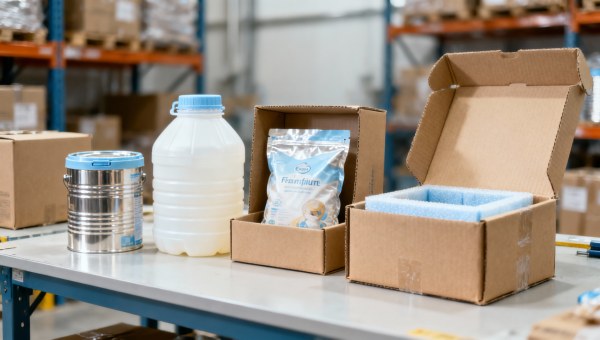
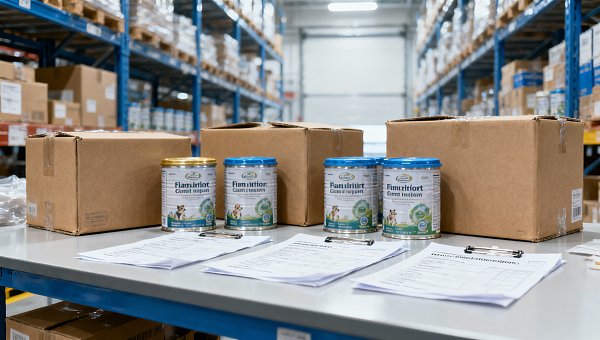
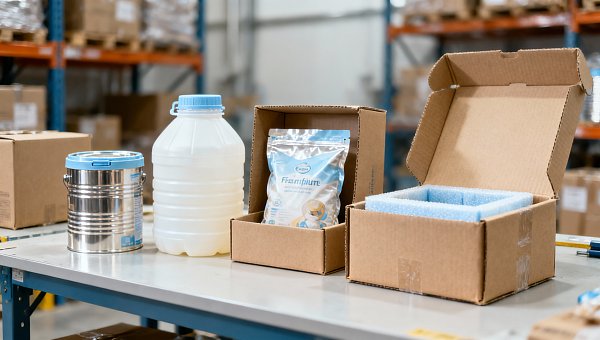
Metal cans and well-designed rigid plastic tubs are the strongest starting points for reducing shipping damage to powdered baby formula. Cans provide strong stacking resistance; tubs combine structural support with greater resistance to visible denting. Flexible pouches reduce packaging weight and empty space, but need a protective carton or other support to resist crushing, punctures, and seal stress. The best result comes from matching the container, closure, and shipping case to the actual delivery route.
This comparison focuses on powdered formula. Ready-to-feed liquid formula introduces different leakage, closure, and processing requirements, so its packaging needs a separate assessment. For powder, the central question is whether the complete pack keeps its protective barrier intact through compression, vibration, drops, and changing environmental conditions.
Where each format has an advantage
“Shipping damage” covers several failures with different consequences. A scuffed label affects presentation. A damaged seam, puncture, or lifted membrane threatens product protection. Comparing formats requires separating cosmetic damage from failures that expose the powder to moisture, oxygen, or contamination.
No format has a universal damage rate. A pouch inside a well-fitted protective carton can survive a route that damages an unsupported tub. Likewise, a strong can can arrive with a compromised closure if its shipping case transfers impact directly into the rim.
Metal cans: strong under stacking, vulnerable at concentrated impacts
A cylindrical metal can carries vertical loads through its body and ends. This makes it a useful candidate for palletized shipments where stacking pressure is a major concern. That advantage weakens when cases overhang a pallet, internal arrangements allow cans to tilt, or uneven support concentrates force on a small area.
Metal also retains evidence of impact. A dent records permanent deformation, making damage easy to see even when the container still appears closed. Location matters: a shallow body dent away from the closure is different from a sharp crease at a seam or sealing area. Visual appearance alone cannot establish that either package remains acceptable.
Assessment criteria should distinguish body dents, seam deformation, rim damage, and interference with opening features. The outer plastic overcap often protects the opening area or supports reclosure; its presence does not prove that the original barrier remains intact. A displaced overcap and a damaged underlying membrane require different investigations.
Case fit deserves particular attention. Excess clearance lets cans strike one another during vibration and drops. An overly tight arrangement transfers side impacts directly through adjacent containers. Dividers, pads, and controlled spacing should address the observed contact points without creating pressure against vulnerable ends.
Rigid plastic tubs: fewer dents, different failure mechanisms
Rigid plastic tubs avoid the permanent metal dent that can make an otherwise intact pack commercially unacceptable. Their performance comes from the combination of resin, wall distribution, ribs, corners, and closure geometry. “Thicker plastic” is an incomplete specification: extra material in a sidewall does little to correct a weak sealing flange or an exposed lid edge.
Impact behavior also changes with temperature. A tub that flexes during a room-temperature drop test could crack under colder conditions if its material becomes less impact resistant. Sustained heat and stacking pressure create another concern: gradual deformation that reduces support or changes the relationship between the lid and sealing surface.
The load path through stacked tubs is therefore important. If the upper container bears on a lower lid, the lid and its supporting structure must carry that force without pressing into the membrane or distorting the seal area. An attractive nesting profile does not establish adequate filled-pack stacking strength.
A lid that remains attached is not sufficient evidence of package integrity. Where a membrane forms the primary barrier, its bond to the tub needs evaluation after transport. Powder on the flange, uneven sealing pressure, or flange distortion can create weaknesses that become apparent only after handling.
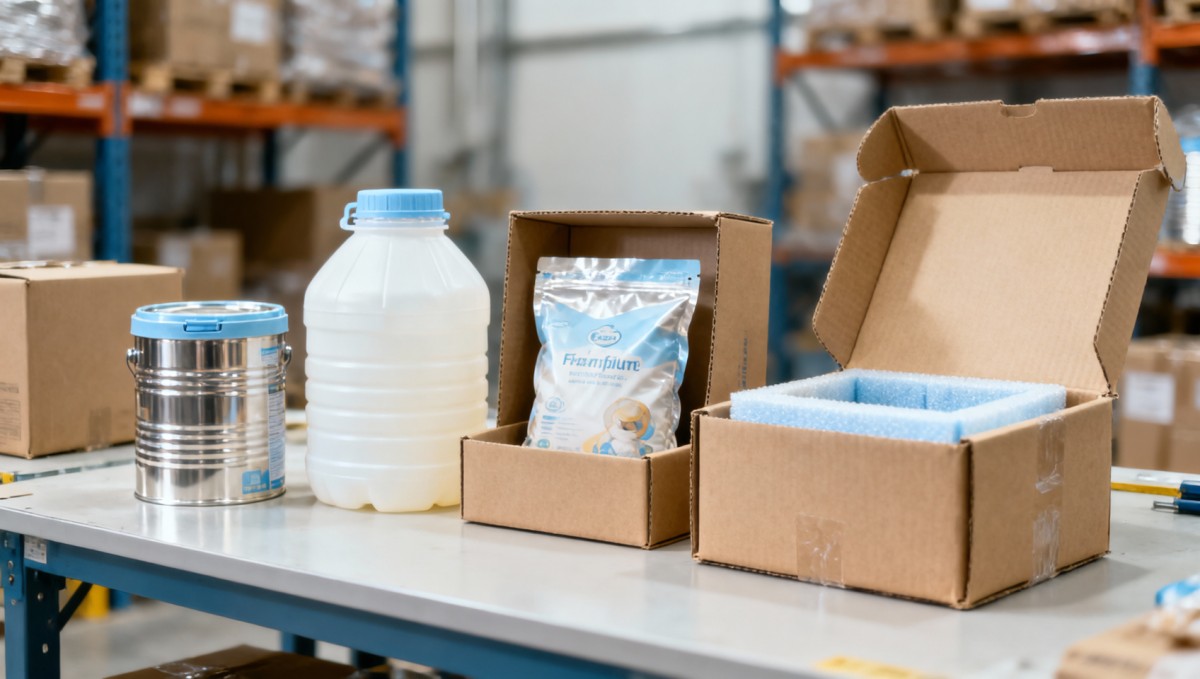
Flexible pouches: shipping efficiency requires external support
Flexible pouches remove much of the rigid packaging mass and can fit efficiently into cartons. Their weakness is limited structural support. Under compression, the powder and pouch deform together, transferring stress toward folds, edges, and seals. A strong laminate still needs protection from concentrated loads.
Powder-filled pouches should not be treated like cushioning bags. Trapped gas, fill volume, and available space inside the pack affect how impact loads reach the seals. Tight packing that appears efficient at dispatch can leave little room for deformation during a drop. Excess freedom inside the case creates repeated rubbing and collisions.
Puncture resistance and barrier performance are separate properties. A laminate with good moisture resistance may remain vulnerable to a sharp carton edge. Repeated bending can damage some barrier structures without producing an obvious tear. Rounded internal surfaces, restrained movement, and protection from exposed divider edges address these failure mechanisms.
Seal quality is especially consequential. Powder trapped across the sealing area can interrupt the bond, while handling stress opens an existing weak path. A zipper intended for reclosure should not be assumed to provide the unopened pack’s protective seal. Transit assessment must include the original sealed boundary.
A pouch inside an individual carton offers useful support and abrasion protection, although the carton adds material and packing work. Its fit still matters: a loose pouch rubs against the board, while a tight carton can pinch corners or fold seals sharply. Pouch-only shipping needs evidence from the intended delivery conditions before it becomes a credible substitute for a rigid pack.
The shipping case can reverse the apparent ranking
The primary container and outer case work together. In a palletized load, the case helps distribute compression. During parcel delivery, it also absorbs impacts and controls movement. A container change evaluated inside an unsuitable case gives a misleading comparison of the packaging formats.
For a heavy can, cushioning must manage impact energy without bottoming out and allowing the rim to strike the case wall. For a tub, inserts should support the body while avoiding concentrated pressure on the flange. For a pouch, protection should prevent sharp contact and excessive folding. Identical void fill does not deliver equivalent protection across these geometries.
Moisture exposure adds another distinction. Humidity can reduce corrugated case strength, leaving the primary packs to carry more load. Wet exposure also creates corrosion concerns for susceptible metal areas and damages paper-based secondary packaging. A pack that survives dry compression testing has not demonstrated performance after humid storage.
Format comparisons should use equivalent product quantities and realistic case weights. Comparing one large can with several smaller pouches changes the number of seals, contact surfaces, and opportunities for movement. Those differences belong in the assessment rather than being attributed entirely to the material.
Tests that reveal meaningful differences
Transit testing should reproduce the distribution hazards closely enough to distinguish between candidate designs. Parcel shipment involves repeated handling and impacts in unpredictable orientations. Pallet distribution places greater emphasis on sustained compression, vibration, and load stability. A route combining both requires evidence for both stages.
Testing empty containers misses the influence of powder mass, fill level, internal movement, and production sealing conditions. Use representative filled packs with the intended case, dividers, tape, and packing arrangement. If several fill sizes share a container family, assess which configuration creates the greatest load or weakest support rather than assuming one result covers all sizes.
A useful evaluation connects each exposure to a measurable failure:
- Compression after environmental conditioning: assess case collapse, tub deformation, can buckling, and stress transferred into pouch seals under the intended stacking conditions.
- Drop impacts should include vulnerable orientations, such as a can rim, tub corner, or pouch seal edge, alongside the orientations required by the selected test method.
- Vibration followed by integrity assessment reveals abrasion, repeated container contact, closure movement, and weaknesses that appearance alone misses.
- Where air transport or significant altitude changes are relevant, evaluate pressure differences and their effect on swelling and closure stress.
Record cosmetic damage separately from loss of containment or barrier integrity. An intact outer case can conceal a damaged primary pack; a crushed case does not establish that every enclosed unit has failed. Inspection should extend to the containers and closures using methods suitable for the package construction.
Leak detection, seal-strength measurements, and examination of sealing surfaces answer different questions. A seal-strength result measures resistance under the test conditions; it does not independently demonstrate the absence of a small leak path. The evaluation needs both appropriate integrity testing and a review of how the pack opened or failed.
Turning test results into a packaging decision
Compare production-equivalent samples with documented construction. Relevant details include can and end design, tub resin and wall distribution, pouch laminate structure, closure components, seal settings, and outer-case specification. Without that record, a successful sample can differ materially from later deliveries despite having the same dimensions and appearance.
Predefine rejection criteria for damaged seams, cracked tubs, lifted membranes, punctures, powder leakage, and deformation that interferes with opening or reclosure. Cosmetic limits should be stated separately. This prevents a format with less visible damage from appearing superior while hidden integrity failures receive inconsistent treatment.
For routes dominated by aligned stacking loads, metal cans provide a strong starting point. Where visible denting drives rejection, a suitably designed tub deserves comparison under the same delivery conditions. Pouches become more attractive when their weight and space savings remain meaningful after adding the support required to pass transit testing.
The final specification should preserve the tested combination of container, closure, case, and packing arrangement. A change in case board, seal geometry, resin, or laminate can alter the failure pattern enough to require renewed evaluation, even when the finished pack looks unchanged.
Related Intelligence
 STEM & Educational ToysOct 22, 2026Blokees Showcases Over 900 Products at the 2026 China International Toy FairBlokees showcases over 900 products at the 2026 China International Toy Fair. Explore Model Kits, BLOKEES WHEELS and key sourcing checks to guide your next purchase.
 Cosmetics & PkgOct 21, 2026BASF Plans Beauty Innovation Showcase at in-cosmetics Asia 2026Explore BASF’s planned beauty innovations at in-cosmetics Asia 2026 in Bangkok, with a focus on skin protection, repair and sustainable solutions for personal care formulators.
 Cosmetics & PkgOct 20, 2026Beauty Tops Amazon’s 2026 Prime Big Deal Days Shopping CategoriesBeauty tops Amazon’s 2026 Prime Big Deal Days at 32% of shoppers, according to Market Defense. Explore what the findings could mean for product selection, inventory and promotional planning.
 Infant Feeding & CareOct 14, 2026What Documents Are Required to Import Baby Formula?What import documents are needed for baby formula? Explore shipment paperwork, health certificates, and market-specific requirements to avoid costly delays and prepare for compliant imports.
 Infant Feeding & CareOct 14, 2026Which Baby Formula Packaging Formats Reduce Shipping Damage?Which baby formula packaging formats reduce shipping damage? Compare metal cans, rigid tubs, and supported pouches to choose better protection and reduce costly transit losses.
 Baby Gear & StrollersOct 14, 2026How Long Does Custom Diaper Bag Production Usually Take?How long does custom diaper bag production usually take? Plan for 30–60 days after sample approval. Discover key lead-time factors and practical tips to avoid delays and launch on schedule.
 Baby Gear & StrollersOct 14, 2026Which Diaper Bag Features Justify a Higher Wholesale Price?What diaper bag features justify a higher wholesale price? Discover durability, comfort, and easy-clean upgrades worth paying for—and source smarter with practical buyer tips.
 Infant Feeding & CareOct 14, 2026How Can Retailers Prevent Baby Clothing Color Bleeding Claims?How can retailers avoid color bleeding claims on baby clothing? Discover testing, supplier controls, and care-label strategies to reduce returns and protect customer trust.
 Infant Feeding & CareOct 14, 2026Which Baby Clothing Materials Are Easier to Source Compliantly?What materials make baby clothing easier to source compliantly? Compare cotton, blends, and certified options, with practical supplier checks to reduce risk and make smarter sourcing decisions.
 Baby Gear & StrollersOct 14, 2026Are Baby Carrier Buckle Failures a Common Reason for Returns?Are baby carrier buckle failures a common return issue? Explore defects, usability complaints, and safety checks to make informed sourcing decisions before your next order.
 Baby Gear & StrollersOct 14, 2026How Do You Compare Baby Carrier Suppliers on Safety and Cost?How do I compare baby carrier suppliers on safety and cost? Learn to verify safety evidence, assess factory controls, and compare total landed costs to make a confident sourcing decision.
 STEM & Educational ToysSep 20, 2026How Do I Verify Age Grading for Educational Toys?How do I verify educational toy age grading? Learn how to assess safety risks, test reports, packaging, and market compliance before buying or selling.
 Corporate & Seasonal GiftsSep 20, 2026Are Promotional Items Worth Ordering for Short Campaigns?Are promotional items worth ordering for short campaigns? Learn how pet brands can choose useful, compliant giveaways that drive measurable engagement, sales, and loyalty.