How Can Retailers Prevent Baby Clothing Color Bleeding Claims?
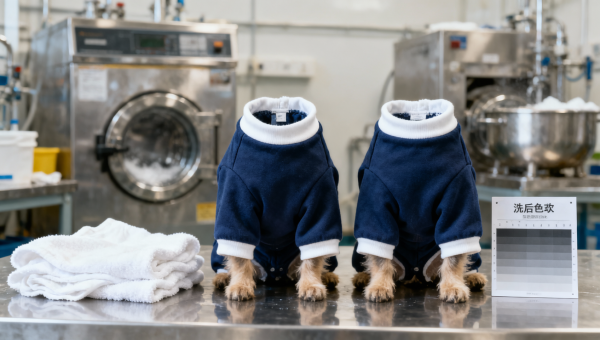
A single wash can turn a bright baby outfit into a customer complaint: the cream collar becomes pink, another garment picks up a blue stain, and a parent wonders whether the clothing is safe to use. For the retailer, the damage extends beyond a refund. One disappointing item can weaken confidence in an entire babywear range.
How can retailers avoid color bleeding claims on baby clothing? The strongest approach combines measurable colorfastness requirements, verified production controls, and testing that reflects how families actually wash clothes. Care labels matter, but they cannot compensate for poorly fixed dyes or inconsistent finishing.
For retail buyers, private-label teams, and sourcing managers, the key comparison is not simply cotton versus polyester or light versus dark. It is the difference between buying on supplier assurances and buying against documented, repeatable performance requirements.
Identify the failure before choosing the remedy
Customers often use “color bleeding” to describe several different problems. Treating them as one issue can send a quality team toward the wrong corrective action.
These distinctions matter commercially. A fabric can retain an acceptable appearance while staining adjacent material. Conversely, some fading may occur without significant transfer. Retailers therefore need separate acceptance criteria for color change and staining, rather than a vague requirement that clothing “wash well.”
Compare fabric and coloration choices—not just fiber labels
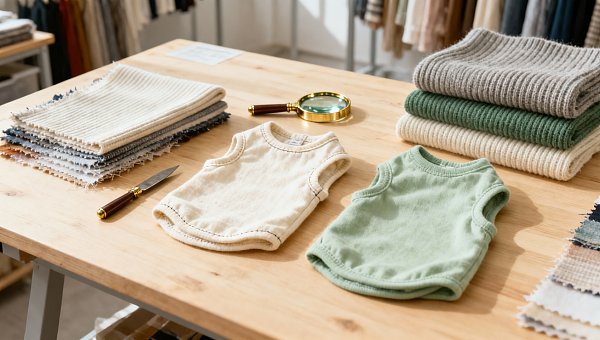
Parents often prefer cotton for its familiar feel, but “100% cotton” says little about colorfastness. Dye selection, fixation, washing-off, finishing, and shade depth all influence performance. Synthetic fabrics are not automatically trouble-free either.
Deep navy, red, black, and other saturated shades deserve closer scrutiny, particularly beside white fabric. This is a risk-based priority, not proof that every dark garment will bleed.
Construction can be as important as material choice. A dark sleepsuit with a white neckline creates a different challenge from a uniformly colored bodysuit. Contrast binding, embroidery thread, printed motifs, lining, and decorative tape should all enter the test plan.
When comparing suppliers, ask which coloration route they propose for the actual design and how they control its known weaknesses. An explanation supported by production records is more useful than a general promise of “premium dyes.”
Supplier assurances versus a purchase specification
A statement such as “colorfastness passed” leaves important questions unanswered. Passed which test? On what shade? Was the sample unfinished fabric, a development garment, or bulk production? What staining grade was achieved?
A workable purchase specification should define:
- Scope: the fabrics, shades, prints, trims, and finished products covered.
- Methods: the named test standard and selected procedure or conditions.
- Acceptance criteria: separate requirements for color change, staining, and dry and wet rubbing.
- Sampling: how production dye lots and higher-risk colorways will be represented.
- Change control: which substitutions or process changes require approval and retesting.
- Failure handling: shipment holds, investigation, corrective action, and release authority.
Common methods include ISO 105-C06 or AATCC TM61 for laundering colorfastness, and ISO 105-X12 or AATCC TM8 for rubbing. Depending on intended use, water or perspiration colorfastness may also be relevant. A qualified textile laboratory should help select appropriate procedures and current editions.
Many assessments use grades running from 1 to 5, with higher grades indicating better performance. Buyers sometimes specify grade 4 or better for particular staining requirements, but this is not a universal legal threshold for baby clothing. The appropriate requirement depends on the method, test conditions, product design, market, and retailer’s quality policy.
Do not compare two reports by their headline grade alone. Different temperatures, detergents, mechanical action, and adjacent fabrics can produce different results. Comparable sourcing decisions require comparable test conditions.
Laboratory tests and household washes answer different questions
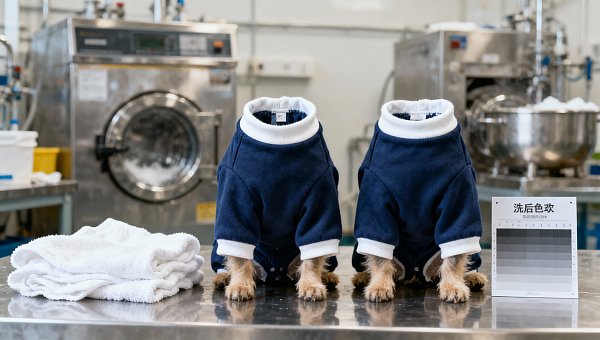
Standardized laboratory testing makes supplier performance easier to compare. A household-style wash reveals issues that matter to customers: staining at seams, dye trapped around trims, changes to prints, or transfer between panels.
Neither should replace the other.
For garment trials, document the machine program, temperature, detergent, load composition, drying method, and assessment conditions. Include appropriate pale witness materials where useful, and examine the garment’s own light-colored components. Assess both initial and repeated washes according to an agreed protocol.
Accelerated laundering tests should not be presented as an exact prediction of a fixed number of household washes unless the specific method supports that interpretation. They are controlled performance tools, not guarantees of lifetime durability.
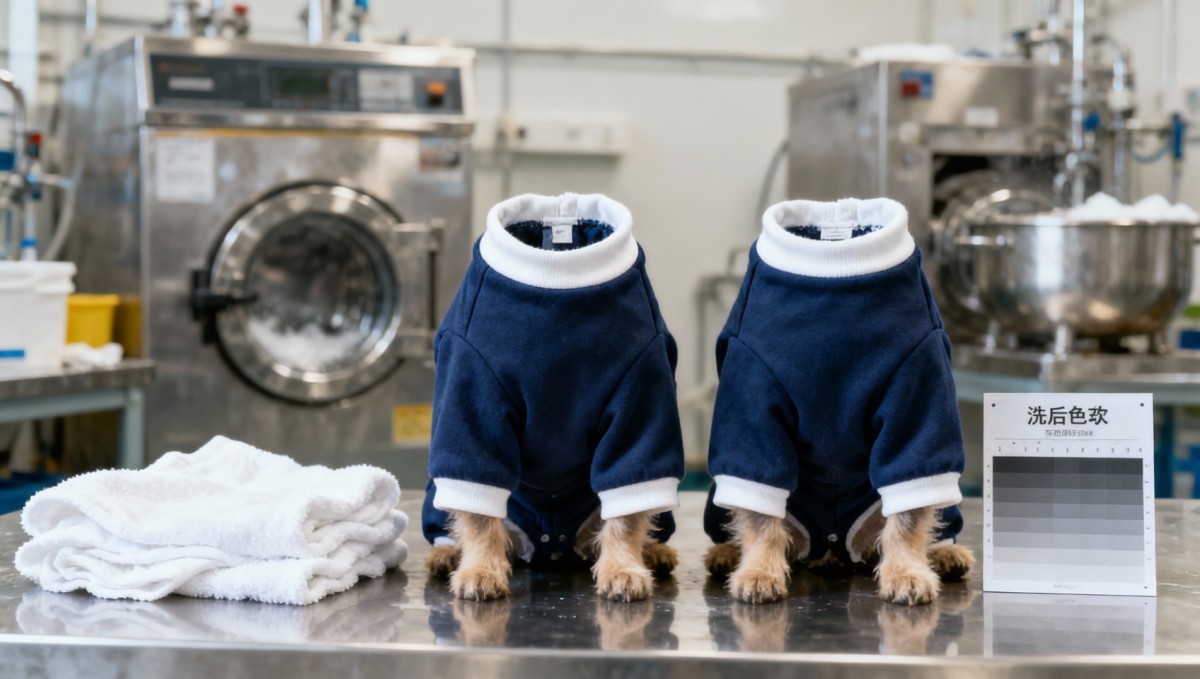
A useful visual review compares the original garment, the washed garment, and the adjacent test fabrics under consistent lighting. Photographing only the garment can miss the staining that triggered the customer complaint.
Sample approval versus bulk-production control
A development sample proves that a supplier can make an acceptable item. It does not establish that every production lot will match it.
Bulk variation can arise from changes in dye supply, processing conditions, washing-off, equipment loading, or subcontracted production. Retailers should therefore connect test results to identifiable production lots, rather than relying indefinitely on a preproduction report.
Before placing the order
Review representative reports for comparable materials and shade depths. Confirm the dyeing and finishing locations, including subcontractors, and establish who is responsible for approving process changes. Where feasible, examine records demonstrating control of relevant processing parameters and corrective actions.
Before releasing bulk goods
Use a documented sampling plan that covers production dye lots and prioritizes high-risk combinations. Dark shades, contrast panels, new print processes, and changed factories deserve particular attention. Choose samples through a controlled process rather than accepting only supplier-selected “best” pieces.
Retain reference samples and connect reports to purchase orders, color codes, lot identifiers, and production dates. Without traceability, a later complaint may force the retailer to investigate a much larger quantity of stock than necessary.
When a lot fails
Hold the affected goods while the cause is investigated. Additional washing or other reprocessing may be appropriate in some cases, but the corrected product needs retesting. Check for unintended effects such as shrinkage, altered hand feel, damaged prints, or reduced component durability.
A failed lot should not become acceptable simply because its care label is changed to “wash separately.”
Care instructions: useful guidance or a warning sign?
Clear washing instructions help parents protect clothing. They also set reasonable expectations about temperature, bleaching, drying, and sorting. However, a babywear range that requires elaborate precautions may conflict with the everyday routine of frequent laundry.
Compare the instruction with the product’s actual performance. “Wash with similar colors” can be sensible advice; it is not evidence that substantial dye release is acceptable. Likewise, “wash before first use” should not shift responsibility for removing excessive loose dye to the customer.
Validate performance under the labeled conditions and consider foreseeable use when setting internal quality requirements. If the proposed care instructions are unusually restrictive, buyers should ask whether a different shade, dye route, or construction would make the garment more practical.
Keep website guidance, packaging, and sewn-in labels consistent. Avoid unsupported claims such as “bleed-proof,” “non-toxic dyes,” or “safe for sensitive skin.” Colorfastness testing does not, by itself, substantiate those statements.
Keep performance claims separate from safety compliance
Visible dye transfer understandably worries parents, but poor colorfastness alone does not establish chemical toxicity. Equally, acceptable colorfastness does not prove compliance with chemical restrictions.
Retailers need separate checks for textile performance and applicable product-safety requirements. Depending on the destination market and product, these may address restricted substances, flammability, labeling, attachments, and other children’s-product obligations.
For U.S. children’s products, a Children’s Product Certificate may be required for applicable safety rules, supported by the relevant testing. It is not a general colorfastness approval. Ordinary baby clothing also should not be assumed to require CE marking or FDA approval simply because it is intended for infants.
Use complaints to improve the next buying decision
Even a well-controlled program needs a fair complaint process. Ask for the item identifier, photographs, washing conditions, and affected garments without making the customer feel blamed. Where possible, obtain the returned product and compare it with retained samples from the same lot.
Track complaints by units sold, colorway, supplier, and production lot—not just total refund value. A cluster around one shade may suggest a processing problem; repeated staining at pale necklines may point toward design changes. Credible reports of skin reactions or other safety concerns need a separate escalation pathway.
For sourcing teams using Global Consumer Sourcing (GCS), this is a useful lens for comparing manufacturing options: evaluate the evidence behind a supplier’s promise, the usability of the care requirements, and the strength of batch traceability—not merely the quoted price.
The most reliable prevention strategy is layered. Select suitable coloration processes, specify measurable performance, test complete garments, verify bulk lots, and give parents honest care guidance. That combination cannot eliminate every complaint, but it makes color bleeding less likely—and gives retailers a defensible, practical response when concerns arise.
Related Intelligence
 Cosmetics & PkgOct 20, 2026Beauty Tops Amazon’s 2026 Prime Big Deal Days Shopping CategoriesBeauty tops Amazon’s 2026 Prime Big Deal Days at 32% of shoppers, according to Market Defense. Explore what the findings could mean for product selection, inventory and promotional planning.
 Infant Feeding & CareOct 14, 2026How Can Retailers Prevent Baby Clothing Color Bleeding Claims?How can retailers avoid color bleeding claims on baby clothing? Discover testing, supplier controls, and care-label strategies to reduce returns and protect customer trust.
 Infant Feeding & CareOct 14, 2026Which Baby Clothing Materials Are Easier to Source Compliantly?What materials make baby clothing easier to source compliantly? Compare cotton, blends, and certified options, with practical supplier checks to reduce risk and make smarter sourcing decisions.
 Baby Gear & StrollersOct 14, 2026Are Baby Carrier Buckle Failures a Common Reason for Returns?Are baby carrier buckle failures a common return issue? Explore defects, usability complaints, and safety checks to make informed sourcing decisions before your next order.
 Baby Gear & StrollersOct 14, 2026How Do You Compare Baby Carrier Suppliers on Safety and Cost?How do I compare baby carrier suppliers on safety and cost? Learn to verify safety evidence, assess factory controls, and compare total landed costs to make a confident sourcing decision.
 STEM & Educational ToysSep 20, 2026How Do I Verify Age Grading for Educational Toys?How do I verify educational toy age grading? Learn how to assess safety risks, test reports, packaging, and market compliance before buying or selling.
 Corporate & Seasonal GiftsSep 20, 2026Are Promotional Items Worth Ordering for Short Campaigns?Are promotional items worth ordering for short campaigns? Learn how pet brands can choose useful, compliant giveaways that drive measurable engagement, sales, and loyalty.
 STEM & Educational ToysSep 20, 2026What Safety Checks Should Wooden Toy Suppliers Pass?What safety checks should wooden toy suppliers pass? Explore essential compliance, material traceability, chemical testing, and quality controls to source safer toys with confidence.
 Infant Feeding & CareSep 20, 2026Which Teething Toy Materials Are Easiest to Clean?Which teething toy materials are easiest to clean? Discover why silicone and natural rubber lead for hygienic, easy-care pet chew toys.
 Infant Feeding & CareSep 20, 2026How Can Retailers Prevent Mold Complaints About Bath Toys?How can retailers prevent mold complaints about bath toys? Explore drainable designs, supplier controls, testing, and care guidance to reduce moisture risks.
 Camping & WaterSep 20, 2026Which Folding Chair Fabrics Last Longest Outdoors?Which folding chair fabrics last longest outdoors? Compare acrylic, PVC-coated polyester, UV-stabilized polyester, and mesh for durable, pet-friendly outdoor seating.
 Camping & WaterSep 20, 2026Are Folding Camping Chairs Tested for Weight Capacity?Are folding camping chairs tested for weight capacity? Learn what credible load testing, safety margins, and supplier documentation mean for confident outdoor product sourcing.
 Corporate & Seasonal GiftsSep 20, 2026How Can Corporate Gift Buyers Avoid Missing Event Deadlines?How do corporate gift buyers avoid missed event deadlines? Discover proven sourcing, customization, compliance, and shipping strategies for pet-themed corporate gifts.