Which Baby Clothing Materials Are Easier to Source Compliantly?
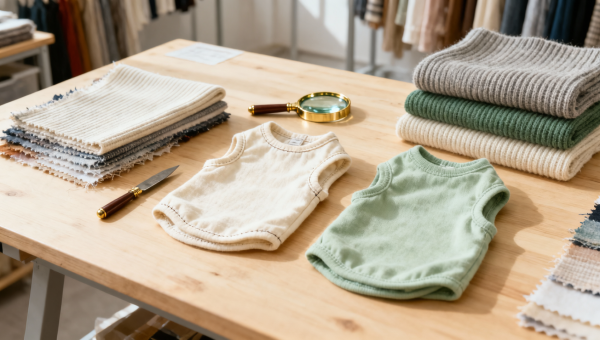
What materials make baby clothing easier to source compliantly? A practical starting point is conventional cotton, certified organic cotton, or a straightforward cotton blend from a supplier with clear material records and controlled production. These fabrics often offer familiar manufacturing processes and accessible documentation. Their advantage depends on the finished fabric, however: its dyes, finishes, prints, and trims can change the compliance picture.
A “natural” label does not establish safety, and a synthetic fiber does not automatically create a compliance problem. The more useful comparison is how easily each material can be specified, traced, tested, and reproduced without unexpected changes. A well-documented polyester fabric can be easier to qualify than organic cotton with incomplete records.
How the main baby clothing materials compare
The table below compares practical sourcing considerations. It assumes ordinary baby apparel; sleepwear needs a separate assessment because garment classification, fit, fabric behavior, and destination-market requirements can affect material selection.
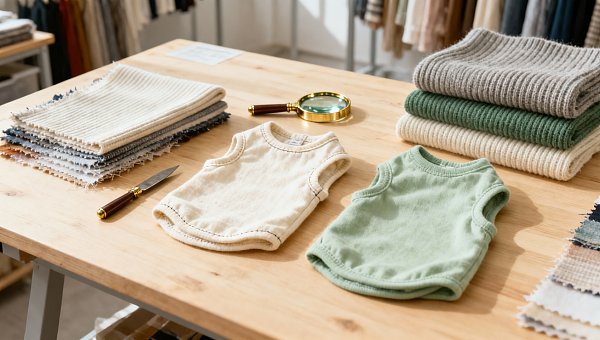
Fabric construction deserves its own comparison. Cotton jersey, rib, interlock, and brushed fleece share a fiber name but behave differently. Surface texture, weight, stretch, and finishing influence durability and can affect flammability assessment. Specifying only “cotton fabric” leaves too much room for variation.
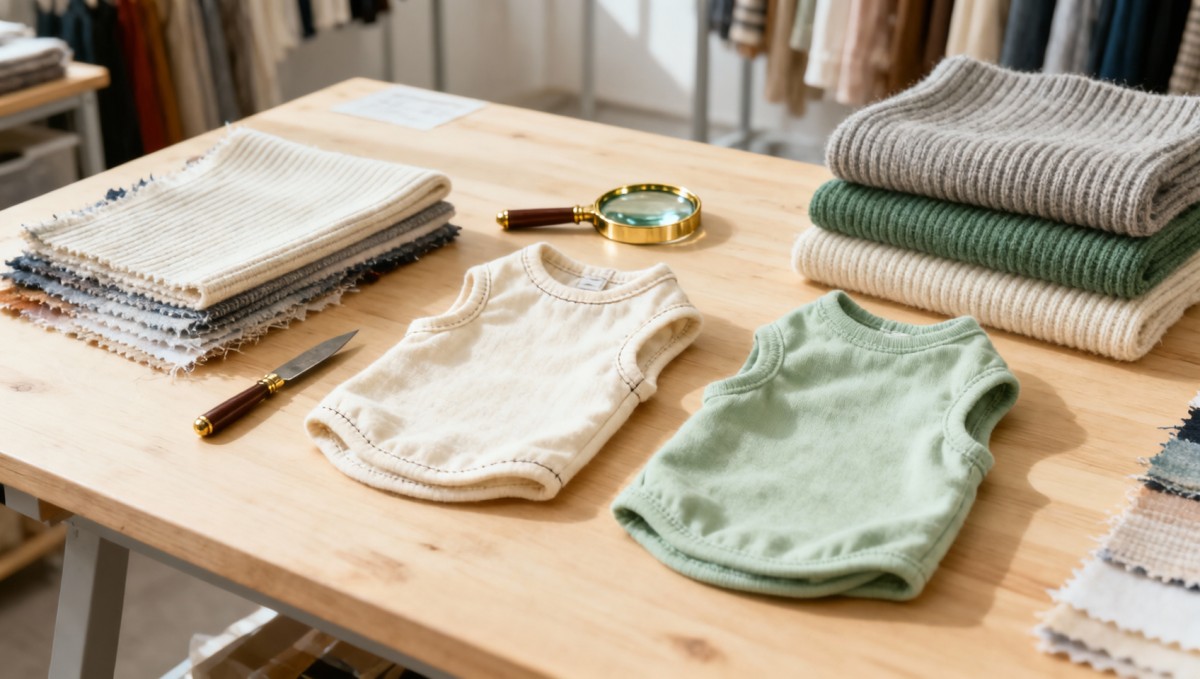
Why cotton is often the simplest starting point
Conventional cotton is a useful baseline because established suppliers commonly work with it across fabric production and garment assembly. That familiarity can make it easier to agree on specifications, obtain relevant records, and reproduce an approved fabric. Plain constructions with limited decoration also reduce the number of materials that need separate assessment.
Cotton still needs processing. Dyeing, bleaching, printing, and finishing introduce substances and production variables that the fiber name alone cannot explain. A soft handle may come from the construction, a mechanical treatment, or an applied softener. Each route should be identifiable in the material specification.
Undyed cotton can remove some color-related variables, but it is not automatically chemical-free or compliant. Bleaching, washing, finishing, and sewing components may remain relevant. Likewise, a pale color does not prove that a fabric has fewer restricted substances than a dark one.
The strongest cotton sourcing option is usually an established fabric with a stable specification and evidence linked to its actual processing route. A familiar material becomes less useful if the supplier changes the dyehouse, finish, or fabric source whenever capacity becomes tight.
Organic cotton adds evidence requirements as well as value
Certified organic cotton makes sense when the product needs a supported organic claim. Depending on the certification scheme and its scope, documentation may address organic inputs, supply-chain traceability, processing requirements, or a combination of these. The certificate must match the relevant operation and product scope.
A supplier’s certificate does not necessarily cover every garment it sells. Purchasing certified yarn also does not, by itself, establish that a finished garment qualifies for a particular certification label. The connection between the certified input, processing stages, and supplied goods needs to remain intact.
Organic cotton therefore offers a clearer claim pathway when the supplier already manages the necessary records. It can create extra work when certification is treated as a logo rather than a controlled sourcing system. Organic status also does not replace finished-product safety assessment.
Cotton blends can be easier to manage when the composition stays stable
A cotton-elastane blend can be a practical choice for garments that need comfortable movement and recovery. Better recovery can help a neckline, cuff, or leg opening retain its intended shape. The extra fiber adds another variable, but a familiar blend from a consistent mill is often manageable.
The specification should state the fiber composition, fabric construction, weight, and finishing route. It should also describe the required performance after washing. An approved stretch fabric may become unsuitable if a replacement elastane yarn or altered heat-setting process changes its recovery.
Cotton-polyester blends can support easy care and shape retention, although performance depends on the blend and construction. They may suit everyday separates where repeated laundering matters. Comfort, pilling, and drying behavior still need assessment on the finished fabric rather than assumptions based on the fiber names.
For either blend, the main sourcing advantage is repeatability. A slightly more complex fabric with reliable production controls can be easier to manage than pure cotton supplied with frequent undocumented substitutions.
Bamboo-derived fabrics require careful naming and claim control
“Bamboo” can describe the plant source without adequately identifying the finished textile fiber. Much clothing marketed this way is made from viscose manufactured using bamboo-derived cellulose. That distinction affects composition labeling and the claims attached to the garment.
Ask for the actual fiber identity and use the terminology required in the destination market. Bamboo-derived viscose should not be presented as mechanically processed bamboo fiber when it is a regenerated cellulose textile.
Viscose and lyocell can provide softness and drape, but these qualities do not prove that a garment is hypoallergenic, antibacterial, or environmentally preferable. Such claims require their own support. Certification of one attribute should not be stretched into evidence for unrelated benefits.
These fabrics also deserve practical wash evaluation. Depending on construction and finishing, dimensional change, wet strength, and surface appearance may affect garment performance. A fabric that feels excellent before washing can still create quality problems during normal use.
They become easier sourcing options when the manufacturer provides accurate fiber declarations, controlled processing information, and relevant performance evidence. Vague “eco bamboo” descriptions make qualification harder because the material itself remains insufficiently defined.
When polyester, recycled fibers, and wool make sense
Polyester can be appropriate for selected outer layers or garments with a clear performance requirement. Its sourcing difficulty often comes from added treatments and garment design rather than the fiber alone. Water-repellent, antimicrobial, or stain-resistant finishes introduce questions that a basic untreated fabric may avoid.
Recycled polyester adds a separate claim obligation. Evidence of recycled content should connect to the supplied material and support the wording used on the product. Recycled-content documentation and chemical safety testing answer different questions; neither substitutes for the other.
Wool may suit seasonal layers, but skin feel, laundering, and shrinkage need close attention. Treatments intended to improve washability also become part of the fabric assessment. Wool is most practical when its properties serve a defined garment purpose and the manufacturer can consistently deliver the required finish.
For these materials, sourcing convenience should follow the intended use. Choosing a performance fiber without a clear performance need can add specification and claim-management work without improving the garment.
The finished garment can change the decision
A straightforward cotton fabric can become a complicated product after adding a large print, metal snaps, elastic, decorative attachments, and a special finish. Each addition introduces another material or process that may need evidence.
Relevant chemical restrictions depend on the destination market and product components. Assessments may need to address dyes, finishing substances, print formulations, coatings, or metal parts. A fabric report cannot automatically establish the suitability of a snap, and a trim report cannot establish the suitability of a printed panel.
Physical safety also matters. Attachments need appropriate security, seams must withstand expected use, and cords or decorative features must be assessed in context. The concern is the finished garment’s behavior, including after laundering.
Sleepwear deserves an early decision. Requirements can differ from those for ordinary daywear, and the route to compliance may depend on classification, sizing, fit, construction, and flammability performance. Do not approve a fabric for sleepwear solely because it passed a chemical screening program.
Certification terminology needs similar care. A voluntary textile certification can provide useful evidence within its scope, but it does not establish every legal requirement for a finished garment. Ordinary baby clothing does not acquire CE-marking or FDA-approval requirements simply because it is intended for babies. Where a US Children’s Product Certificate is required, it concerns applicable product rules; it is not a general fabric-quality seal.
Compare supplier evidence before approving the material
Two suppliers offering the same fiber may present very different sourcing risks. A useful comparison follows the connection between the proposed fabric, its documentation, and the goods that will enter production.
- Define the garment and market. Establish intended use, age range, product classification, and sales destinations before selecting the compliance plan.
- Specify the complete fabric. Record composition, construction, weight, color, prints, and finishes. Include the performance expectations that affect garment use.
- Connect evidence to the proposed product. Check sample descriptions, material references, tested components, and report scope. A generic pass report provides little value if it cannot be linked to the order.
- Separate safety evidence from claim evidence. Chemical testing, organic certification, and recycled-content records serve different purposes. Request each only where it supports a defined requirement or claim.
- Control production changes. Require review of changes to fabric sources, dyehouses, finishes, print formulations, and trims before substitution.
- Assess the finished sample. Check laundering performance, dimensional stability, color transfer, attachment security, and construction alongside the applicable compliance assessment.
Color coverage also needs a deliberate approach. A report for an undyed base fabric may not address substances introduced during dyeing or printing. A sensible testing plan considers shared processes and meaningful differences between variants, with those decisions reflected in the documentation.
For a simple everyday range, an established cotton fabric or controlled cotton blend is often a practical starting point. Choose certified organic cotton when the organic claim has a clear purpose and the supply chain can support it. Choose regenerated cellulose, recycled synthetics, or wool when their properties justify the additional specifications and evidence.
Before placing an order, request one complete evidence package for the exact proposed fabric and garment components. The material that is easiest to source compliantly is usually the one whose identity, processing, claims, and production changes can be explained clearly and kept consistent from sample approval to delivery.
Related Intelligence
 Cosmetics & PkgOct 20, 2026Beauty Tops Amazon’s 2026 Prime Big Deal Days Shopping CategoriesBeauty tops Amazon’s 2026 Prime Big Deal Days at 32% of shoppers, according to Market Defense. Explore what the findings could mean for product selection, inventory and promotional planning.
 Infant Feeding & CareOct 14, 2026How Can Retailers Prevent Baby Clothing Color Bleeding Claims?How can retailers avoid color bleeding claims on baby clothing? Discover testing, supplier controls, and care-label strategies to reduce returns and protect customer trust.
 Infant Feeding & CareOct 14, 2026Which Baby Clothing Materials Are Easier to Source Compliantly?What materials make baby clothing easier to source compliantly? Compare cotton, blends, and certified options, with practical supplier checks to reduce risk and make smarter sourcing decisions.
 Baby Gear & StrollersOct 14, 2026Are Baby Carrier Buckle Failures a Common Reason for Returns?Are baby carrier buckle failures a common return issue? Explore defects, usability complaints, and safety checks to make informed sourcing decisions before your next order.
 Baby Gear & StrollersOct 14, 2026How Do You Compare Baby Carrier Suppliers on Safety and Cost?How do I compare baby carrier suppliers on safety and cost? Learn to verify safety evidence, assess factory controls, and compare total landed costs to make a confident sourcing decision.
 STEM & Educational ToysSep 20, 2026How Do I Verify Age Grading for Educational Toys?How do I verify educational toy age grading? Learn how to assess safety risks, test reports, packaging, and market compliance before buying or selling.
 Corporate & Seasonal GiftsSep 20, 2026Are Promotional Items Worth Ordering for Short Campaigns?Are promotional items worth ordering for short campaigns? Learn how pet brands can choose useful, compliant giveaways that drive measurable engagement, sales, and loyalty.
 STEM & Educational ToysSep 20, 2026What Safety Checks Should Wooden Toy Suppliers Pass?What safety checks should wooden toy suppliers pass? Explore essential compliance, material traceability, chemical testing, and quality controls to source safer toys with confidence.
 Infant Feeding & CareSep 20, 2026Which Teething Toy Materials Are Easiest to Clean?Which teething toy materials are easiest to clean? Discover why silicone and natural rubber lead for hygienic, easy-care pet chew toys.
 Infant Feeding & CareSep 20, 2026How Can Retailers Prevent Mold Complaints About Bath Toys?How can retailers prevent mold complaints about bath toys? Explore drainable designs, supplier controls, testing, and care guidance to reduce moisture risks.
 Camping & WaterSep 20, 2026Which Folding Chair Fabrics Last Longest Outdoors?Which folding chair fabrics last longest outdoors? Compare acrylic, PVC-coated polyester, UV-stabilized polyester, and mesh for durable, pet-friendly outdoor seating.
 Camping & WaterSep 20, 2026Are Folding Camping Chairs Tested for Weight Capacity?Are folding camping chairs tested for weight capacity? Learn what credible load testing, safety margins, and supplier documentation mean for confident outdoor product sourcing.
 Corporate & Seasonal GiftsSep 20, 2026How Can Corporate Gift Buyers Avoid Missing Event Deadlines?How do corporate gift buyers avoid missed event deadlines? Discover proven sourcing, customization, compliance, and shipping strategies for pet-themed corporate gifts.