How Can Retailers Check Plush Toy Stuffing Quality?
How Can Retailers Check Plush Toy Stuffing Quality?
A plush pet toy may feel soft on the shelf, but its stuffing can hide quality problems that lead to customer complaints and safety concerns. A well-shaped sample does not tell a buyer whether production units will contain uneven filling, shed loose fibers, or stay damp after washing.
How do retailers check plush toy stuffing quality? Effective checks combine hands-on inspection, destructive examination, supplier records, and targeted testing. Each answers a different question. The aim is not to find the softest filling; it is to confirm that the material is consistent, suitable for the toy’s intended use, and adequately contained.
Judge the filling against the toy’s job
A lightweight comfort toy and a plush tug toy should not share an identical acceptance specification. The comfort toy may need a loose, compressible feel. A tug toy puts more stress on its seams and attachment points, although extra stuffing alone will not make it durable.
Overfilling can make a toy look more substantial while loading its seams before play begins. Underfilling can leave fabric folds that are easy to grip and pull. Neither judgment should depend on appearance alone: the approved construction, fill weight, and intended use need to agree.
Before comparing suppliers, specify the filling material, target fill weight and tolerance, distribution by body section, washing instructions, and any internal squeaker or liner. Keep an approved reference sample. “Soft polyester stuffing” is too vague to settle a disagreement after delivery.
Compare materials without confusing claims with quality
Virgin polyester fiberfill, recycled polyester fiberfill, and chopped foam can produce quite different handling and drying characteristics. However, the material name does not establish cleanliness, resilience, or safety. Fiber construction, processing, storage, and assembly all affect the finished product.
Recycled content is not automatically inferior, and virgin material is not automatically clean. Likewise, “hypoallergenic,” “non-toxic,” and “premium cotton” require clarification. Ask what the claim means, which material it covers, and what evidence supports it. A pet-toy listing that calls polyester filling “cotton” creates an avoidable specification and labeling problem.
Use the squeeze test as a screen, not a verdict
Compare multiple production units, preferably drawn from different cartons under an agreed sampling plan. A supplier-selected development sample can establish the desired feel, but it cannot demonstrate shipment consistency.
Work through the body, head, limbs, and narrow attachment areas. Look for empty pockets, hard lumps, unexpected particles, and filling that shifts away from pressure. Some unevenness may be intentional—for example, a floppy limb—but it should match the approved design.
For a simple resilience comparison, compress the same area of each sample using a consistent procedure, then compare recovery after the same rest period. Record flattening or persistent clumping. This is useful screening, not a standardized laboratory result unless the method has been formally defined.
Whole-toy weight is another useful screen, but shell fabric, squeakers, ropes, and trims also contribute. An underweight unit deserves investigation; it does not prove missing stuffing. Where fill weight is contractual, confirm it through destructive measurement rather than inferring it from total weight.
Open samples: the most revealing check is often destructive
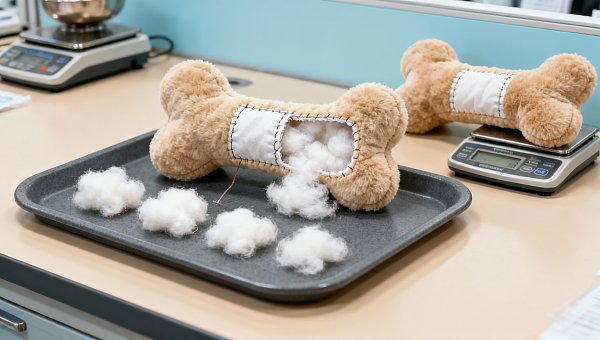
External handling cannot establish what is inside. Open designated inspection samples in a clean area, photograph the filling in place, and separate the material by section before disturbing its distribution. This helps distinguish poor filling from poor pattern design or assembly.
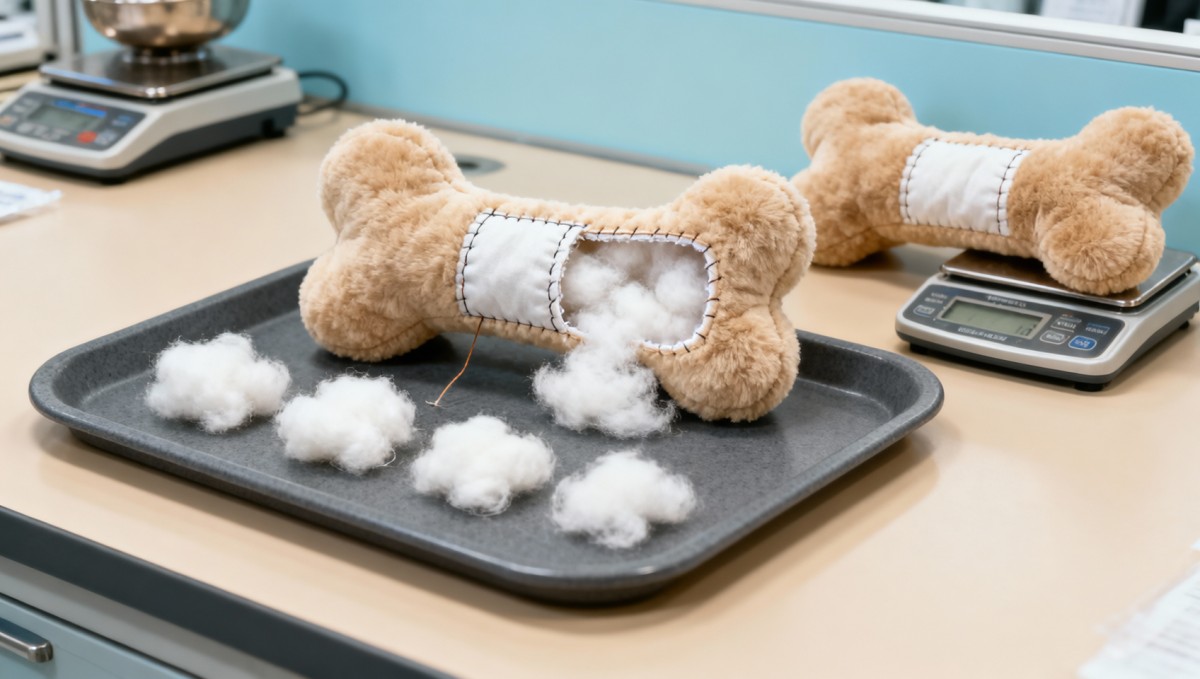
Spread the removed filling on a clean, contrasting surface. Check for fabric scraps, rigid fragments, insects, visible mold, discoloration, and unexplained mixed materials. Note unusual chemical or musty odors, but do not treat smell as a chemical safety test. Odor-free material can still require testing; an odor complaint alone cannot identify a substance.
Gently tease apart several portions. A tangled cluster may explain why a toy feels lumpy, while a hard inclusion needs a different response. Material deliberately used as chopped textile filling should not be confused with accidental contamination, but it must still match the approved specification and suitability assessment.
Visible mold or sharp foreign matter should trigger a shipment hold and investigation, not simply removal of the failed sample. Establish the affected lot, examine storage and material-handling records, and agree on corrective action before release. Destructively inspected units should never return to saleable stock.
Check containment separately from stuffing quality
Clean filling can still become a hazard when a seam opens. For plush pet toys, stuffing quality and containment must therefore be assessed together, even though they are separate acceptance criteria.
Inspect closure seams, narrow necks, limb attachments, and areas around squeakers. Look for skipped stitches, exposed filling, fabric damage at stitch holes, and stuffing trapped across the closure. Then use an agreed mechanical test appropriate to the construction and intended use.
A casual hand pull can reveal an obvious defect, but results vary with the operator. Instrumented testing makes supplier comparisons more meaningful because force, direction, duration, and failure location can be recorded. Avoid borrowing a pull-force threshold from an unrelated product and presenting it as a universal pet-toy requirement.
Record how failure occurs. A seam opening, fabric tearing beside intact stitching, and fibers migrating through the fabric suggest different corrective actions. Stronger thread will not necessarily solve a weak shell. Adding more filling may worsen seam loading.
No loose stuffing should be presented as safe to swallow. Supervised-play and discard-if-damaged instructions support appropriate use, but they do not replace sound construction or justify “indestructible” claims.
Compare new, washed, and shipment-conditioned samples
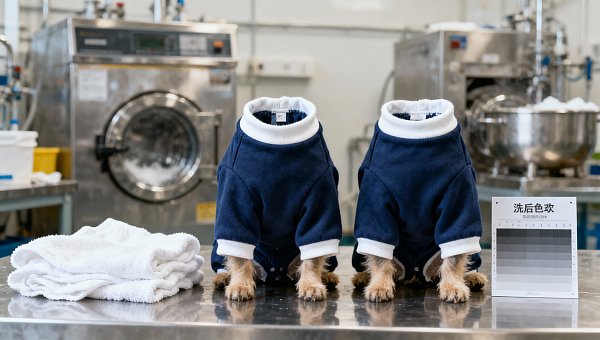
A fresh sample may perform well while a washed one develops clumps or persistent damp areas. Where the product carries washable-care instructions, evaluate it using those instructions and document the wash and drying conditions. Compare shape, filling migration, seam condition, odor, and internal dryness—not just whether the outer fabric looks clean.
Thick filling pockets deserve particular attention. The surface can feel dry before the interior has dried. If the proposed care method leaves internal moisture, reconsider the fill density, construction, or care directions. Do not invent a drying-time promise without evidence.
Compressed shipping creates another comparison worth making. Assess samples after a defined unpacking and recovery period rather than immediately after opening. Otherwise, temporary compression can be mistaken for poor resilience—or slow recovery can go unnoticed because buyers only inspect uncompressed showroom samples.
Know what documents and laboratory tests can actually prove
Request a filling specification, material declaration, relevant test reports, and traceability linking the material to production. Ask how incoming filling is checked, stored, and protected from contamination, and whether substitutions require written approval. A technically capable supplier should be able to explain these controls beyond saying that the stuffing is “certified.”
Read the scope of every report. Does it cover loose fiber, finished fabric, or the assembled toy? Does its material description match the current order? A passing report for one component cannot establish that every component—or every subsequent shipment—complies.
Independent testing is especially useful when introducing an unfamiliar filling, investigating contamination, supporting a specific claim, or assessing mechanical and chemical risks that visual inspection cannot resolve. Ask a competent laboratory to propose a scope based on the actual product, intended market, and foreseeable use. A generic “full test” quotation may leave important questions unanswered.
Keep pet-product requirements distinct from children’s toy requirements. In the United States, a Children’s Product Certificate relates to applicable children’s product rules; it is not a general pet-toy certificate. CE marking likewise is not a universal quality badge for pet accessories. Products with dual positioning need careful classification. Applicable obligations should be confirmed for the destination market rather than copied from a supplier’s standard document pack.
Turn inspection findings into a purchasing decision
For a sourcing platform such as Global Consumer Sourcing (GCS), the useful comparison is not simply which supplier offers the softest sample. It is which supplier can connect material identity, production consistency, test evidence, and corrective action to the goods being purchased.
Build acceptance criteria around observable outcomes: permitted fill-weight variation, approved distribution, recovery under a defined method, absence of specified contamination, and containment performance. Agree on sampling and defect classifications before production. Critical safety concerns should have explicit escalation rules rather than being averaged against acceptable units.
When two samples feel equally good, favor the supplier that can explain and control the differences between batches. Before releasing the order, retain a reference sample, confirm the current filling specification, and document what happens if production material changes. That is a stronger buying decision than approving a plush toy because it passes one reassuring squeeze.
Related Intelligence
 STEM & Educational ToysOct 23, 20262026 China Toy Expo Gives AI Toys a Dedicated Hall as Practical Features Take Priority2026 China Toy Expo spotlights AI toys with a dedicated hall. Explore how practical features and everyday play experiences are reshaping manufacturers’ product priorities.
 STEM & Educational ToysOct 22, 2026Blokees Showcases Over 900 Products at the 2026 China International Toy FairBlokees showcases over 900 products at the 2026 China International Toy Fair. Explore Model Kits, BLOKEES WHEELS and key sourcing checks to guide your next purchase.
 Cosmetics & PkgOct 21, 2026BASF Plans Beauty Innovation Showcase at in-cosmetics Asia 2026Explore BASF’s planned beauty innovations at in-cosmetics Asia 2026 in Bangkok, with a focus on skin protection, repair and sustainable solutions for personal care formulators.
 Cosmetics & PkgOct 20, 2026Beauty Tops Amazon’s 2026 Prime Big Deal Days Shopping CategoriesBeauty tops Amazon’s 2026 Prime Big Deal Days at 32% of shoppers, according to Market Defense. Explore what the findings could mean for product selection, inventory and promotional planning.
 Corporate & Seasonal GiftsOct 14, 2026How Can Retailers Check Plush Toy Stuffing Quality?How do retailers check plush toy stuffing quality? Discover practical inspections, supplier checks, and testing tips to reduce defects and make smarter pet toy sourcing decisions.
 Corporate & Seasonal GiftsOct 14, 2026Are Embroidered Eyes Safer Than Plastic Eyes on Plush Toys?Are plush toys with embroidered eyes safer than plastic eyes? Discover key pet-toy risks, quality checks, and sourcing tips to make smarter buying decisions.
 Infant Feeding & CareOct 14, 2026What Documents Are Required to Import Baby Formula?What import documents are needed for baby formula? Explore shipment paperwork, health certificates, and market-specific requirements to avoid costly delays and prepare for compliant imports.
 Infant Feeding & CareOct 14, 2026Which Baby Formula Packaging Formats Reduce Shipping Damage?Which baby formula packaging formats reduce shipping damage? Compare metal cans, rigid tubs, and supported pouches to choose better protection and reduce costly transit losses.
 Baby Gear & StrollersOct 14, 2026How Long Does Custom Diaper Bag Production Usually Take?How long does custom diaper bag production usually take? Plan for 30–60 days after sample approval. Discover key lead-time factors and practical tips to avoid delays and launch on schedule.
 Baby Gear & StrollersOct 14, 2026Which Diaper Bag Features Justify a Higher Wholesale Price?What diaper bag features justify a higher wholesale price? Discover durability, comfort, and easy-clean upgrades worth paying for—and source smarter with practical buyer tips.
 Infant Feeding & CareOct 14, 2026How Can Retailers Prevent Baby Clothing Color Bleeding Claims?How can retailers avoid color bleeding claims on baby clothing? Discover testing, supplier controls, and care-label strategies to reduce returns and protect customer trust.
 Infant Feeding & CareOct 14, 2026Which Baby Clothing Materials Are Easier to Source Compliantly?What materials make baby clothing easier to source compliantly? Compare cotton, blends, and certified options, with practical supplier checks to reduce risk and make smarter sourcing decisions.
 Baby Gear & StrollersOct 14, 2026Are Baby Carrier Buckle Failures a Common Reason for Returns?Are baby carrier buckle failures a common return issue? Explore defects, usability complaints, and safety checks to make informed sourcing decisions before your next order.