EU EPR Rules Take Effect for Beauty & Baby Monitors on Apr 29, 2026
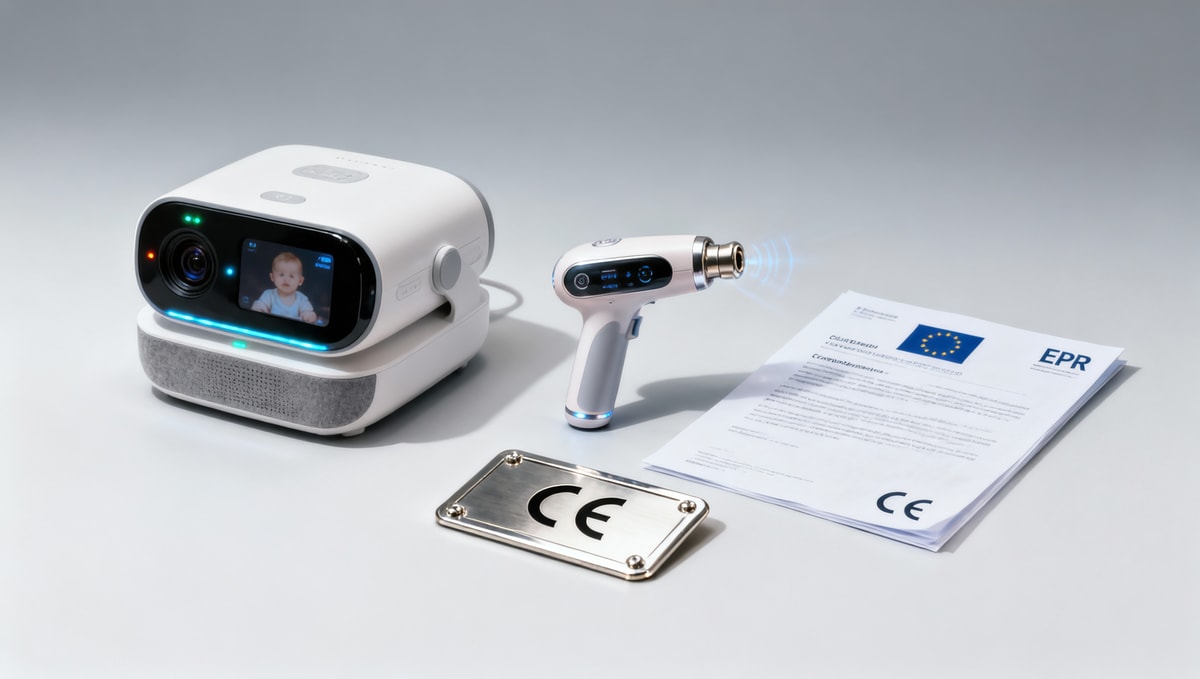
Starting April 29, 2026, the EU’s Harmonised Implementation Guidance on Extended Producer Responsibility (EPR) for Packaging and Electrical and Electronic Equipment will apply mandatorily to beauty devices and baby monitors. This development directly affects Chinese exporters of beauty instruments and nursery monitoring equipment — particularly OEM/ODM manufacturers supplying EU-based brands and distributors.
Event Overview
As confirmed in official guidance documents published by the European Commission, the EPR registration and fee payment requirement for beauty devices (e.g., facial massagers, LED therapy devices) and baby monitors (including audio/video and smart-connected variants) becomes enforceable across all EU Member States effective April 29, 2026. Products failing to demonstrate valid EPR registration status in the relevant national systems — including proof of fee payment for end-of-life collection and recycling — will be denied warehouse entry and held at EU customs checkpoints.
Which Subsectors Are Affected
Original Equipment Manufacturers (OEMs) and Original Design Manufacturers (ODMs)
OEM/ODM firms producing beauty or baby monitoring devices for EU clients must now provide verified EPR registration numbers and signed compliance declarations to their overseas partners. Without these, EU-based importers and distributors cannot complete customs clearance or list products on retail platforms — making EPR documentation a prerequisite for order fulfillment, not just a regulatory formality.
Export Trading Companies Specializing in Beauty Devices
Trading companies handling cross-border shipments of beauty instruments face new pre-shipment verification requirements. Customs brokers and logistics providers in the EU are increasingly requesting EPR evidence prior to booking cargo, meaning delays or rejection may occur if registration is incomplete, expired, or misaligned with the declared product category or country of import.
Distributors and Retailers of Nursery Monitoring Equipment
EU-based distributors and e-commerce sellers of baby monitors must verify EPR status before accepting inventory. Marketplaces such as Amazon DE and OTTO now require EPR IDs during seller onboarding for regulated categories; failure to submit valid registration triggers deactivation of product listings — even for previously approved SKUs.
What Relevant Enterprises or Practitioners Should Focus On Now
Confirm National-Level Registration Requirements per Target Market
While the EU guideline harmonises principles, implementation remains national: Germany (EAR), France (Eco-systèmes), Italy (CdC RAEE), and Spain (ECOLEC) each operate distinct EPR schemes with varying fee structures, reporting deadlines, and product classification rules. Exporters must map exact registration pathways for each destination country — not assume mutual recognition.
Validate Product Classification Against EPR Scope Definitions
Analysis shows that ‘baby monitor’ and ‘beauty device’ are not self-evident under EPR law. For example, non-battery-powered analog audio-only monitors may fall outside WEEE scope in some jurisdictions, whereas Wi-Fi-enabled models with rechargeable batteries typically do. Similarly, handheld LED skin devices classified as Class I medical accessories may be exempt in certain cases — but only if formally notified. Misclassification risks invalid registration and subsequent non-compliance penalties.
Secure Documentation Flow Between Manufacturer and EU Importer
From industry perspective, EPR responsibility rests legally with the ‘producer’ placing the product on the EU market — usually the EU-based importer or brand owner. However, practical compliance depends on timely provision of manufacturer-level data (e.g., weight, material composition, annual sales volume). OEMs must align internal recordkeeping and update contractual terms to clarify data-sharing obligations and liability boundaries.
Prepare for Ongoing Reporting and Fee Reconciliation
Observably, EPR is not a one-time registration. Most national schemes require annual reporting of placed-on-market quantities and corresponding fee payments. Exporters should establish internal tracking mechanisms — especially for multi-country distribution — to avoid late fees, audit findings, or suspension of registration status.
Editorial Perspective / Industry Observation
This regulation is better understood as an enforcement milestone rather than a policy introduction: the underlying EPR obligations for electrical equipment have existed under the WEEE Directive since 2012. What changes on April 29, 2026, is the explicit inclusion of two high-volume consumer electronics subcategories — beauty devices and baby monitors — into mandatory, cross-border operational compliance. Analysis shows this reflects growing regulatory focus on fast-growing, low-awareness segments where producer accountability has historically been fragmented. It signals tightening alignment between environmental policy and supply chain due diligence — not just for large brands, but for upstream manufacturing partners whose compliance posture now directly constrains downstream market access.
Current observation suggests the rule functions primarily as a gatekeeping mechanism at customs and digital storefronts, rather than a subject of proactive audits at launch. That said, early enforcement patterns in Germany and France indicate rapid escalation from warnings to financial penalties within 6–12 months post-implementation. Therefore, industry attention should shift from ‘if’ to ‘how’ — specifically, how registration integrates with existing export workflows, product labeling, and contract management.
Conclusion: The April 2026 EPR requirement for beauty and baby monitoring devices marks a structural shift in EU market access conditions — not merely a procedural update. It formalises upstream producers’ role in environmental accountability and makes EPR documentation a non-negotiable element of commercial readiness. For affected exporters, the priority is not broad strategic adaptation, but precise, jurisdiction-specific execution: correct classification, valid registration, and documented handover to EU partners. This is less about new sustainability strategy and more about updated trade compliance infrastructure.
Information Sources: European Commission Guidance Document ‘Harmonised Implementation Guidance on EPR for Packaging and EEE’ (2025 edition); National EPR scheme portals (EAR Germany, Eco-systèmes France, CdC RAEE Italy, ECOLEC Spain); Public notices issued by EU customs authorities (Q4 2025). Note: Final national transposition details remain subject to confirmation by individual Member States through early 2026 — ongoing monitoring is advised.
Related Intelligence
") Skincare OEMApr 30, 2026FDA Adds New INCI Code for Plant Stem Cell Extracts (PSC-2026)FDA's new PSC-2026 INCI code for plant stem cell extracts demands strict documentation—get compliant fast to avoid U.S. shipment delays.
Skincare OEMApr 30, 2026FDA Adds New INCI Code for Plant Stem Cell Extracts (PSC-2026)FDA's new PSC-2026 INCI code for plant stem cell extracts demands strict documentation—get compliant fast to avoid U.S. shipment delays. Electronic & RC ToysApr 30, 2026RC Toy Orders Shift to South China Cluster, Lead Time Cuts to 6 WeeksRC toy orders are shifting to South China’s Dongguan–Shenzhen–Zhongshan cluster—lead times slashed to 6 weeks. Discover how exporters, suppliers & logistics players can adapt now.
 Cosmetics & PkgApr 30, 2026SASO Updates Cosmetics Packaging Rules for Plant ExtractsSASO updates cosmetics packaging rules for plant extracts—mandatory migration & light stability testing from Oct 1, 2026. Act now to avoid delays!
 Corporate & Seasonal GiftsApr 30, 2026Germany UBA Launches Mandatory Carbon Labelling Pilot for Corporate Gift InksGermany UBA's new Carbon Labelling Pilot mandates verified ink carbon footprints for corporate gifts—key for Chinese exporters & B2B gifting suppliers entering Germany.
 Fitness EquipmentApr 30, 2026THE Alliance Cuts Shanghai–LA Capacity Again: Fitness Equipment Shipment Delays to 8–10 WeeksFitness equipment shipment delays hit 8–10 weeks as THE Alliance cuts Shanghai–LA capacity by 22%. Urgent insights for exporters, forwarders & U.S. importers.
 Camping & WaterApr 30, 2026Vietnam MOIT Suspends Import Licenses for Camping & Water PumpsVietnam MOIT suspends import licenses for camping & water pumps—IP6X and ASTM B117 compliance now mandatory. Act now to avoid delays.
 Smart Pet DevicesApr 30, 2026Japan METI Adds Smart Cat Litter Machines to PSE Fast-Track ListSmart cat litter machines now qualify for Japan's PSE fast-track certification — just 7 days for Chinese-made units with auto-cleaning, APP control & biological sensing.
 STEM & Educational ToysApr 30, 2026CPSC Tightens STEM Toy Battery Compartment StandardsCPSC Tightens STEM Toy Battery Compartment Standards: New ASTM F963-26 Annex D2 test mandates dynamic pressure + vibration compliance by July 1, 2026—act now to avoid shipment rejections.
 Infant Feeding & CareApr 30, 2026RCEP Launches Infant Feeding Fast Track for China NMPA Class II ProductsRCEP Infant Feeding Fast Track now live: China NMPA Class II products skip redundant testing in 5 ASEAN markets — faster certification, 40%+ cost savings.
 Beauty DevicesApr 30, 2026EU EPR Rules Take Effect for Beauty & Baby Monitors on Apr 29, 2026EU EPR rules for beauty & baby monitors take effect Apr 29, 2026 — mandatory registration, fees & compliance for exporters. Act now to avoid customs delays & marketplace deactivation.
 2026/789 on Beauty Device Packaging Takes Effect") Beauty DevicesApr 29, 2026EU Regulation (EU) 2026/789 on Beauty Device Packaging Takes EffectEU Regulation (EU) 2026/789 mandates 30% recycled plastic & LCA declarations for beauty device packaging — act now to avoid Amazon.de/fr rejections!
Beauty DevicesApr 29, 2026EU Regulation (EU) 2026/789 on Beauty Device Packaging Takes EffectEU Regulation (EU) 2026/789 mandates 30% recycled plastic & LCA declarations for beauty device packaging — act now to avoid Amazon.de/fr rejections! Electronic & RC ToysApr 29, 2026ICTA: RC Toy Orders Shift to South China, Lead Time Cuts to 6 WeeksICTA reports RC toy orders shifting to South China—78% now flow to Guangdong’s cluster, cutting lead times to just 6 weeks. Act now to optimize sourcing, compliance & logistics.
 STEM & Educational ToysApr 29, 2026CPSC Nanomaterial Migration Rule for STEM Toys Effective Q3 2026CPSC Nanomaterial Migration Rule for STEM Toys: New ASTM F963–24 testing (≤0.05 mg/cm²/h) mandatory from Oct 1, 2026—avoid detention & recalls.