Germany UBA Launches Mandatory Carbon Labelling Pilot for Corporate Gift Inks
On April 26, 2026, the German Federal Environment Agency (UBA) launched the ‘Corporate Gifts Carbon Labelling Pilot’, mandating lifecycle carbon footprint disclosure for inks used in printed corporate and seasonal gifts. This initiative directly affects exporters of custom-printed promotional items—especially Chinese suppliers selling into Germany—and signals a new compliance threshold for packaging labelling and supply chain transparency in the B2B gifting sector.
Event Overview
The German Federal Environment Agency (UBA) officially initiated the ‘Corporate Gifts Carbon Labelling Pilot’ on April 26, 2026. Under this pilot, participating enterprises—including all Chinese suppliers marketing custom-printed corporate gifts in Germany—must, starting Q3 2026, display the life cycle assessment (LCA) carbon footprint of printing inks on product packaging and B2B platform pages. The required metric is kg CO₂e per kg of ink, and the data must be verified by an ISO 14040-certified LCA provider. The first phase covers printed corporate and seasonal gifts only.
Industries Affected
Direct Exporters & Brand Owners (B2B Gifting Companies)
These companies are directly subject to the labelling requirement. Since they control product specification, packaging, and B2B platform content, they bear primary responsibility for accurate ink carbon data display. Impact manifests in updated packaging design, revised digital asset management, and potential delays in product launch cycles if ink LCA documentation is unavailable or contested.
Printing & Finishing Manufacturers
Suppliers performing custom printing (e.g., offset, screen, or digital printing on mugs, notebooks, or apparel) must now provide verifiable ink carbon data to their clients. This introduces new upstream data collection obligations—not just for ink volume, but for supplier-specific LCA reports tied to exact ink formulations and batch lots.
Ink Formulators & Distributors
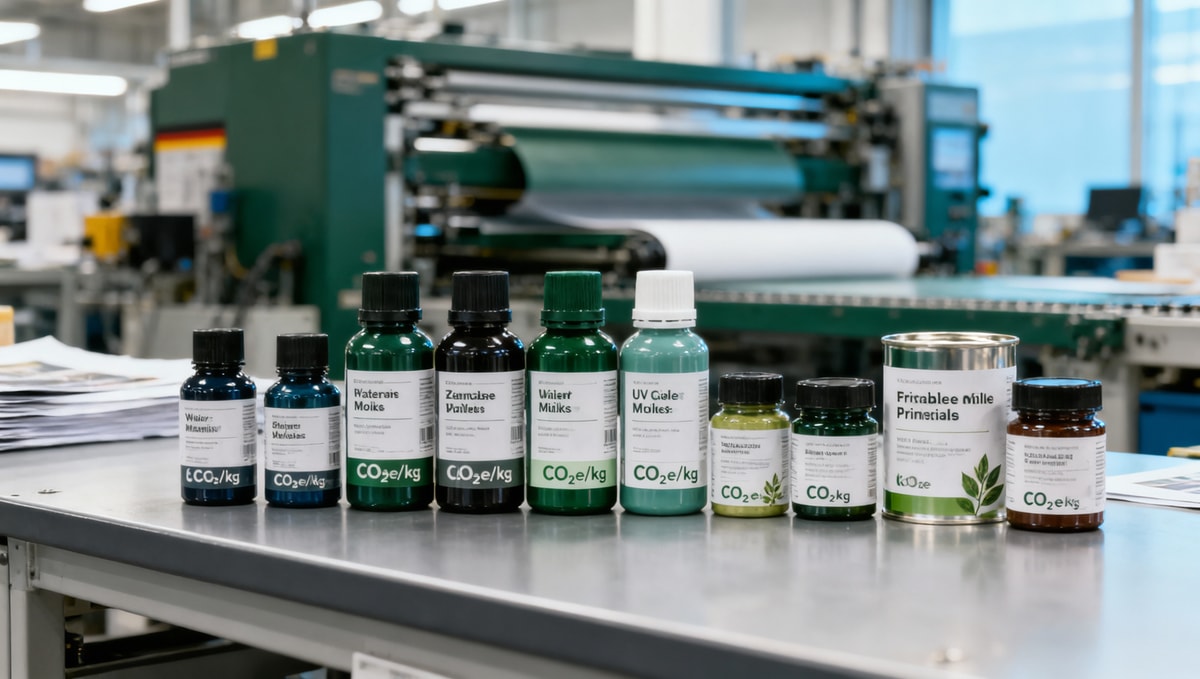
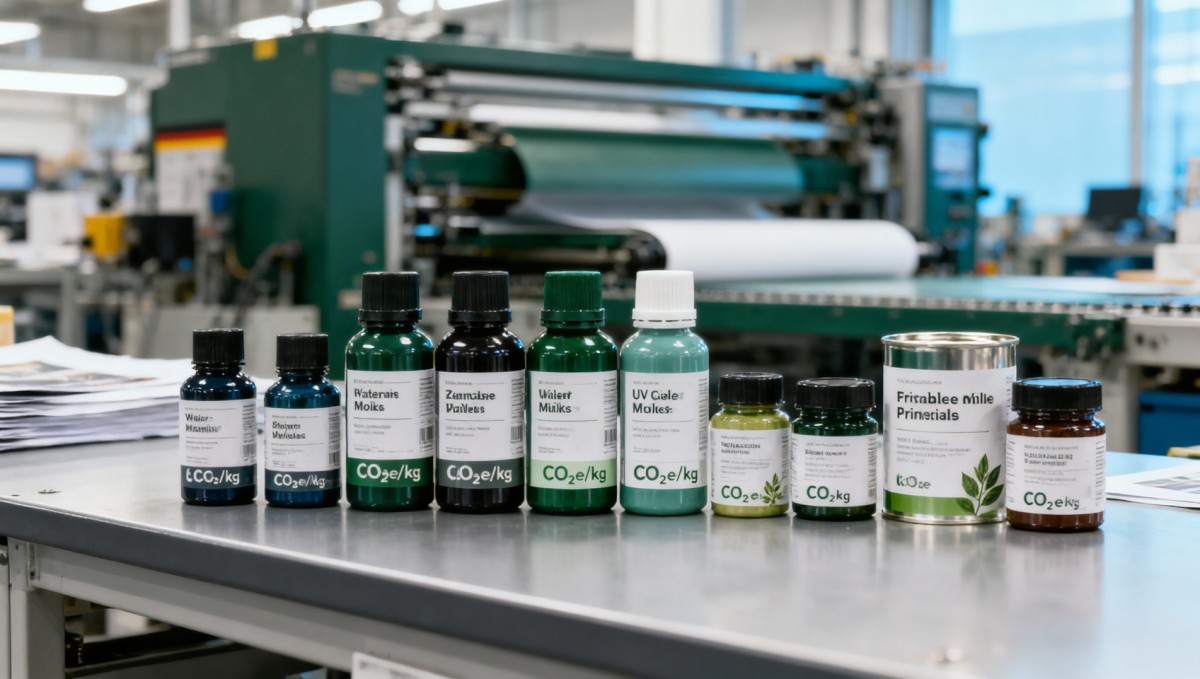
Companies supplying inks to European printers face increased demand for ISO 14040-compliant LCA documentation. As UBA does not accept generic or industry-average carbon values, formulation-level reporting becomes essential—even for standard solvent-based, UV-curable, or water-based inks used in promotional print applications.
Supply Chain Verification & Certification Service Providers
LCA verification bodies accredited to ISO 14040 gain a newly defined niche: ink-specific carbon footprint validation for promotional goods. However, no dedicated methodology or database has been published yet by UBA; current practice relies on existing LCA frameworks applied at material level.
What Enterprises Should Monitor and Do Now
Track official UBA guidance updates beyond the pilot announcement
The pilot’s scope, enforcement timeline, and list of accepted verification bodies remain subject to further clarification. Enterprises should monitor UBA’s dedicated pilot webpage and official notices—not third-party summaries—for binding definitions of ‘printing ink’, acceptable system boundaries (e.g., cradle-to-gate vs. cradle-to-grave), and whether recycled content adjustments are permitted.
Prioritise ink sourcing transparency for Q3 2026–ready SKUs
Businesses should identify high-volume printed gift SKUs scheduled for German market release from Q3 2026 onward—and map each to its specific ink type and supplier. Where ink suppliers cannot yet provide ISO 14040-verified LCA data, procurement teams should initiate dialogue now to assess feasibility and lead time.
Distinguish between policy signal and operational mandate
This is a pilot, not full-scale regulation. While participation is mandatory for enrolled companies, broader legal enforceability under German or EU law (e.g., Ecodesign for Sustainable Products Regulation) remains unconfirmed. Enterprises should treat current requirements as binding *within the pilot framework*, but avoid assuming automatic extension to non-participating firms or other product categories before formal adoption.
Prepare internal cross-functional alignment on data handover protocols
Marketing, procurement, logistics, and compliance teams must agree on how ink carbon data flows—from ink supplier → printer → brand owner → packaging/B2B platform. Standardised templates for data exchange (e.g., PDF reports with unique audit IDs, metadata on functional unit and allocation methods) will reduce misalignment during implementation.
Editorial Perspective / Industry Observation
Observably, this pilot marks Germany’s first targeted application of carbon labelling to a high-volume, low-awareness B2B product category—custom printed gifts. Analysis shows it functions less as an immediate regulatory outcome and more as a calibrated test of traceability infrastructure across fragmented global supply chains. From an industry perspective, the focus on ink—not finished goods—suggests UBA is probing material-level accountability where environmental impact is concentrated but historically undocumented. Current emphasis lies on verifying data provenance rather than setting absolute carbon thresholds, making transparency capacity—not just emissions reduction—the initial benchmark for compliance.
Current more suitable interpretation is that this pilot serves as a diagnostic tool for future policy scaling: it reveals gaps in LCA readiness among mid-tier chemical suppliers and exposes coordination challenges between Asian ink manufacturers and European printers. Industry stakeholders should therefore view it as both a compliance checkpoint and a stress test for upstream sustainability data governance.
Conclusion: The UBA’s pilot introduces a concrete, near-term compliance requirement for ink carbon disclosure in printed corporate gifts sold in Germany—but its broader significance lies in validating a granular, input-material-focused approach to carbon labelling. For affected enterprises, the priority is not speculative adaptation, but precise, documented readiness for Q3 2026 implementation. This is best understood not as the start of a broad regulatory wave, but as a narrowly scoped, operationally grounded trial with high visibility into supply chain data maturity.
Source: German Federal Environment Agency (UBA) official pilot announcement, dated April 26, 2026. Note: UBA has not yet published technical annexes, approved verifier lists, or methodology specifications; these elements remain under observation.
Related Intelligence
") Skincare OEMApr 30, 2026FDA Adds New INCI Code for Plant Stem Cell Extracts (PSC-2026)FDA's new PSC-2026 INCI code for plant stem cell extracts demands strict documentation—get compliant fast to avoid U.S. shipment delays.
Skincare OEMApr 30, 2026FDA Adds New INCI Code for Plant Stem Cell Extracts (PSC-2026)FDA's new PSC-2026 INCI code for plant stem cell extracts demands strict documentation—get compliant fast to avoid U.S. shipment delays. Electronic & RC ToysApr 30, 2026RC Toy Orders Shift to South China Cluster, Lead Time Cuts to 6 WeeksRC toy orders are shifting to South China’s Dongguan–Shenzhen–Zhongshan cluster—lead times slashed to 6 weeks. Discover how exporters, suppliers & logistics players can adapt now.
 Cosmetics & PkgApr 30, 2026SASO Updates Cosmetics Packaging Rules for Plant ExtractsSASO updates cosmetics packaging rules for plant extracts—mandatory migration & light stability testing from Oct 1, 2026. Act now to avoid delays!
 Corporate & Seasonal GiftsApr 30, 2026Germany UBA Launches Mandatory Carbon Labelling Pilot for Corporate Gift InksGermany UBA's new Carbon Labelling Pilot mandates verified ink carbon footprints for corporate gifts—key for Chinese exporters & B2B gifting suppliers entering Germany.
 Fitness EquipmentApr 30, 2026THE Alliance Cuts Shanghai–LA Capacity Again: Fitness Equipment Shipment Delays to 8–10 WeeksFitness equipment shipment delays hit 8–10 weeks as THE Alliance cuts Shanghai–LA capacity by 22%. Urgent insights for exporters, forwarders & U.S. importers.
 Camping & WaterApr 30, 2026Vietnam MOIT Suspends Import Licenses for Camping & Water PumpsVietnam MOIT suspends import licenses for camping & water pumps—IP6X and ASTM B117 compliance now mandatory. Act now to avoid delays.
 Smart Pet DevicesApr 30, 2026Japan METI Adds Smart Cat Litter Machines to PSE Fast-Track ListSmart cat litter machines now qualify for Japan's PSE fast-track certification — just 7 days for Chinese-made units with auto-cleaning, APP control & biological sensing.
 STEM & Educational ToysApr 30, 2026CPSC Tightens STEM Toy Battery Compartment StandardsCPSC Tightens STEM Toy Battery Compartment Standards: New ASTM F963-26 Annex D2 test mandates dynamic pressure + vibration compliance by July 1, 2026—act now to avoid shipment rejections.
 Infant Feeding & CareApr 30, 2026RCEP Launches Infant Feeding Fast Track for China NMPA Class II ProductsRCEP Infant Feeding Fast Track now live: China NMPA Class II products skip redundant testing in 5 ASEAN markets — faster certification, 40%+ cost savings.
 Beauty DevicesApr 30, 2026EU EPR Rules Take Effect for Beauty & Baby Monitors on Apr 29, 2026EU EPR rules for beauty & baby monitors take effect Apr 29, 2026 — mandatory registration, fees & compliance for exporters. Act now to avoid customs delays & marketplace deactivation.
 2026/789 on Beauty Device Packaging Takes Effect") Beauty DevicesApr 29, 2026EU Regulation (EU) 2026/789 on Beauty Device Packaging Takes EffectEU Regulation (EU) 2026/789 mandates 30% recycled plastic & LCA declarations for beauty device packaging — act now to avoid Amazon.de/fr rejections!
Beauty DevicesApr 29, 2026EU Regulation (EU) 2026/789 on Beauty Device Packaging Takes EffectEU Regulation (EU) 2026/789 mandates 30% recycled plastic & LCA declarations for beauty device packaging — act now to avoid Amazon.de/fr rejections! Electronic & RC ToysApr 29, 2026ICTA: RC Toy Orders Shift to South China, Lead Time Cuts to 6 WeeksICTA reports RC toy orders shifting to South China—78% now flow to Guangdong’s cluster, cutting lead times to just 6 weeks. Act now to optimize sourcing, compliance & logistics.
 STEM & Educational ToysApr 29, 2026CPSC Nanomaterial Migration Rule for STEM Toys Effective Q3 2026CPSC Nanomaterial Migration Rule for STEM Toys: New ASTM F963–24 testing (≤0.05 mg/cm²/h) mandatory from Oct 1, 2026—avoid detention & recalls.