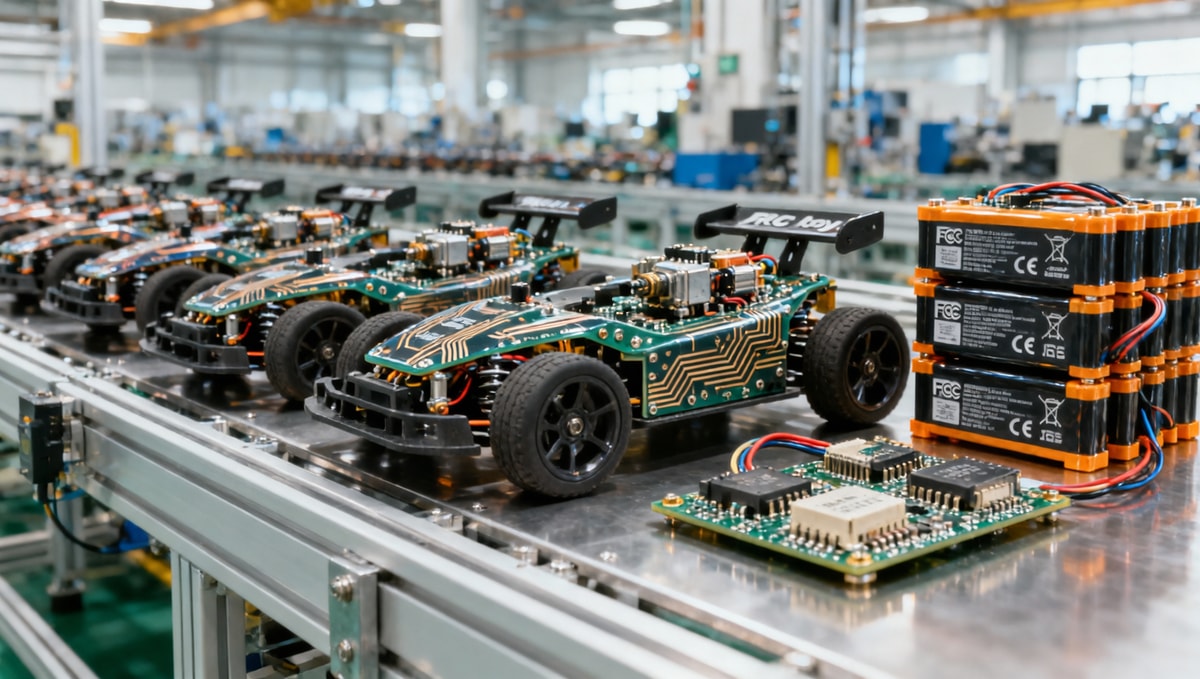
RC Toy Orders Shift to South China Cluster, Lead Time Cuts to 6 Weeks
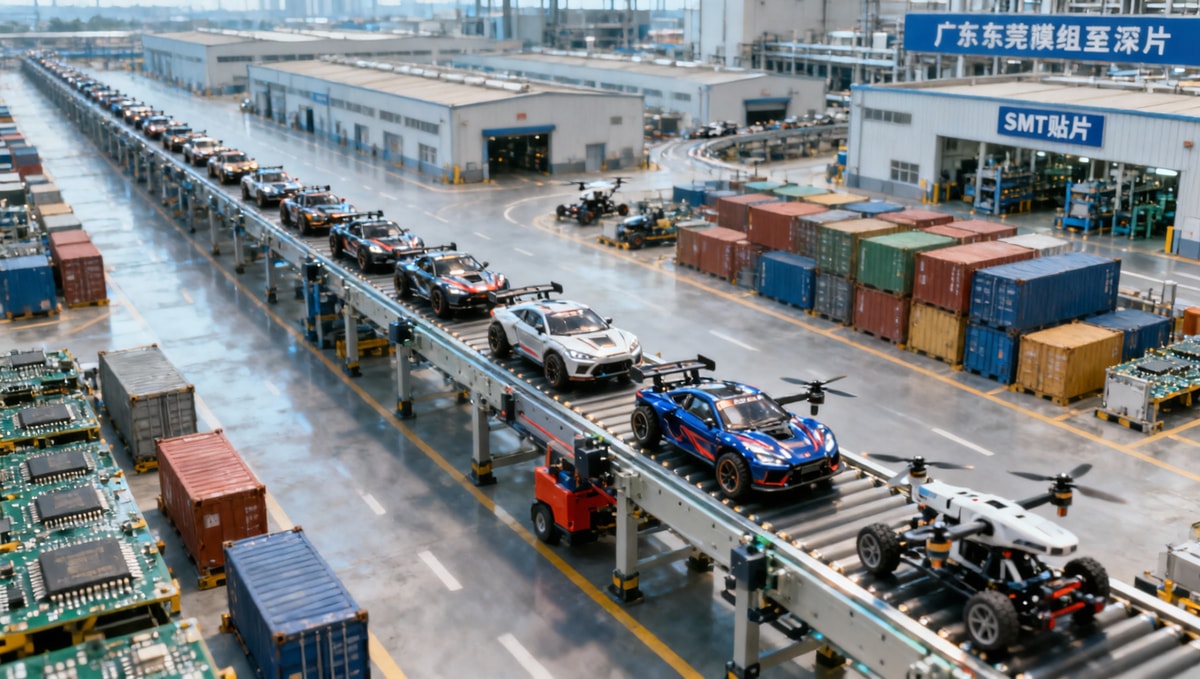
On April 24, 2026, the International Council of Toy Associations (ICTA) confirmed a notable shift in global RC toy procurement: orders are concentrating in China’s Guangdong-based manufacturing cluster — centered on Dongguan, Shenzhen, and Zhongshan — driven by back-to-school and Black Friday demand in North America and Europe. This trend directly impacts electronic toy exporters, component suppliers, contract manufacturers, logistics providers, and third-party quality assurance services.
Event Overview
On April 24, 2026, ICTA released its Q1 2026 Global RC Toy Procurement Trends Brief. The report states that Electronic & RC Toy orders are increasingly centralized in the ‘South China RC Manufacturing Cluster’ (Dongguan–Shenzhen–Zhongshan). Supported by localized chip module supply and flexible production scheduling, the average delivery lead time has shortened to six weeks — down 11 days from Q4 2025 — with an on-time delivery rate of 98.3%.
Which Subsectors Are Affected
Direct Trading Companies (Exporters/Importers)
These firms face tighter scheduling windows and higher expectations for reliability. The compressed 6-week lead time implies reduced buffer for customs delays, documentation errors, or port congestion — increasing pressure on pre-shipment coordination and documentation accuracy.
Raw Material & Component Suppliers
Local chip module availability is cited as a key enabler of faster turnaround. Suppliers serving the cluster — especially those providing microcontrollers, RF modules, and battery management ICs — may see rising order frequency and stricter just-in-time delivery requirements, particularly for mid-tier RC models targeting Q3 retail cycles.
OEM/ODM Manufacturing Firms
Firms outside the South China cluster may experience order diversion, especially if they rely on imported modules or lack integrated SMT and final assembly capacity. The 98.3% on-time delivery benchmark sets a new de facto performance threshold for competitive bidding on RC toy programs.
Distribution & Channel Operators (Wholesalers, E-commerce Fulfillment Hubs)
With delivery cycles now predictable to within six weeks, channel partners must align inventory planning more precisely with regional retail calendars — especially for U.S. back-to-school (July–August) and Black Friday (November) timelines. Overstocking or late ordering carries greater risk of missed shelf windows.
Supply Chain Service Providers (Logistics, QA, Compliance)
Third-party inspection agencies and compliance labs operating near the cluster may see increased demand for expedited testing (e.g., FCC, CE, EN71-3), while freight forwarders need to prioritize consistent vessel space allocation on Trans-Pacific routes to meet tight handover deadlines.
What Relevant Companies or Practitioners Should Monitor and Do Now
Track ICTA’s upcoming regional procurement updates
ICTA’s Q1 brief signals a structural shift — not a one-off seasonal spike. Watch for follow-up releases (e.g., Q2 trends, regional breakdowns by EU vs. U.S.) to assess whether this concentration is broadening across subcategories (e.g., drones, hobby-grade RC) or remains limited to mass-market electronic RC toys.
Validate actual lead time performance per product tier
The reported 6-week average includes all RC toys in the cluster — but entry-level toy-grade units may ship faster than mid-tier programmable models. Buyers should request tier-specific lead time data before committing to volume orders, especially for firmware-dependent variants requiring certification revalidation.
Assess local module sourcing dependencies
Analysis shows the shortened cycle relies heavily on proximity to domestic chip module suppliers. Firms relying on imported modules (e.g., Nordic nRF52, ESP32-based boards from non-Guangdong sources) may not achieve equivalent lead times — even when assembling in the same region.
Prepare contingency protocols for certification bottlenecks
Observably, faster physical production does not automatically accelerate regulatory clearance. Companies should pre-submit test plans to accredited labs and confirm lab capacity for surge testing ahead of Q3 order ramp-up — especially for updated RF or battery safety requirements.
Editorial Perspective / Industry Observation
This development is best understood not as a temporary demand surge, but as evidence of maturing regional specialization: the South China cluster is evolving from a general electronics hub into a vertically coordinated RC toy value chain — integrating design support, component sourcing, firmware integration, and compliance execution. From an industry perspective, it reflects consolidation around operational predictability rather than just cost. That said, the 98.3% on-time rate remains contingent on stable export logistics and unchanged regulatory review timelines — both subject to external volatility. Continued monitoring is warranted, particularly through Q2 2026 shipment data and ICTA’s next quarterly update.
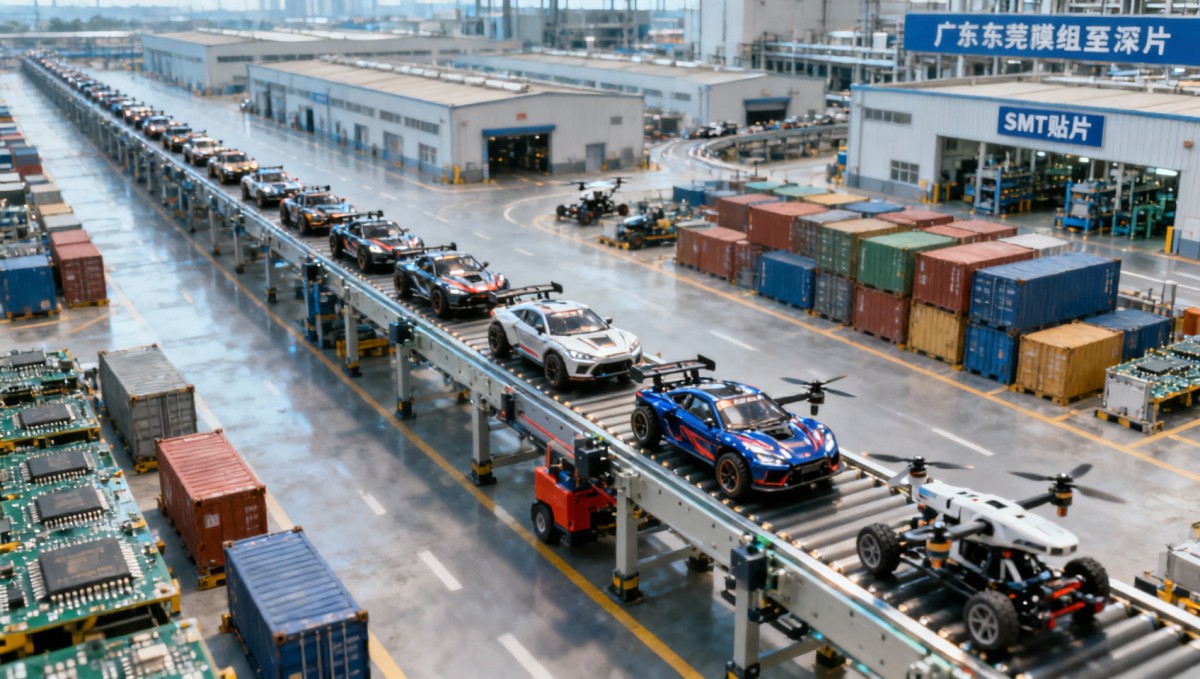
In summary, the ICTA’s confirmation signals a measurable tightening of RC toy supply chain responsiveness — centered geographically and operationally in South China. It does not indicate universal improvement across all toy categories or regions, nor does it eliminate execution risk. Rather, it marks a shift toward narrower, more reliable delivery windows for a defined product segment — one that buyers and suppliers alike must now treat as a new baseline, not an exception.
Source: International Council of Toy Associations (ICTA), Q1 2026 Global RC Toy Procurement Trends Brief, published April 24, 2026.
Note: Ongoing observation is recommended for ICTA’s Q2 2026 report and any updates regarding regional certification processing times or shipping lane reliability.
Related Intelligence
") Skincare OEMApr 30, 2026FDA Adds New INCI Code for Plant Stem Cell Extracts (PSC-2026)FDA's new PSC-2026 INCI code for plant stem cell extracts demands strict documentation—get compliant fast to avoid U.S. shipment delays.
Skincare OEMApr 30, 2026FDA Adds New INCI Code for Plant Stem Cell Extracts (PSC-2026)FDA's new PSC-2026 INCI code for plant stem cell extracts demands strict documentation—get compliant fast to avoid U.S. shipment delays. Electronic & RC ToysApr 30, 2026RC Toy Orders Shift to South China Cluster, Lead Time Cuts to 6 WeeksRC toy orders are shifting to South China’s Dongguan–Shenzhen–Zhongshan cluster—lead times slashed to 6 weeks. Discover how exporters, suppliers & logistics players can adapt now.
 Cosmetics & PkgApr 30, 2026SASO Updates Cosmetics Packaging Rules for Plant ExtractsSASO updates cosmetics packaging rules for plant extracts—mandatory migration & light stability testing from Oct 1, 2026. Act now to avoid delays!
 Corporate & Seasonal GiftsApr 30, 2026Germany UBA Launches Mandatory Carbon Labelling Pilot for Corporate Gift InksGermany UBA's new Carbon Labelling Pilot mandates verified ink carbon footprints for corporate gifts—key for Chinese exporters & B2B gifting suppliers entering Germany.
 Fitness EquipmentApr 30, 2026THE Alliance Cuts Shanghai–LA Capacity Again: Fitness Equipment Shipment Delays to 8–10 WeeksFitness equipment shipment delays hit 8–10 weeks as THE Alliance cuts Shanghai–LA capacity by 22%. Urgent insights for exporters, forwarders & U.S. importers.
 Camping & WaterApr 30, 2026Vietnam MOIT Suspends Import Licenses for Camping & Water PumpsVietnam MOIT suspends import licenses for camping & water pumps—IP6X and ASTM B117 compliance now mandatory. Act now to avoid delays.
 Smart Pet DevicesApr 30, 2026Japan METI Adds Smart Cat Litter Machines to PSE Fast-Track ListSmart cat litter machines now qualify for Japan's PSE fast-track certification — just 7 days for Chinese-made units with auto-cleaning, APP control & biological sensing.
 STEM & Educational ToysApr 30, 2026CPSC Tightens STEM Toy Battery Compartment StandardsCPSC Tightens STEM Toy Battery Compartment Standards: New ASTM F963-26 Annex D2 test mandates dynamic pressure + vibration compliance by July 1, 2026—act now to avoid shipment rejections.
 Infant Feeding & CareApr 30, 2026RCEP Launches Infant Feeding Fast Track for China NMPA Class II ProductsRCEP Infant Feeding Fast Track now live: China NMPA Class II products skip redundant testing in 5 ASEAN markets — faster certification, 40%+ cost savings.
 Beauty DevicesApr 30, 2026EU EPR Rules Take Effect for Beauty & Baby Monitors on Apr 29, 2026EU EPR rules for beauty & baby monitors take effect Apr 29, 2026 — mandatory registration, fees & compliance for exporters. Act now to avoid customs delays & marketplace deactivation.
 2026/789 on Beauty Device Packaging Takes Effect") Beauty DevicesApr 29, 2026EU Regulation (EU) 2026/789 on Beauty Device Packaging Takes EffectEU Regulation (EU) 2026/789 mandates 30% recycled plastic & LCA declarations for beauty device packaging — act now to avoid Amazon.de/fr rejections!
Beauty DevicesApr 29, 2026EU Regulation (EU) 2026/789 on Beauty Device Packaging Takes EffectEU Regulation (EU) 2026/789 mandates 30% recycled plastic & LCA declarations for beauty device packaging — act now to avoid Amazon.de/fr rejections! Electronic & RC ToysApr 29, 2026ICTA: RC Toy Orders Shift to South China, Lead Time Cuts to 6 WeeksICTA reports RC toy orders shifting to South China—78% now flow to Guangdong’s cluster, cutting lead times to just 6 weeks. Act now to optimize sourcing, compliance & logistics.
 STEM & Educational ToysApr 29, 2026CPSC Nanomaterial Migration Rule for STEM Toys Effective Q3 2026CPSC Nanomaterial Migration Rule for STEM Toys: New ASTM F963–24 testing (≤0.05 mg/cm²/h) mandatory from Oct 1, 2026—avoid detention & recalls.